

In the vibrant Porta Venezia district of Milan, specifically on Via Lazzaretto, THE LINE has unveiled itself during the 2026 Milan Design Week. This new space emerges from the former premises of Fondazione Il Lazzaretto, which operated from 2014 until its closure in March. Fondazione Il Lazzaretto was known for its diverse projects spanning visual arts, literature, performance, photography, publishing, and psycho-physical practices, where the concept of a ‘lazzaretto’ (quarantine station) was reinterpreted as a method for meeting and cross-pollination.
THE LINE picks up this legacy, establishing a fresh context that places a concentrated emphasis on material, form, and longevity. The inaugural exhibition is accessible until April 26th, after which there will be a pause before the resumption of activities in the autumn, signaling a new direction for the venue. The vision and curation behind THE LINE are attributed to Francesco Librizzi and Riccardo Robustini.
Francesco Librizzi, who studied in Palermo, founded his studio in 2005. His work, encompassing interiors, installations, and objects, is characterized by a keen attention to proportion and the interplay of voids and solids. Riccardo Robustini leads Breath Design, with operations in both Italy and the Gulf region. His academic background, including studies in Bologna, Madrid, ETH Zurich, and MIT, informs a practice that artfully blends craftsmanship with technical innovation.
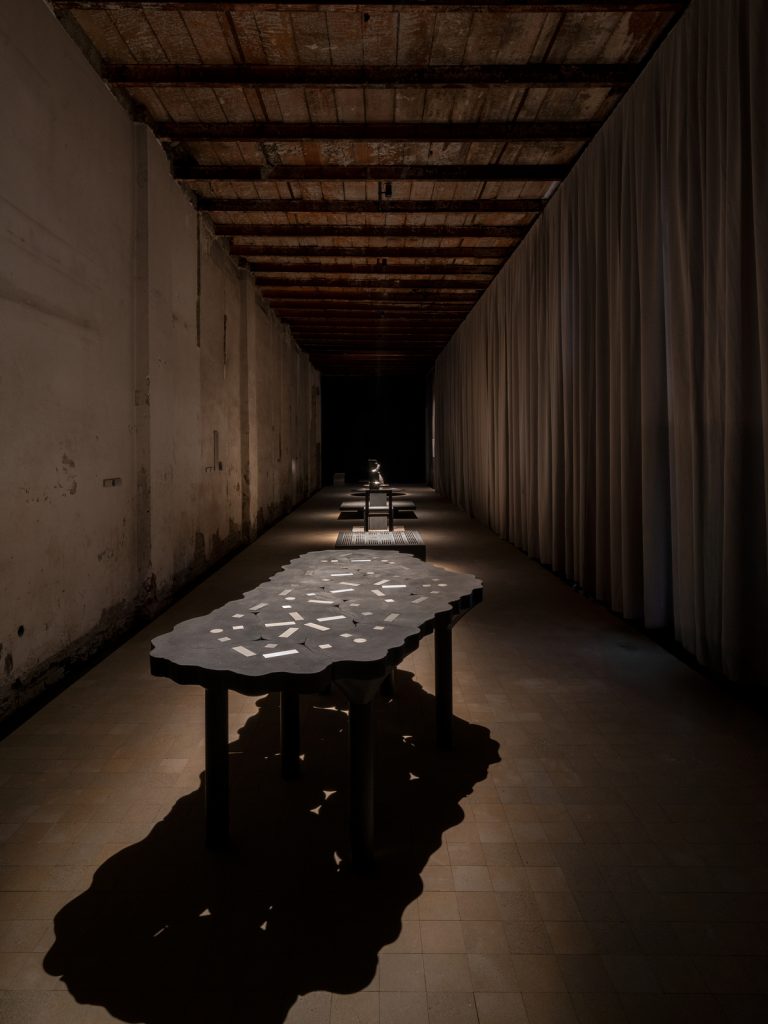
The space itself is a distinctive, linear environment measuring approximately thirty meters in length, situated within a late 19th-century building that was originally an industrial warehouse and is now undergoing transformation.
“7+1 Acts of Survival”: The Inaugural Exhibition
The initial exhibition, titled 7+1 Acts of Survival, poses a direct and thought-provoking question: what enables objects to endure over time? The response is explored through Nero Zimbabwe, a black African stone formed over two and a half billion years ago. Each contributing artist was given an identical volume of this stone. From this shared material and conceptual origin, seven distinct interpretations emerge, existing at the intersection of sculpture and functional design.
This first chapter sets the stage for a broader narrative, structured in three phases: Memory, Survival, and Archaeology of the Future, thereby defining the exhibition’s core areas of inquiry from the outset.
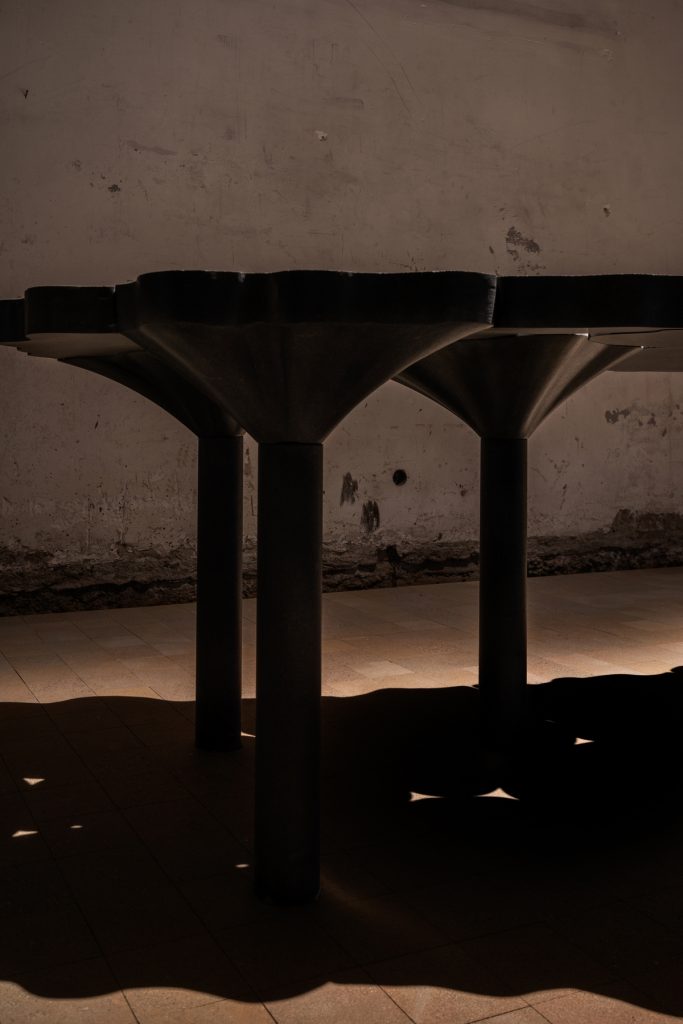
A Diverse Collective of Visionaries
The exhibition brings together artists and architects with varied and distinguished careers:
- Kengo Kuma (born in Yokohama, 1954) is renowned for his exploration of the relationship between nature and artifice.
- Marcio Kogan (born in São Paulo, 1952), founder of Studio MK27, brings a sensibility informed by cinema, evident in his articulation of sequences and spatial openings. He collaborates on this project with Diana Radomysler and Pedro Ribeiro.
- Bernard Khoury (born in Beirut, 1968), who experienced the civil war, has developed a body of work marked by tension and conflict. His early project, Evolving Scars, examined the city’s wounds, and he continues to advocate for an architecture that resists any attempt at pacification.
- Claudio Silvestrin, based between Milan and London, crafts an essential language built upon proportion, silence, and materiality.
- Ugo Cacciatori, originally from Carrara, brings a direct engagement with stone, focusing on its cut, weight, and manipulation.
- Elias Anastas and Yousef Anastas, from Bethlehem and Paris respectively, approach stone as a form of knowledge and structure.
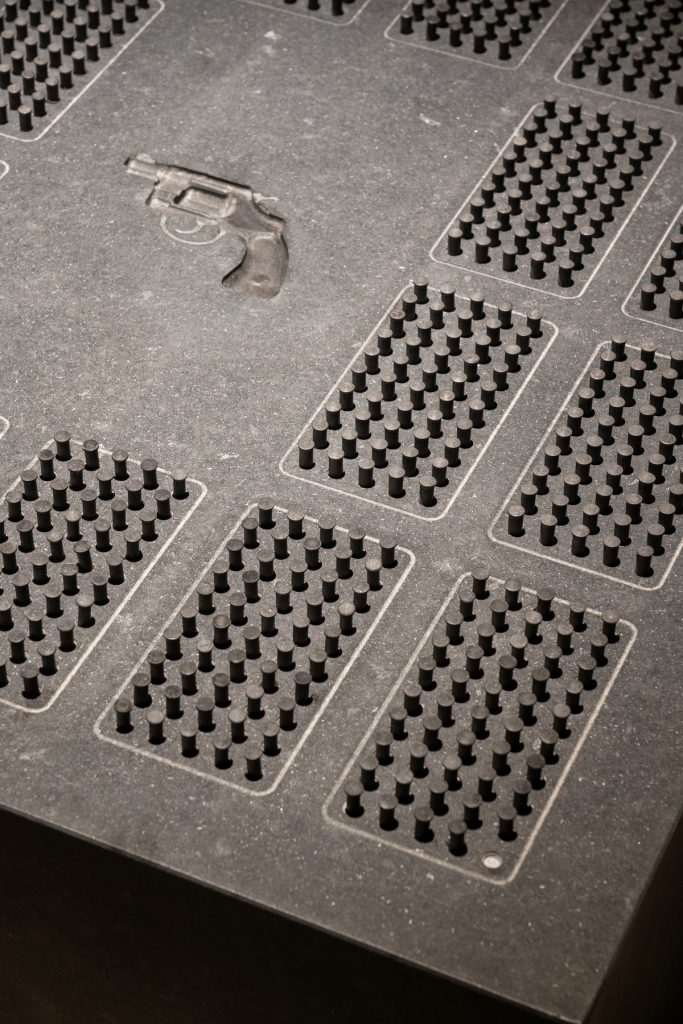
Each participant has engaged with the identical block of Nero Zimbabwe stone, resulting in unique expressions:
- Kuma opens the stone to light and impermanence.
- Kogan returns it to a continuous cycle.
- Khoury emphasizes contingency.
- Silvestrin seeks a primary presence.
- Cacciatori works through subtraction.
- The Anastas brothers achieve balance through interlocking forms.
Librizzi and Robustini contribute their own piece, The Shore, a low table that explores the concept of the barrier as a dynamic condition.
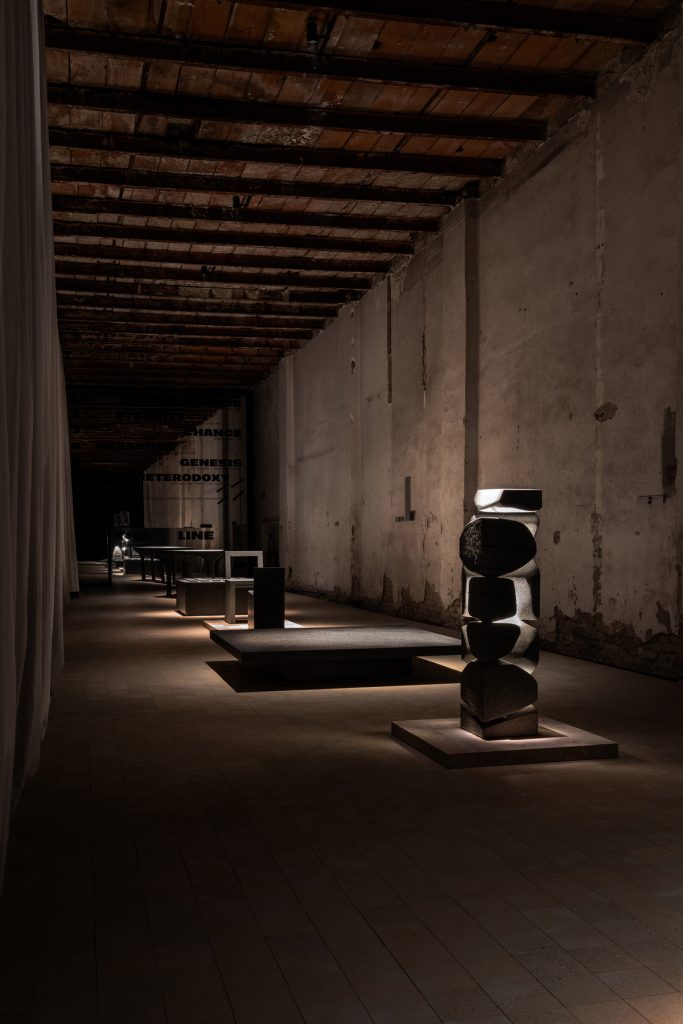
The exhibition’s progression is arranged sequentially along the depth of the rectangular space, enveloped in a carefully calibrated, dim lighting designed by PSLab. THE LINE stands for clarity: a single material, a profound question, and a series of diverse variations, offering a unique opportunity for deeper understanding.