

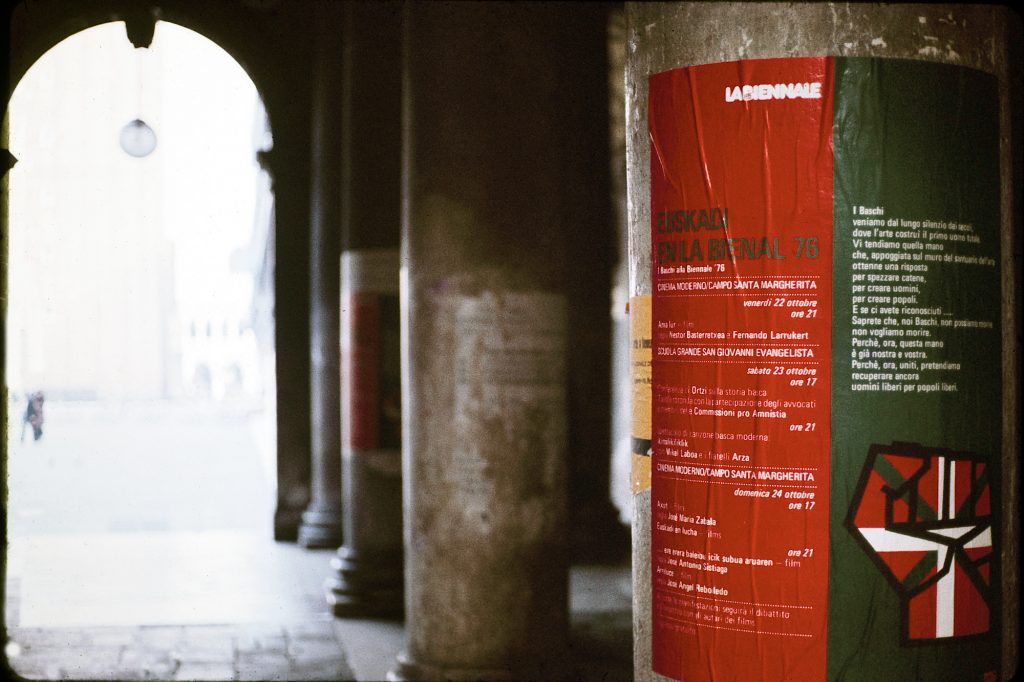
In 1976, as Spain was cautiously moving past the Franco dictatorship, a group of Basque artists made their voices heard at the Venice Biennale. Now, fifty years later, that voice resonates once more in the lagoon with The Basques at the Biennale 1976/2026, a project that transforms memory into a creative act projected into the present.
The Archive as a “Living Work”
Promoted by the Basque Government and the Etxepare Institute, the project aims to go beyond nostalgic remembrance. From May 6th to 8th at Palazzo Contarini della Porta di Ferro, a “living archive” will be established. Audiovisual and sound materials from 1976 will interact with contemporary works, creating a temporal dialogue that questions the viewer on art’s role in collective affirmation.
The program will visit symbolic locations of Venice from fifty years ago. On May 7th, the official inauguration at the Scuola Grande San Giovanni Evangelista – the site of a historic political conference on the Basque situation in 1976 – will be attended by Lehendakari Imanol Pradales.
Concurrently, the Auditorium Santa Margherita (Ca’ Foscari) will host the international conference Euskadi at the Venice Biennale, 1976: Memory for the Future. This venue, formerly the Cinema Moderno where works challenging censorship were screened in the 1970s, was chosen deliberately. The conference will examine social transformations and new identity practices, concluding with a performance by the collective Tripak.
Contemporary Dialogue: Itziar Okariz and Performance
Memory is embodied through performance. On May 7th and 8th, artist Itziar Okariz and the collective Tripak will bridge the various project locations, transforming the journey between Palazzo Contarini and other city spaces into an aesthetic experience. This is not merely an exhibition, but a research process shared with the Artium Museoa of Vitoria-Gasteiz, which will carry forward the legacy of these events for a subsequent museum exhibition.
The return of the Basques to Venice, in synergy with Ca’ Foscari University, underscores the vitality of a region that has used art not only as a political statement but also as a universal language. Fifty years later, the question remains the same: how can art engage with the world without sacrificing its identity?