The Time of Art is the Time of Transcendence: Silvia Scaringella's "Passages" Exhibition
The name Fumone originates from smoke signals. Before it was a castle, this place served as a communication system: perched at 800 meters above the Sacco Valley, it was a lookout point for lower Lazio, transmitting messages through the air for centuries. The name retains the trace of that function. When Silvia Scaringella describes the exhibition staged here – Passages, curated by Francesca Pietracci, the second installment of the Avvistamenti & Incontri cycle promoted by Giulio de Paolis – she uses a precise image to distinguish it from the exhibition seen in January at the Carlo Bilotti Museum in Rome: "Here, I managed to achieve a narrative by path rather than by backdrop: a narrative that unfolds petal by petal." It's a technical distinction, but it signifies far more than it appears.
At the Aranciera of Villa Borghese, the work was presented frontally: visible all at once, in the clarity of a neutral space. Here, however, along the medieval rampart walk, a path of the edge and defense reactivated as an exhibition space, each artwork is encountered in stages. It doesn't present itself; it allows itself to be found. Thus, something deeper also changes: the time one is willing to spend within them.
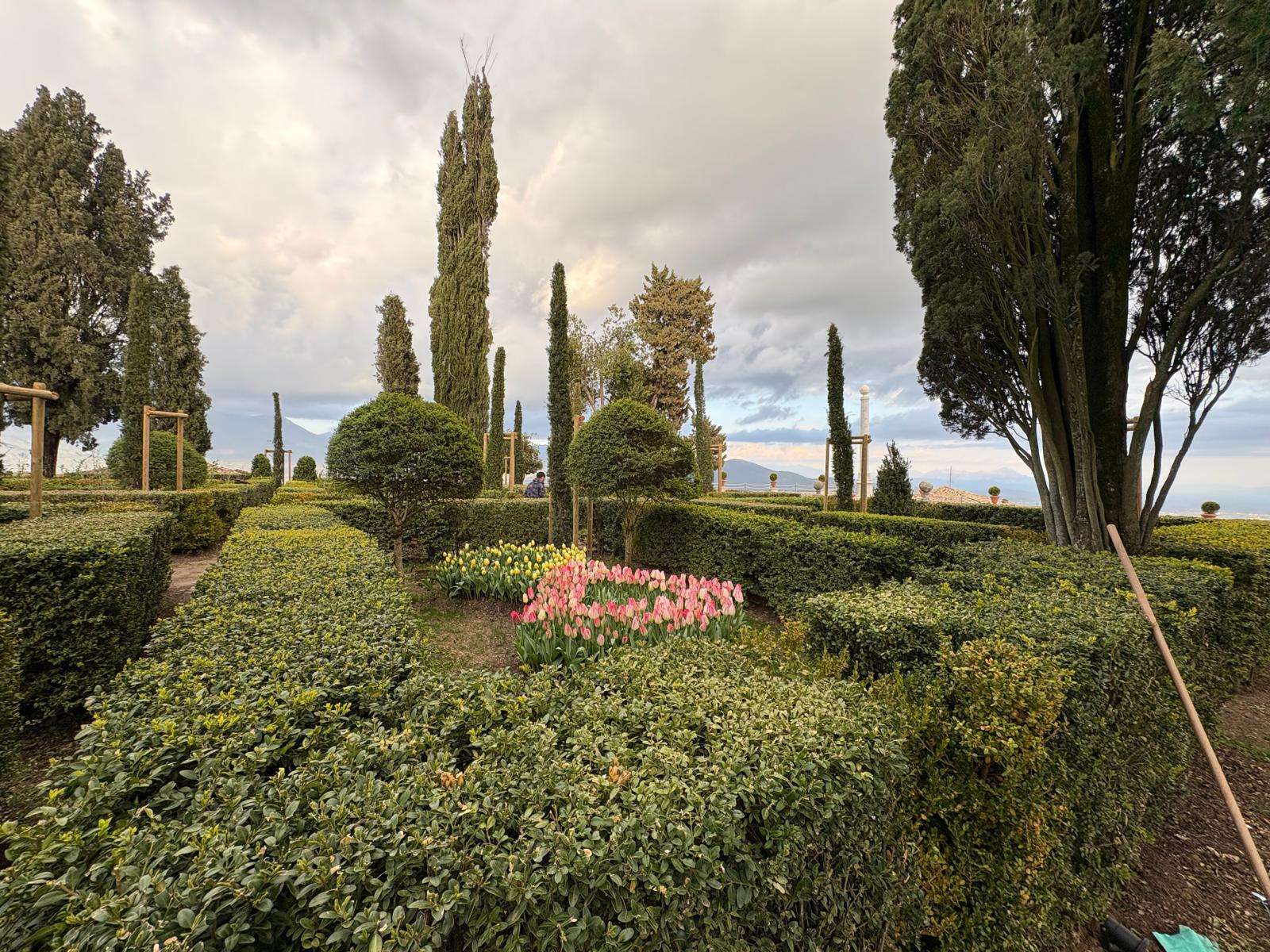
This idea of process – entrusted to sculpture but also to canvases made with architectural transparencies and iron inserts – has long been a part of Scaringella's work. In Fumone, however, it becomes even clearer.
The white marble dragonflies inhabiting the Rampart Walk carry within them the sculpted form of a possibility. They emerge from water, from a larva the artist herself calls "Hideous," and then become something capable of flying 360 degrees, capturing the entire visual field.
It is not metamorphosis, Scaringella clarifies: it is transcendence. The distinction is not subtle. Metamorphosis changes form; transcendence changes plane. "Any inner evil," says the artist, "if you know how to transform it, can only be a resource."
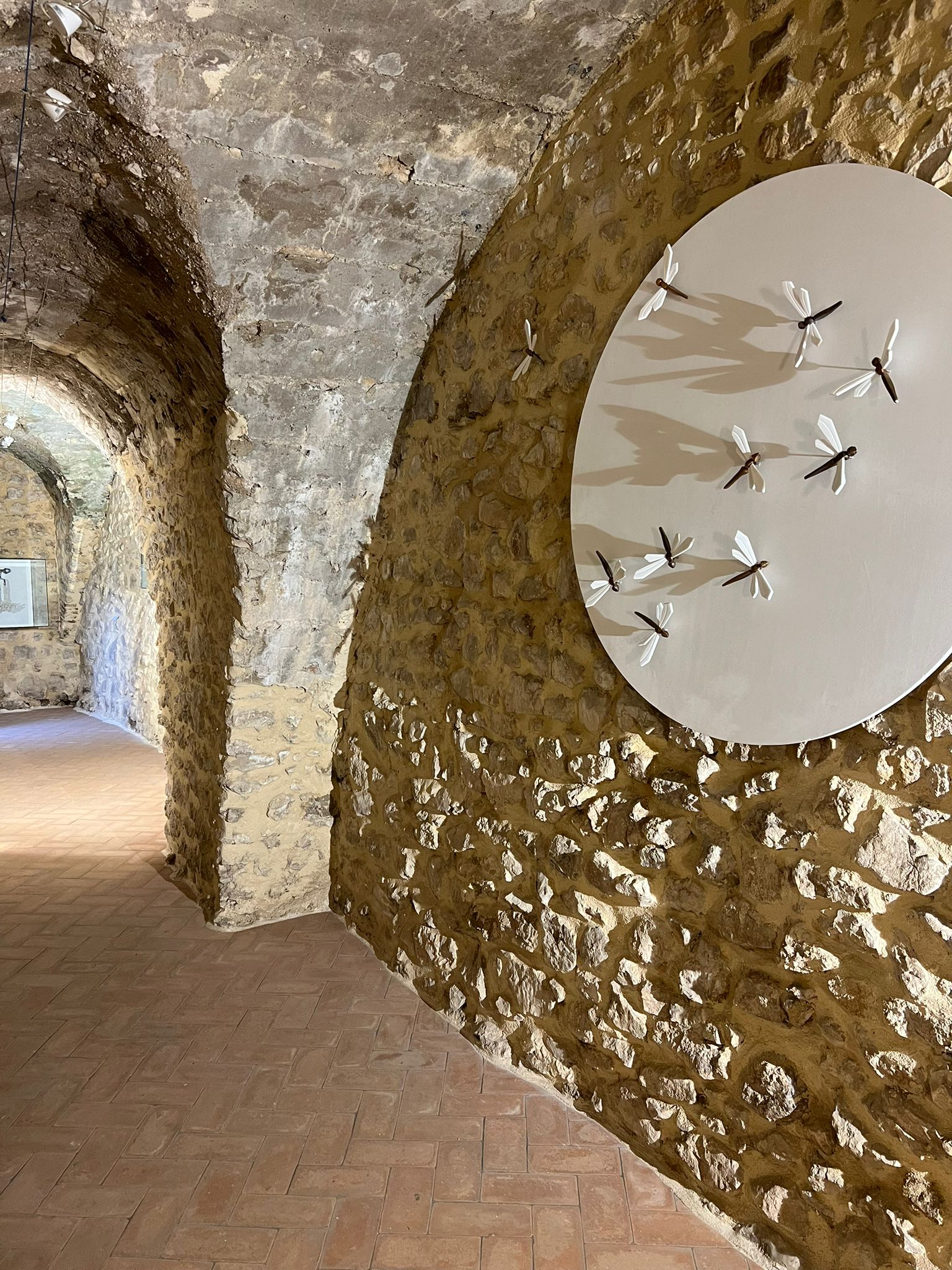
The same movement – from bottom to top, from the invisible to the visible – permeates the entire bestiary of white marble that inhabishes the passage. The bees, already praised by Virgil in the Georgics as a model of coexistence, return from artwork to artwork to "Bring back that archetype of mutual aid that nature suggests to us": not an ornament but an argument.
The ants carry with them a story gathered in a Senegalese village, where the community still maintains an active anthill near their homes: waste goes to the ants, which store it, ready for times of scarcity, in a system of millennial resilience founded on the relationship with what is unseen but sustaining.
Even the marble comes from below, from a depth that the sculptor's work slowly brings to light. It is an emergence that requires care, practice, and slowness. 20 years of experience in the gesture, Scaringella says, are not to be taken for granted: "There is much more work in the process of knowing how to do than in the final result."
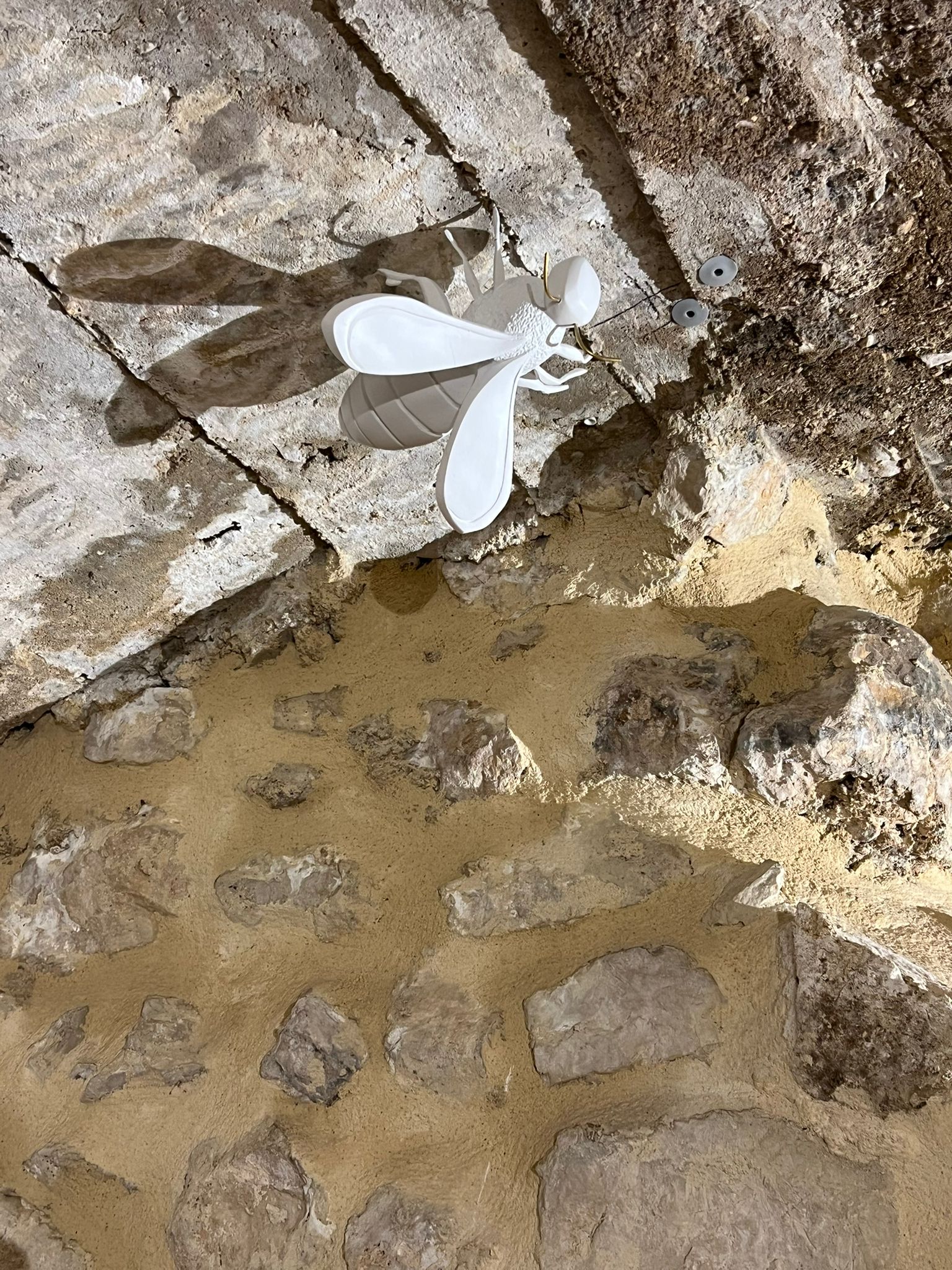
And it is precisely here that her work distinguishes itself: in a contemporary era accustomed to prioritizing the result, Scaringella insists on remaining within the doing, in what she calls the only truly natural time, "As nature, we should live in the process, not in the end."
This is the phrase that could most serve as an epigraph for Passages, because here the Rampart Walk – recently restored and made accessible by the Longhi de Paolis family – transcends its function as a historical corridor to become a narrative device. To traverse it means receiving the artworks one after another, constructing a sequence that has no endpoint but finds its meaning in the journey.
For this reason too, the mind drifts to the hanging gardens that crown the castle: 3500 square meters suspended over vaults and ramparts, where migratory birds of Ciociaria still pass today. Another passage, this time in a literal sense.
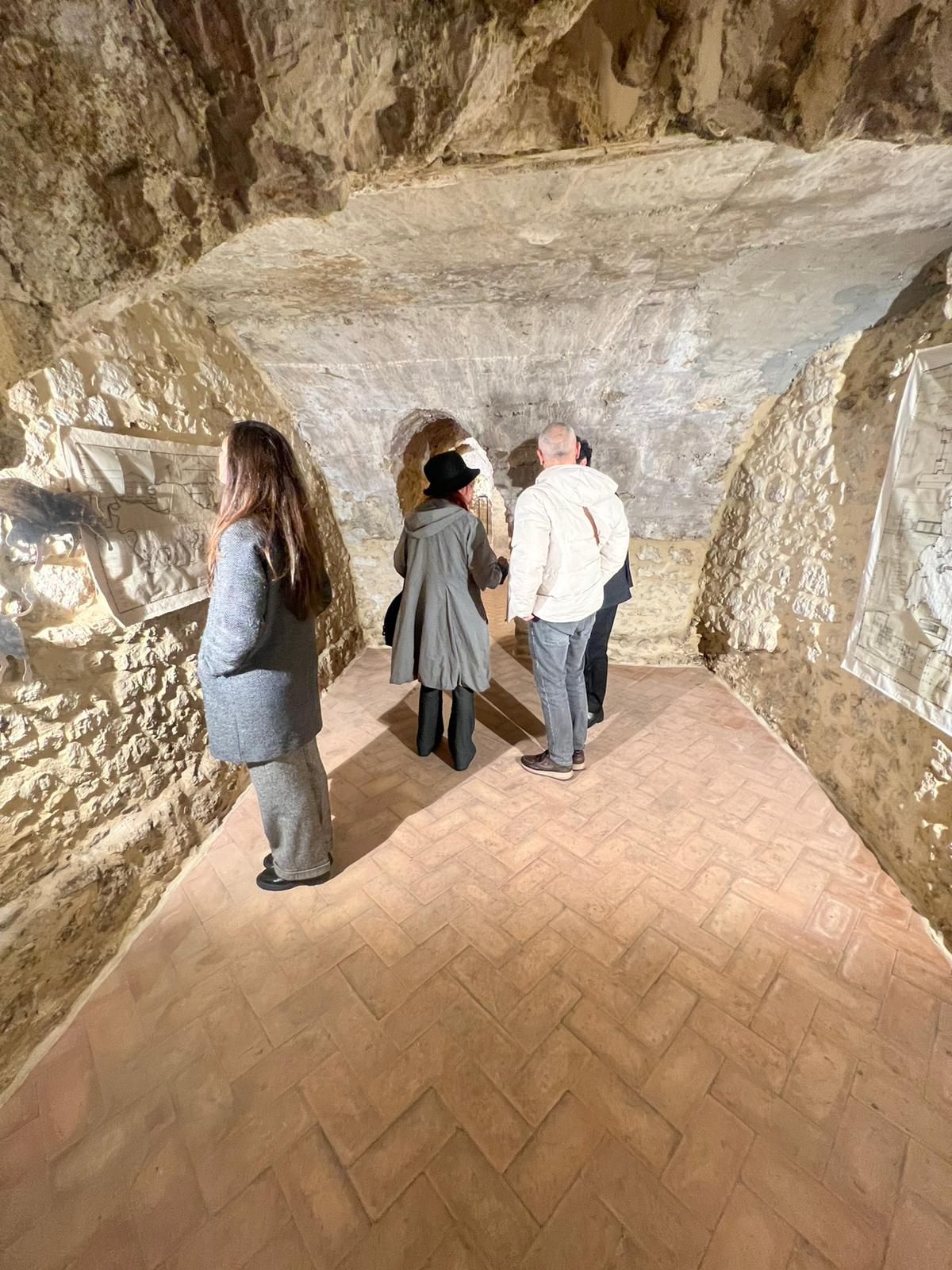
It is no coincidence that curator Francesca Pietracci speaks of a "marked installation continuity," both conceptual and formal: Scaringella's work maintains its coherence through materials, scales, and obsessions. But in Fumone, this continuity finds its place. The castle does not serve as a backdrop; it is the structure that makes visible what is already present in the work but remains implicit elsewhere – the idea that an artwork is not exhausted the moment it is seen but continues in the time of those who have experienced it.
"We are in passage," says Silvia Scaringella. And Fumone, which for centuries transmitted messages through the air, receives one more.
Novedades — Society
La participación cultural: más allá de la mera asistencia, la necesidad de compartir el poder
```html La participación cultural: más allá de la mera asistencia, la necesidad de compartir el poder La participación se ha convertido en un término ubicuo, presente en convocatorias, proyectos europeos, programas culturales y planes de regeneración urbana. Se presenta como un
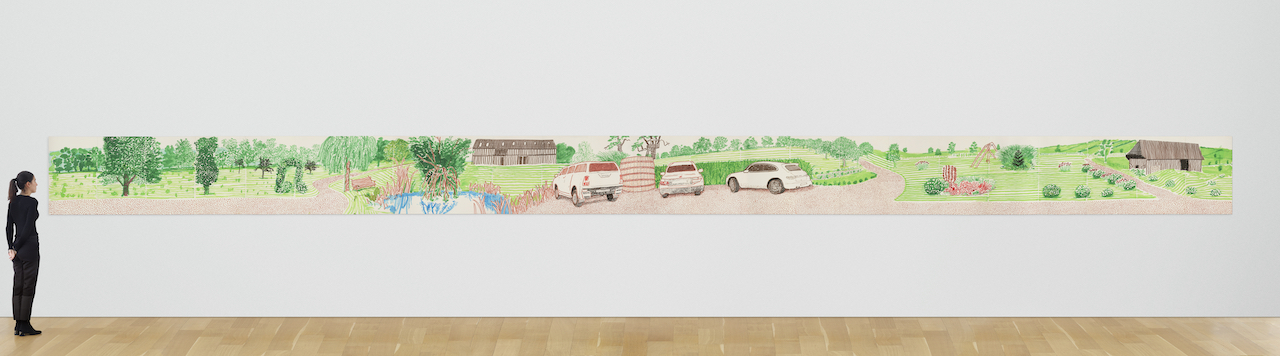
David Hockney's Monumental 12-Meter Print Heads to Christie's Auction
A truly unique lot is being offered by Christie's, available online from March 17 to 31, and on display at the major London galleries until March 31. This remarkable piece is one of David Hockney's largest creations, a staggering 12 meters long, printed on a single sheet of paper, and his most

El Greco Masterpiece Uncovered in Vatican: Hidden Under a Forgery
Art history is frequently punctuated by unexpected and serendipitous discoveries. Among these is the latest revelation from the Vatican Museums, where a routine conservation intervention has brought to light an authentic painting by El Greco, which had remained invisible for decades beneath a

Modena's Gate26A Hosts Aleksandr Nuss's Art: Where Matter Erodes and Light Reveals
Modena offers a serene escape from the vibrant chaos of nearby Bologna, presenting itself as an ordered and pristine city, a tranquil setting for everyday life. Within this calm environment, an independent space named Gate26A, founded by a collective of four individuals, injects a dynamic ener

Peggy Guggenheim's London Years: The Birth of a Collector in Venice Exhibition
Many are unaware of a crucial, often overlooked chapter in the life of Peggy Guggenheim, the visionary who transformed a palazzo on the Grand Canal into a bastion of modernism: her entrepreneurial venture with the Guggenheim Jeune gallery in London. The exhibition, Peggy Guggenheim in London: B
Selvatica 2026 in Biella: Art and Nature in Dialogue, Featuring Historical Authors and New Talents
The eleventh edition of Selvatica – Art and Nature in Festival, a biennial event held in Piazzo, Biella's historic district, has commenced and will run until July 19, 2026. The festival aims to foster a dialogue between artistic languages, scientific research, and educational practices to crea