The Alpine Art of Hotel Bellevue in Cogne: A Living Museum
Nature and art are the two key elements defining the Hotel Bellevue in Cogne, founded in 1925. Its establishment coincided with the creation of the national park in 1922 and preceded legislation in 1926 that would have prohibited new construction on the Sant'Orso meadows, granting the hotel an exceptional location. However, the most remarkable encounter with art happens indoors. Beginning in the 1980s, under the initiative of Piero Roullet, the hotel became the custodian of a collection that has grown organically over time.
The history of Bellevue is inextricably linked to the Jeantet-Roullet family. A pivotal figure was Maria Romilda Albert, the "Signora" of Bellevue, who with elegance and dedication saved the building from looting during the Liberation. The legacy then passed to Piero Roullet, who passed away in 2022. Described as a "visionary with pragmatic romanticism," he rejected industrial furnishings to transform the hotel into a stronghold of Aosta Valley memory. This led to his quest through markets and antique shops, where he began to recover furniture, decorative objects, sculptures, ex-votos, and 19th-century paintings, all united by the culture of the valley. Today, his daughter Laura, along with her husband Domenico and sons Pietro and Leonardo, continues to honor this heritage, managing what they affectionately call not just a hotel, but "Casa Bellevue."
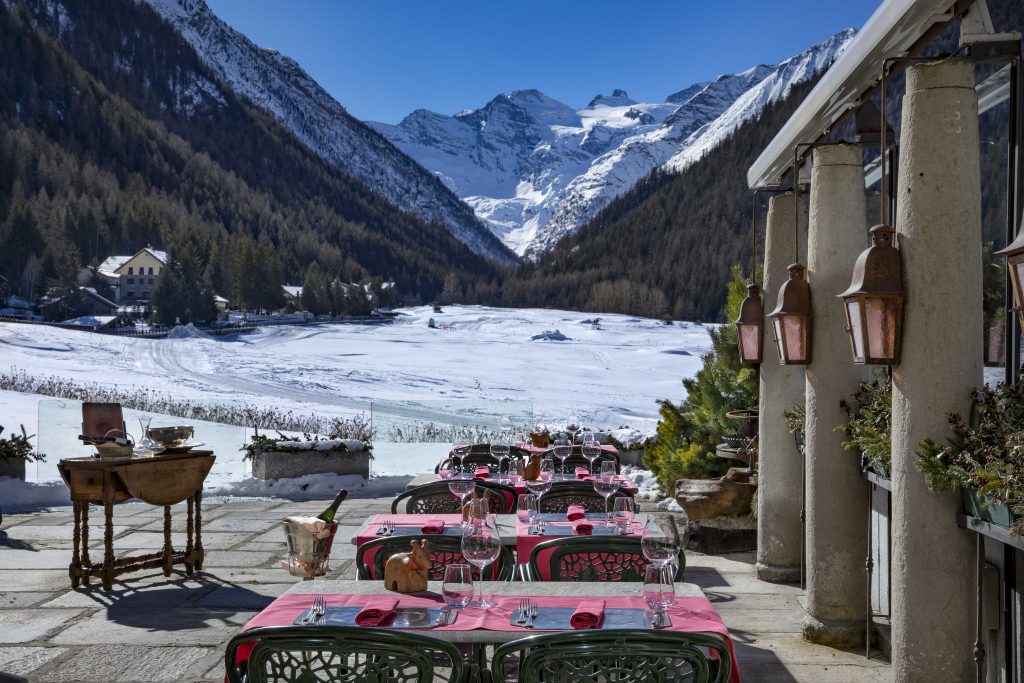
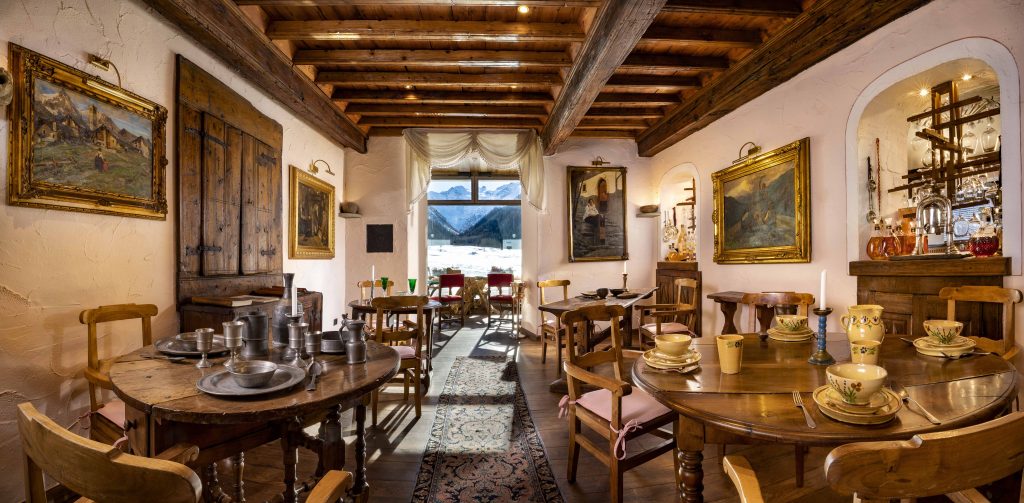
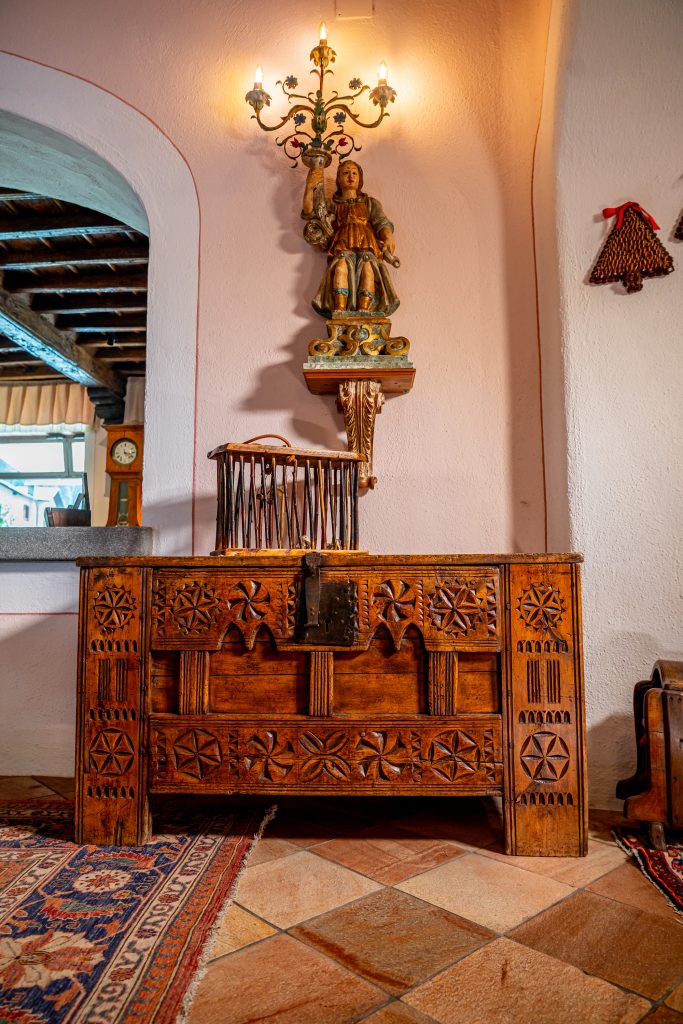
Each room is truly unique in its furnishings and artworks adorning the walls of this historic structure. The hotel itself is a veritable "scattered museum" (museo diffuso) – it has no labels, no mandatory paths, and no glass display cases. Works by Bazzaro, Mus, and Roda hang on the walls of the dining room, corridors, and resting areas. Alongside them, without stealing the spotlight, are antique objects: a 14th-century wooden statue, a 17th-century larch chest, all testifying to the material culture of the valley. However, the heart of the collection remains painting, which here lives as it once did in the homes of mountaineers or village inns – not as a distant fetish to be contemplated, but as a familiar presence.
This exhibition choice, conceived by Piero Roullet and summarized by the motto "tradition in motion," represents a precise theoretical stance. Roullet did not want to embalm the past; he wanted it to continue to breathe. Thus, altar columns became bed canopies, butter shelves returned to the kitchen, and paintings watch over guests as they eat or read. Alpine painting, which spoke of daily life, finally returns to the flow of life. The most precious core consists of three pictorial voices – Leonardo Bazzaro, Italo Mus, and Leonardo Roda – each telling the story of the mountains with its own visual grammar.
Leonardo Bazzaro: Realism at Bellevue
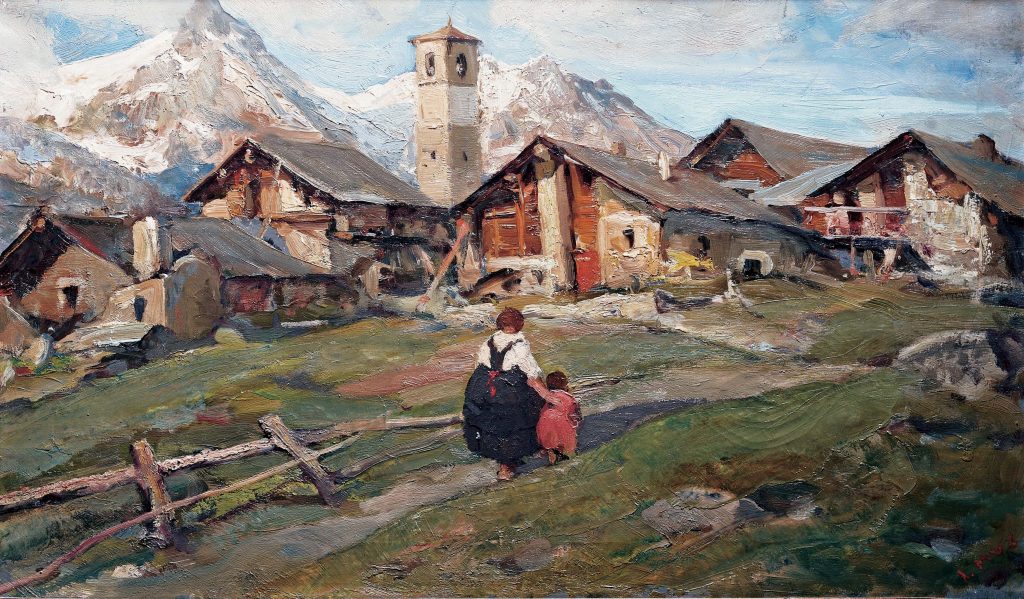
Born in Milan in 1853 and trained at the Brera Academy, Leonardo Bazzaro's early works were marked by interiors of 18th-century churches and palaces. However, it was his encounter with en plein air painting that shifted his interest towards landscapes and genre scenes. Lagoon waters, diffused light, fishing boats – Bazzaro honed a technique that alternated thick brushstrokes with subtle glazes, always attentive to optical truth. His approach to the mountains came through Lake Verbano and Mottarone, where Bazzaro settled in a villa in Alpino. Here, his gaze focused on village life, agricultural work, and stone houses that seemed to grow from the earth.
The three works preserved at Bellevue all belong to this period and were executed between 1910 and 1911. Nei campi (In the fields, 1910) depicts a woman busy making hay. She wears the traditional Cogne dress: a scarf tied on her head, a dark apron, and long sleeves. The fabric of the dress is rendered with quick touches, while the woman's face is only vaguely sketched, as if her individual identity mattered less than the universal gesture she is performing.
Alla fontana (At the fountain, 1911) transports the observer to the small square of Gimillan, the hamlet perched above Cogne. Here, Bazzaro abandons the solitude of work to represent a moment of rest and social interaction. Several figures gather around the flowing water; there is no rush, no explicit narrative. Alta dimora alpestre (High alpine dwelling, 1910) concludes the triptych with another view of the mountains. A woman holds a child in her arms, on the back of a horse. Bazzaro portrays her frontally, contrasted against the white of the snow-capped mountains. The work has an almost documentary value, but not a cold one: the light warms the faces, and the overall impression conveys a sense of protection and calm.
Italo Mus: Color and the Vallée
Italo Mus was born in Châtillon in 1892 into a family of artists; his father Eugène was a wood sculptor, and the young Italo quickly learned to handle the tools of the trade. His academic training took place in Turin, where he attended the courses of Giacomo Grosso and Paolo Gaidano.
Unlike Bazzaro, Mus did not like to stray far from his valley. The Vallée was his constant, almost obsessive subject. The artist himself divided his work into three phases; the most relevant for the Bellevue collection is the first, dominated by scenes of mountain life. One work testifies to his connection with Gimillan. Titled Veduta del paese di Gimillan (View of Gimillan village, 1934), it adopts a detached, almost bird's-eye perspective. The houses cluster together, and the church serves as a visual anchor.
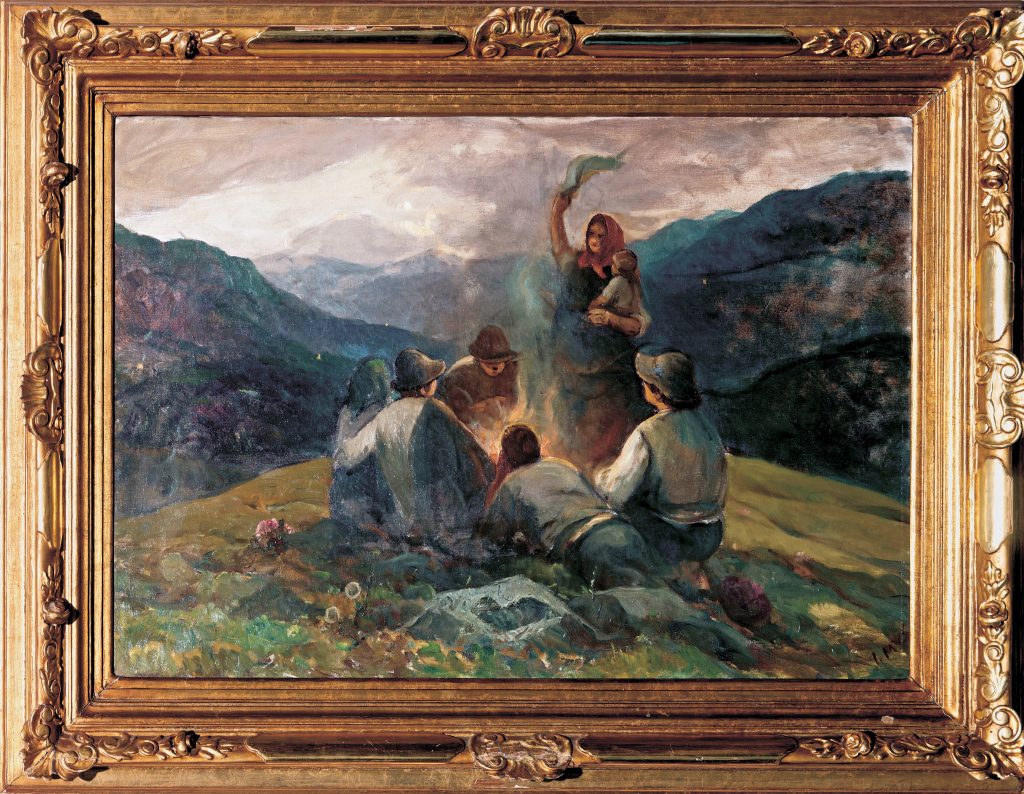
The other unmissable work is I fuochi di San Giovanni (The bonfires of Saint John), dated to the 1930s. On late June nights, many Alpine villages light bonfires to celebrate the summer solstice. Mus does not describe the ritual didactically; he transfigures it. In the foreground are not the flames, but the bodies. The fire appears among the heads of the characters, surrounded by their figures. An orange and red tongue of flame is perfectly positioned in the center of the canvas. This work anticipates the expressive turn the artist would take in the following decade, when he declared his intention to "make color" regardless of reality.
Leonardo Roda: The Object as Portrait
Leonardo Roda, the least known of the three, deserves re-evaluation and is currently the subject of several exhibitions. A self-taught artist who refined his skills under the guidance of Mario Cardellini, Roda was also a mountaineer and botanist, and he loved observing nature directly in the field. His work is divided between marine and alpine landscapes. In particular, among his alpine scenes, he painted countless versions of the Matterhorn, captured in different seasons and light conditions.
However, the work preserved at Bellevue is atypical for his catalog. La fontana in ferro di Cogne (The iron fountain of Cogne, 1906) is a bustling village scene. The iron fountain occupies the center of the composition, but life flows around it. Several people are visible: some are drawing water, others are walking down the street. Roda captures the atmosphere of an ordinary afternoon in an early 20th-century Alpine village; there is no exceptional event, no celebration. There is simply the community living its public space, where the fountain is the natural meeting point. The work deserves to be rediscovered not only as a historical document but as an example of an approach to painting that does not require grand subjects to be powerful.
Novedades — Society
La participación cultural: más allá de la mera asistencia, la necesidad de compartir el poder
```html La participación cultural: más allá de la mera asistencia, la necesidad de compartir el poder La participación se ha convertido en un término ubicuo, presente en convocatorias, proyectos europeos, programas culturales y planes de regeneración urbana. Se presenta como un
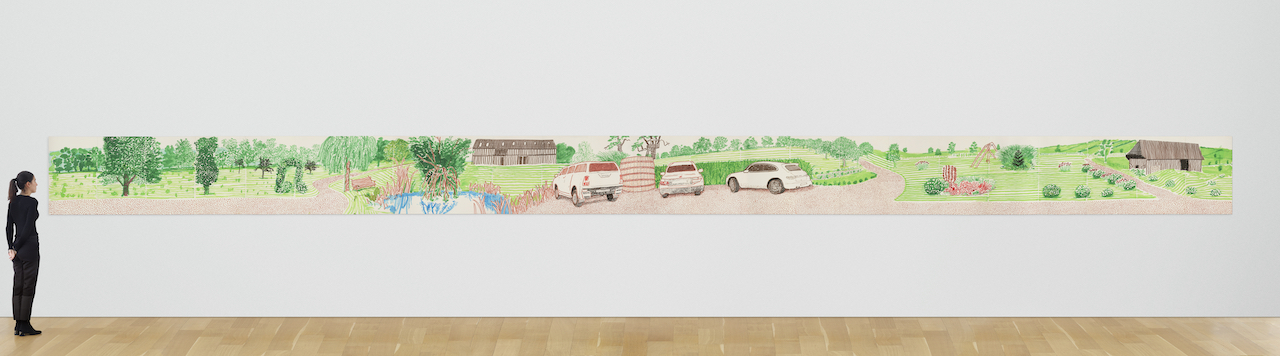
David Hockney's Monumental 12-Meter Print Heads to Christie's Auction
A truly unique lot is being offered by Christie's, available online from March 17 to 31, and on display at the major London galleries until March 31. This remarkable piece is one of David Hockney's largest creations, a staggering 12 meters long, printed on a single sheet of paper, and his most

El Greco Masterpiece Uncovered in Vatican: Hidden Under a Forgery
Art history is frequently punctuated by unexpected and serendipitous discoveries. Among these is the latest revelation from the Vatican Museums, where a routine conservation intervention has brought to light an authentic painting by El Greco, which had remained invisible for decades beneath a

Modena's Gate26A Hosts Aleksandr Nuss's Art: Where Matter Erodes and Light Reveals
Modena offers a serene escape from the vibrant chaos of nearby Bologna, presenting itself as an ordered and pristine city, a tranquil setting for everyday life. Within this calm environment, an independent space named Gate26A, founded by a collective of four individuals, injects a dynamic ener

Peggy Guggenheim's London Years: The Birth of a Collector in Venice Exhibition
Many are unaware of a crucial, often overlooked chapter in the life of Peggy Guggenheim, the visionary who transformed a palazzo on the Grand Canal into a bastion of modernism: her entrepreneurial venture with the Guggenheim Jeune gallery in London. The exhibition, Peggy Guggenheim in London: B
Selvatica 2026 in Biella: Art and Nature in Dialogue, Featuring Historical Authors and New Talents
The eleventh edition of Selvatica – Art and Nature in Festival, a biennial event held in Piazzo, Biella's historic district, has commenced and will run until July 19, 2026. The festival aims to foster a dialogue between artistic languages, scientific research, and educational practices to crea