Sardinian Clay Art on Display in Venice: The Soul of Clay at Palazzetto Tito
Ceramics have always been and continue to be a primary language in Sardinian culture. The exhibition Clay Forms: A Century of Sardinian Ceramics (1900–2000), held at Palazzetto Tito in Venice, offers a rigorous synthesis of this central production in the island's culture, presenting eighty wor
Ceramics have always been and continue to be a primary language in Sardinian culture. The exhibition Clay Forms: A Century of Sardinian Ceramics (1900–2000), held at Palazzetto Tito in Venice, offers a rigorous synthesis of this central production in the island's culture, presenting eighty works from the collection of the Nuoro Museum of Ceramics to the public. The project, promoted by the Higher Regional Ethnographic Institute of Sardinia (ISRE) in collaboration with the Bevilacqua La Masa Foundation, is conceived as a historical analysis of a heritage that, for a long time, was confined to a purely local dimension.
The exhibition is part of an internationalization program strongly desired by ISRE, aimed at integrating the island's material heritage into contemporary art circuits. In this regard, the choice of Venice is not accidental: Palazzetto Tito, home to one of Italy's oldest institutions for the promotion of emerging art, serves as an ideal setting to spark a dialogue between the persistence of Sardinian tradition and the experimental vocation of the Venetian context.
The exhibition traces a full century of activity, documenting how the island's ceramic production evolved from a purely functional dimension, linked to daily and agricultural life, towards an aesthetic awareness that, after World War II, opened up to the new languages of design and applied arts. The merit of the exhibition design, curated by architect Giovanni Filindeu, lies in its ability to move the works away from classical musealization, favoring an interpretation that highlights the morphological and symbolic characteristics of each artifact. The arrangement of the objects allows for an understanding of the variety of local technical schools, differences in clay mixtures, and the constant formal research that characterized Sardinian artisan-artists throughout the 20th century.
The chronological narrative begins with artifacts related to daily life, then unfolds through the decisive renewal initiated in the 1920s by figures like Francesco Ciusa, a pioneer in moving ceramics from the functional to the artistic realm. From this premise, a genealogy of masters develops: from Ciriaco Piras and the Dorgali school to the fundamental contribution of the brothers Federico and Melkiorre Melis, who skillfully combined technical quality with stylistic research.
A central chapter of the analysis concerns the consolidation of the relationship between ceramics and sculpture in the post-war period. Artists such as Maria Lai, Costantino Nivola, and Pinuccio Sciola interpreted the material with distant yet complementary approaches: Nivola through the engraving of primordial signs, Sciola by subtracting material to approach stone sculpture. Alongside them, figures like Paola Dessy, Giuseppe Silecchia, and Gavino Tilocca successfully oriented production towards formal abstractions, opening a fruitful dialogue between island craftsmanship and the demands of modern design. The exhibition also acknowledges historical ambivalences, documenting the dissemination, between the 1930s and 1940s, of a stereotypical image of Sardinia intended for the national market, through the works of Edina Altara and Alessandro Molari.
However, the merit of Clay Forms also lies in its not being limited to a retrospective of the past. The final section, dedicated to contemporary artistic ceramics with works by Michele Ciacciofera, Antonello Cuccu, Caterina Lai, and others, demonstrates that the vitality of this tradition is far from exhausted. The capacity for renewal, also visible in the video by the duo NARENTE presented in the exhibition, attests that Sardinian ceramics is a continually evolving language, capable of absorbing present-day changes.
Novedades — Society
La participación cultural: más allá de la mera asistencia, la necesidad de compartir el poder
```html La participación cultural: más allá de la mera asistencia, la necesidad de compartir el poder La participación se ha convertido en un término ubicuo, presente en convocatorias, proyectos europeos, programas culturales y planes de regeneración urbana. Se presenta como un
David Hockney's Monumental 12-Meter Print Heads to Christie's Auction
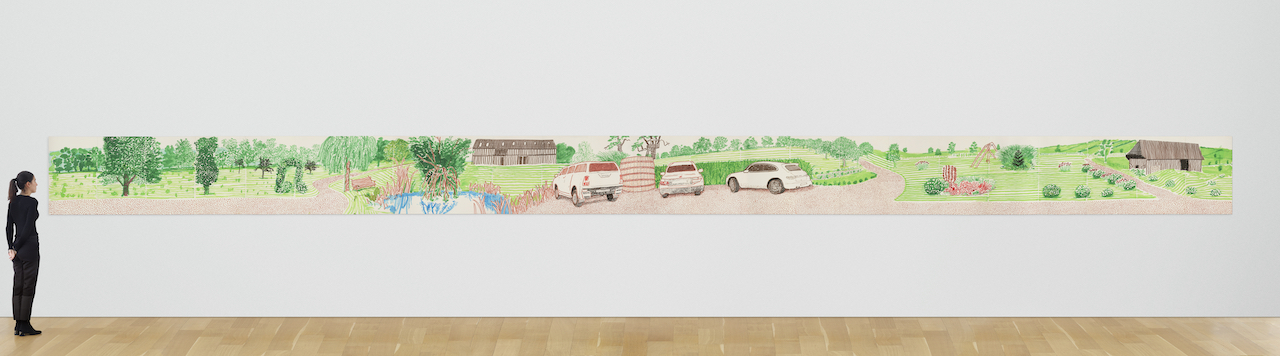
A truly unique lot is being offered by Christie's, available online from March 17 to 31, and on display at the major London galleries until March 31. This remarkable piece is one of David Hockney's largest creations, a staggering 12 meters long, printed on a single sheet of paper, and his most

El Greco Masterpiece Uncovered in Vatican: Hidden Under a Forgery
Art history is frequently punctuated by unexpected and serendipitous discoveries. Among these is the latest revelation from the Vatican Museums, where a routine conservation intervention has brought to light an authentic painting by El Greco, which had remained invisible for decades beneath a

Modena's Gate26A Hosts Aleksandr Nuss's Art: Where Matter Erodes and Light Reveals
Modena offers a serene escape from the vibrant chaos of nearby Bologna, presenting itself as an ordered and pristine city, a tranquil setting for everyday life. Within this calm environment, an independent space named Gate26A, founded by a collective of four individuals, injects a dynamic ener

Peggy Guggenheim's London Years: The Birth of a Collector in Venice Exhibition
Many are unaware of a crucial, often overlooked chapter in the life of Peggy Guggenheim, the visionary who transformed a palazzo on the Grand Canal into a bastion of modernism: her entrepreneurial venture with the Guggenheim Jeune gallery in London. The exhibition, Peggy Guggenheim in London: B
Selvatica 2026 in Biella: Art and Nature in Dialogue, Featuring Historical Authors and New Talents
The eleventh edition of Selvatica – Art and Nature in Festival, a biennial event held in Piazzo, Biella's historic district, has commenced and will run until July 19, 2026. The festival aims to foster a dialogue between artistic languages, scientific research, and educational practices to crea