Mario Ceroli: When Wood Comes Alive – An Antological Exhibition
Mario Ceroli, a pivotal figure in the Roman art scene from the 1960s to the 2000s, is celebrated as one of the most innovative artists of his era. He is recognized for his significant contributions to Italian Pop Art, particularly his iconic wooden silhouettes, and his explorations within Arte Povera. Ceroli's sculpture, rich with allusions to classical and Renaissance art, boldly moves away from the traditional "in-the-round" approach. Instead, his work achieves remarkable imaginative vitality, transcending the mere physicality of wood to create visions of profound impact, both scenically and emotionally.
Tornabuoni Arte is currently hosting a compelling exhibition featuring forty of Ceroli’s works, including sculptures, installations, and distinctive wooden silhouettes. This intense display offers an unprecedented deep dive into Ceroli's creative journey, revealing an extraordinary richness in his figurative and stylistic expressions. Among the highlights is the bronze version of Squilibrio (1988), drawing inspiration from Leonardo da Vinci's celebrated Vitruvian Man. Visitors can also encounter the striking volumetric forms of his more recent Le talebane (2002), whose iconic plasticity powerfully conveys the communicative force of an act of faith. A series of wood panel works from the 1980s and early 1990s depict figures from ancient Greece – heroes and warriors – reinterpreting the iconic Riace Bronzes. Examples include Interno tempio (I Bronzi di Riace) and Ritratto di guerriero, both from 1981, crafted with mixed media and gold leaf on wood, underscoring the Master's enduring fascination with classicism. Also from 1981, La scuola di Atene offers a fresh perspective on Raphael's renowned Vatican masterpiece through Ceroli's characteristic wooden profiles and silhouettes.
Beyond classical and Renaissance references, the exhibition prominently features the theme of nature. Ceroli's interest in this subject aligns with his research during the Arte Povera movement, through which he preserved its poetic ideals with highly evocative subjects and stylistic choices. Notable works include Eleusi (1979), where the artist celebrates the Great Eleusinian Mysteries using branches, straw, and ears of grain embedded in the table surfaces. Another piece, Senza titolo (1975), showcases delicate wooden butterflies—a recurring motif in Ceroli's oeuvre—soaring gracefully before a benevolent sun. Volo di gabbiani (1976) masterfully captures the swirling motion of a bird flock through an ascending spiral arrangement of silhouettes.
Finally, the Maestro's art is often imbued with a distinctive irony, evident in the monumental wood and bronze altarpiece titled Gloria eterna ai caduti per la pittura (Eternal Glory to Those Who Died for Painting, 1972). This work serves as an epitaph, listing the names of art critics, collectors, and dealers. Between 1972 and 1975, writing took on a primary role in Ceroli's art, as exemplified by La Geometria, quale paesaggio pittoresco (Geometry, What a Picturesque Landscape, 1974). Here, the names of geometric shapes become the subject themselves, transforming a discipline into a powerful and iconic visual evocation.
Novedades — Society
La participación cultural: más allá de la mera asistencia, la necesidad de compartir el poder
```html La participación cultural: más allá de la mera asistencia, la necesidad de compartir el poder La participación se ha convertido en un término ubicuo, presente en convocatorias, proyectos europeos, programas culturales y planes de regeneración urbana. Se presenta como un
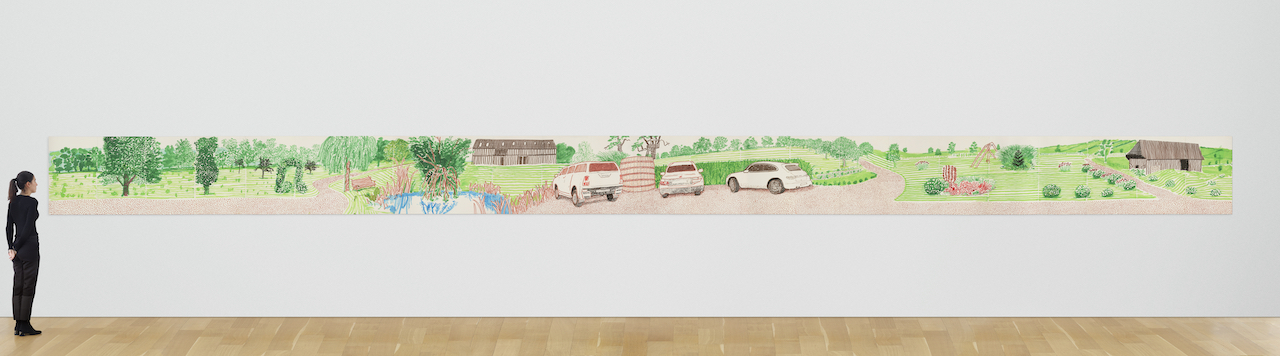
David Hockney's Monumental 12-Meter Print Heads to Christie's Auction
A truly unique lot is being offered by Christie's, available online from March 17 to 31, and on display at the major London galleries until March 31. This remarkable piece is one of David Hockney's largest creations, a staggering 12 meters long, printed on a single sheet of paper, and his most

El Greco Masterpiece Uncovered in Vatican: Hidden Under a Forgery
Art history is frequently punctuated by unexpected and serendipitous discoveries. Among these is the latest revelation from the Vatican Museums, where a routine conservation intervention has brought to light an authentic painting by El Greco, which had remained invisible for decades beneath a

Modena's Gate26A Hosts Aleksandr Nuss's Art: Where Matter Erodes and Light Reveals
Modena offers a serene escape from the vibrant chaos of nearby Bologna, presenting itself as an ordered and pristine city, a tranquil setting for everyday life. Within this calm environment, an independent space named Gate26A, founded by a collective of four individuals, injects a dynamic ener

Peggy Guggenheim's London Years: The Birth of a Collector in Venice Exhibition
Many are unaware of a crucial, often overlooked chapter in the life of Peggy Guggenheim, the visionary who transformed a palazzo on the Grand Canal into a bastion of modernism: her entrepreneurial venture with the Guggenheim Jeune gallery in London. The exhibition, Peggy Guggenheim in London: B
Selvatica 2026 in Biella: Art and Nature in Dialogue, Featuring Historical Authors and New Talents
The eleventh edition of Selvatica – Art and Nature in Festival, a biennial event held in Piazzo, Biella's historic district, has commenced and will run until July 19, 2026. The festival aims to foster a dialogue between artistic languages, scientific research, and educational practices to crea