Joseph Kosuth in Venice: Language Between Object and Context
Joseph Kosuth, born in 1945, is widely recognized as a pivotal figure in contemporary art. As the seminal father of Conceptual Art, he profoundly reshaped artistic discourse by introducing the radical idea that art's core essence lies not in "forms and colors, but in the production of meaning." This assertion, now seemingly self-evident, was revolutionary in the 1960s, creating an irreversible shift in how art was created and understood.
Kosuth's connection to Venice is particularly deep, a city he has embraced as his own and where his artistic presence is tangibly felt. Notably, he is responsible for "The Material of Ornament," the first—and only—permanent neon installation on a Venetian facade, exhibited at the Fondazione Querini Stampalia since 1997. His extensive engagement with the city is further highlighted by his participation in eight editions of the Venice Art Biennale, including representing Hungary in 1993 and receiving an honorable mention.
Currently, Venice celebrates Kosuth with an elegant solo exhibition at the Casa dei Tre Oci on the island of Giudecca. Presented by Berggruen Arts & Culture and Berggruen Institute Europe, and curated by Mario Codognato and Adriana Rispoli, the exhibition bears the highly programmatic title: "The-exchange-value-of-language-has-fallen-to-zero."
Language has consistently been central to Kosuth's artistic practice, and it again serves as the conceptual anchor of this new display. As the title suggests, in today's media landscape—dominated by the proliferation of images and the semantic automation of artificial intelligence—words appear to have lost their inherent weight and communicative value. It is within this ambiguity that the exhibition situates itself, re-examaming historical works through the lens of our contemporary condition.
Among the featured pieces are his now-iconic "Proto-Investigations," where Kosuth pairs an everyday object (famously exemplified by a chair) with its photograph and definition. The exhibition includes "One and Three Mirrors" (1965), which introduces a crucial variation: the mirror. By reflecting both the viewer and the surrounding environment, the work explicitly underscores the relational nature of meaning, echoing the philosophical inquiries of Ludwig Wittgenstein, who posited that meaning always emerges from use, context, and situation.
This semantic instability is further explored in works such as "Text/Context" (1978–1979), initially conceived for the Van Abbemuseum in Eindhoven. This piece was designed to exist simultaneously in two forms: as a public billboard in urban spaces and as wallpaper within the museum. This deliberate translocation generates a significant conceptual shift: meaning is never fixed but alters based on its environment, compelling viewers to confront the cultural frameworks that shape their understanding.
Similarly, other historical works like "The Fifth Investigation" (1969), "Where Are You Standing?" (1976), and the white neon "One and Eight – A Description" (1965) continue to interrogate language in its material dimension, transforming words into objects and objects into articulate statements.
This conceptual thread extends into Kosuth's most recent creations, culminating in a site-specific installation commissioned for the exhibition. Titled "A Chain of Resemblance," this neon artwork greets visitors on the ground floor, enveloping them in a luminous pattern that reinterprets a passage by Michel Foucault. Here, the world appears as a chain of correspondences, a system of interspecies relationships where each element references another through a logic of similarity and contiguity. Water, earth, and sky thus intertwine in a seamless semantic and visual continuum, transforming language into a profound spatial experience.
Novedades — Society
La participación cultural: más allá de la mera asistencia, la necesidad de compartir el poder
```html La participación cultural: más allá de la mera asistencia, la necesidad de compartir el poder La participación se ha convertido en un término ubicuo, presente en convocatorias, proyectos europeos, programas culturales y planes de regeneración urbana. Se presenta como un
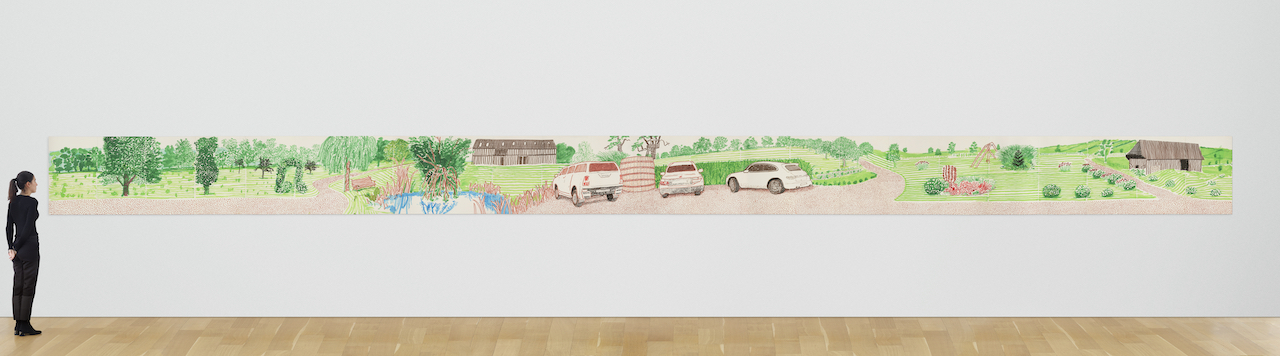
David Hockney's Monumental 12-Meter Print Heads to Christie's Auction
A truly unique lot is being offered by Christie's, available online from March 17 to 31, and on display at the major London galleries until March 31. This remarkable piece is one of David Hockney's largest creations, a staggering 12 meters long, printed on a single sheet of paper, and his most

El Greco Masterpiece Uncovered in Vatican: Hidden Under a Forgery
Art history is frequently punctuated by unexpected and serendipitous discoveries. Among these is the latest revelation from the Vatican Museums, where a routine conservation intervention has brought to light an authentic painting by El Greco, which had remained invisible for decades beneath a

Modena's Gate26A Hosts Aleksandr Nuss's Art: Where Matter Erodes and Light Reveals
Modena offers a serene escape from the vibrant chaos of nearby Bologna, presenting itself as an ordered and pristine city, a tranquil setting for everyday life. Within this calm environment, an independent space named Gate26A, founded by a collective of four individuals, injects a dynamic ener

Peggy Guggenheim's London Years: The Birth of a Collector in Venice Exhibition
Many are unaware of a crucial, often overlooked chapter in the life of Peggy Guggenheim, the visionary who transformed a palazzo on the Grand Canal into a bastion of modernism: her entrepreneurial venture with the Guggenheim Jeune gallery in London. The exhibition, Peggy Guggenheim in London: B
Selvatica 2026 in Biella: Art and Nature in Dialogue, Featuring Historical Authors and New Talents
The eleventh edition of Selvatica – Art and Nature in Festival, a biennial event held in Piazzo, Biella's historic district, has commenced and will run until July 19, 2026. The festival aims to foster a dialogue between artistic languages, scientific research, and educational practices to crea