In Bergamo, Vernacular Kodachrome Photographs Become a Collective Narrative
What happens when images created outside of any artistic intention enter an exhibition space and are offered to a shared gaze? What does it mean to look at something that was not conceived to be viewed in this way? What remains of an image when it is removed from its original flow? From the overcoming of this threshold emerges Memory Is Not A File. 7×7=49. The past is not behind, it surrounds us, a project conceived and curated by Damiano Carrara, which opens today in Bergamo, at SANBE15/C, an exhibition space envisioned and curated by Paola Amadeo and Francesca Parisi.
Seven images per day for seven days, composing a temporary archive of 49 photographs. This is not a linear sequence but a structure that proceeds through emotional returns and variations. Each day is organized around a perceptual field, from shared silence to the domestic dimension, from suspended time to the daily gesture, building a kind of emotional atlas for the visitor to navigate.
The images come from a vast archive of over a million Kodachrome slides, collected over the years by Carrara. These are vernacular photographs, taken between the late 1940s and the early 1980s – anonymous, familiar, and family images, often technically imperfect, born without aesthetic ambition. Yet, it is precisely in this absence of intention that their strength resides. They were not intended to be seen as artworks but to be lived, shared, preserved within a circuit as intimate as it was communal.
This is where the project introduces a shift. These same images, removed from their original context and put back into circulation, reveal a communicative capacity that we might today call “viral,” but in an analog time. Before digital hyper-production, before instant circulation, there existed a form of slow, layered diffusion, in which images were transmitted through relationships, memories, and family archives. A diffusion without a network, entrusted to the persistence of the gaze.
A primary role is therefore assumed by the “medium” itself, which can be considered an “author” in its own right. Kodachrome, introduced by Eastman Kodak in 1935, was the first widely used color film, appreciated for its chromatic depth and its ability to resist fading over time. Used in both photography and cinematography, Kodachrome became particularly prominent after the Second World War, becoming one of the privileged tools for photography, and a constitutive element of the visual imagination of the twentieth century.
Kodachrome accompanied reportages, family archives, and cinematic productions for decades. From the 1980s, however, its use progressively declined, due in part to the spread of more economical and easier-to-develop color films, as well as the advent of video and, subsequently, digital photography.
Production was definitively discontinued in 2009, closing a cycle that lasted over 70 years. The last roll was entrusted to Steve McCurry and developed in 2010 at the last laboratory in the world capable of processing it. More than a technical support, Kodachrome remained a true "skin of time," capable of fixing the visual memory of the last century with a chromatic quality still difficult to replicate today.
«Every work is an open gateway. An invitation to enter and get lost. An extraordinary journey into memory, where interpretation expands without limits and the past continues to generate new possibilities. Because memory is not a file,» explains Carrara. The path is guided by narrative clues, hints, possibilities. Names, places, eras that suspend the experience between reality and fiction, with the spectator called upon to complete or reinvent the images. Looking at these photographs, we will not be able to recognize the subjects portrayed, nor will we have defined access to their stories. Yet we recognize gestures, postures, situations. A party, a holiday, a domestic moment, an anticipation. It is a recognition that does not pass through identity but through a more subtle, almost unconscious, archetypal proximity. The images function as fragments of a collective story, in which the stranger becomes familiar and the past is reactivated in the present.
In this sense, Carrara's operation insists on reactivation. The selection, restoration, and juxtaposition create a field of emotional resonance in which each photograph becomes a gateway. There is no imposing authorship, but a montage that allows connections, affinities, and dissonances to emerge. Art, as the project suggests, is an effect generated in the encounter.
Color also plays a decisive role; the images are permeated, marked, transformed. Kodachrome, with its material density and nostalgic imperfection, presents itself as a sensitive surface of time, which is not behind us but all around us, as the exhibition's subtitle suggests.
Memory Is Not A File aims to overcome the opposition between analog and digital, to interrogate the very conditions of vision. In this distance between intention and use, between origin and reactivation, a space of possibility opens up. A place where images, liberated from their original function, once again speak, not as documents but as presences.
Novedades — Society
La participación cultural: más allá de la mera asistencia, la necesidad de compartir el poder
```html La participación cultural: más allá de la mera asistencia, la necesidad de compartir el poder La participación se ha convertido en un término ubicuo, presente en convocatorias, proyectos europeos, programas culturales y planes de regeneración urbana. Se presenta como un
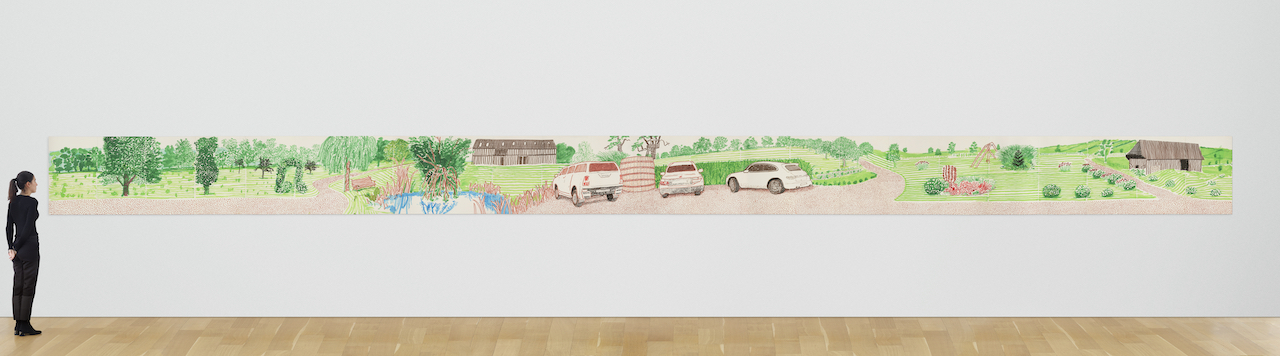
David Hockney's Monumental 12-Meter Print Heads to Christie's Auction
A truly unique lot is being offered by Christie's, available online from March 17 to 31, and on display at the major London galleries until March 31. This remarkable piece is one of David Hockney's largest creations, a staggering 12 meters long, printed on a single sheet of paper, and his most

El Greco Masterpiece Uncovered in Vatican: Hidden Under a Forgery
Art history is frequently punctuated by unexpected and serendipitous discoveries. Among these is the latest revelation from the Vatican Museums, where a routine conservation intervention has brought to light an authentic painting by El Greco, which had remained invisible for decades beneath a

Modena's Gate26A Hosts Aleksandr Nuss's Art: Where Matter Erodes and Light Reveals
Modena offers a serene escape from the vibrant chaos of nearby Bologna, presenting itself as an ordered and pristine city, a tranquil setting for everyday life. Within this calm environment, an independent space named Gate26A, founded by a collective of four individuals, injects a dynamic ener

Peggy Guggenheim's London Years: The Birth of a Collector in Venice Exhibition
Many are unaware of a crucial, often overlooked chapter in the life of Peggy Guggenheim, the visionary who transformed a palazzo on the Grand Canal into a bastion of modernism: her entrepreneurial venture with the Guggenheim Jeune gallery in London. The exhibition, Peggy Guggenheim in London: B
Selvatica 2026 in Biella: Art and Nature in Dialogue, Featuring Historical Authors and New Talents
The eleventh edition of Selvatica – Art and Nature in Festival, a biennial event held in Piazzo, Biella's historic district, has commenced and will run until July 19, 2026. The festival aims to foster a dialogue between artistic languages, scientific research, and educational practices to crea