Apparizioni: Claudio Palmieri's Sculptures Inhabit the Roman Houses of Caelian Hill
Occasionally, art exhibitions create a fruitful and unexpected dialogue between the ancient and the contemporary, merging a site's unique history with a long artistic endeavor. This is precisely what has happened with Claudio Palmieri's exhibition, Apparizioni, conceived and organized by CoopCulture and curated by Romina Guidelli. On display until March 22, 2026, the artist has strategically placed 21 sculptures, created from the late 1980s to the present day, within the evocative complex of the Roman Houses of Caelian Hill (Case Romane del Celio) – an archaeological site extending beneath the Basilica of Saints John and Paul.
The Roman artist, a student of Mino Delle Site and active in Rome since the mid-1980s (with his first solo exhibition in 1985 at Galleria L’Attico), recounts how this exhibition marks a return to a place he adventurously explored in adolescence. Descending into the darkness, he navigated narrow passages and vast caverns, sensing an "esoteric allure." Years later, he views the creation of this exhibition as "a symbolic call, a magical return to reinterpret, through matter and form, that remote youthful experience of mine — a convergence of memory, time, and creation."
Apparizioni is, therefore, far more than a mere anthological solo exhibition, which in itself would be a significant recognition of a long artistic journey. This exhibition embodies Palmieri's profound connection with his city, Rome. This is evident partly in a Baroque theatricality, expressed by his desire to surprise viewers with multiple visual interpretations of his sculptures, and conversely, in creations that echo an informal matrix, recalling the urban landscapes of Rome's peripheries.
A multifaceted artist, Palmieri has explored and merged various techniques and languages throughout his career, from painting to sculpture, photography to music, striving to unite the passionate with the rational soul. This continuous exploration is already evident in his 1980s sculptures (such as Glaciale, 1987; Manto and S. Sebastiano, 1988; Divinità, 1989; Eraclito, 1990), where geometric metal structures contain and interact with soft, organic forms that fold upon themselves. This interplay creates, as Achille Bonito Oliva described in 1986, a "short circuit between structural rigor and emotional impulse." The fold, an element that has always captivated Palmieri and originates from hot metalworking, evokes Baroque theatricality and, in its hypothetically continuous unfolding, allows him to create an infinity of paths and, consequently, visions.
Material experimentation is another characteristic of the artist, who extends beyond traditional sculptural materials. Alongside metals and ceramics – the latter allowing him to convey the tactility of his gesture directly onto the work's surface – Palmieri also employs plastics and fabrics. He twists, pulls, and models these, almost in a continuous "struggle," to compose his biomorphic figures. Prigione (2016), a sculpture fashioned from knotted plastic sheets fused with heat, exemplifies the duality between spirit and body, where the knots, like existential lumps, oppose and engage in a continuous dance with the expansive movements of the same material.
His painterly sensibility is revealed in the consistent use of color, demonstrating the artist's ability to interweave different lines of inquiry to express the unity of his thought. Sculptures like Pianta sulfurea (2016), Forma aliena, and Forma biomorfa (2017) captivate with the energy suggested by their movements and accentuated by the phosphorescent coloration of their surfaces, illuminating the darkness of the room. Their organic resemblances seem to suggest plant or animal life, yet this is contradicted by unnatural colorations that reflect certain artificial scenarios hinted at by contemporary urban life.
Biomorphic figures imprint their trace onto organic matter: Adamo ed Eva (1996) and Kouros (2008) narrate the desire to retain the fleeting, almost fossilized semblances of the human figure. Enclosed within rectangular geometric forms, these works ideally connect to the symbol of physical and spiritual perfection embodied by ancient Greek kouroi.
The artist's interest in natural forms is also evident in sculptures dedicated to the rose, chosen as a homage to the Roman Houses due to the flower's profound symbolic value in ancient Roman culture. In works like Rosa di luce (2025), Rosae (1994), and Rosa sulfurea (2024), Palmieri, employing diverse stylistic approaches, translates into this quintessential natural form: firstly, his exploration of concentric organic shapes in dialogue with geometric metal structures; secondly, the use of fluorescent colors and pigments that embody an antithesis to the naturalism of the chosen subject, moving away from any imitative intent; and finally, his masterful handling of various materials such as metal mesh or ceramic.
Thus, like unexpected guests, Claudio Palmieri's sculptures reside for these months within the Roman Houses, welcoming visitors as if they were new inhabitants or guardian spirits of the place. It is precisely in the visual surprise created by their presence, in the unusual characterization of certain spaces and corners, and in the striking contrast between the ancient history of these places and the forms and colors of these sculptures, that the language of contrasts Palmieri pursues throughout his entire artistic research finds its life and concrete expression.
Novedades — Society
La participación cultural: más allá de la mera asistencia, la necesidad de compartir el poder
```html La participación cultural: más allá de la mera asistencia, la necesidad de compartir el poder La participación se ha convertido en un término ubicuo, presente en convocatorias, proyectos europeos, programas culturales y planes de regeneración urbana. Se presenta como un
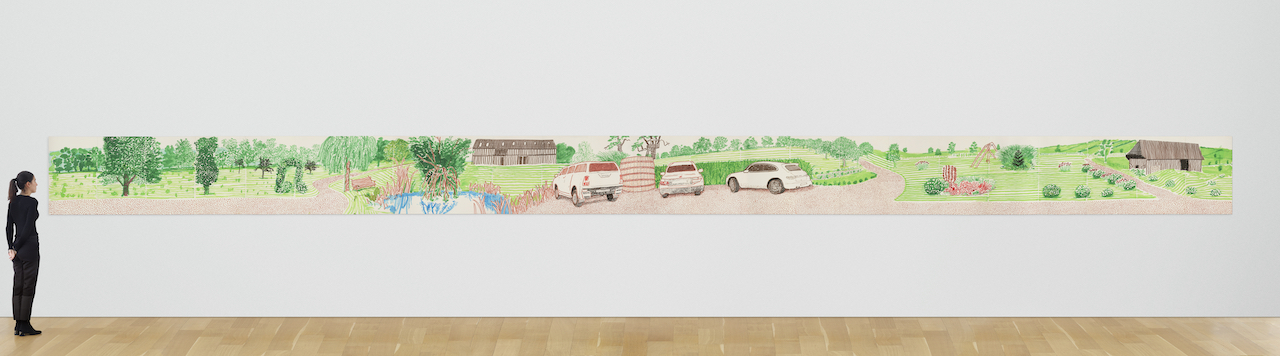
David Hockney's Monumental 12-Meter Print Heads to Christie's Auction
A truly unique lot is being offered by Christie's, available online from March 17 to 31, and on display at the major London galleries until March 31. This remarkable piece is one of David Hockney's largest creations, a staggering 12 meters long, printed on a single sheet of paper, and his most

El Greco Masterpiece Uncovered in Vatican: Hidden Under a Forgery
Art history is frequently punctuated by unexpected and serendipitous discoveries. Among these is the latest revelation from the Vatican Museums, where a routine conservation intervention has brought to light an authentic painting by El Greco, which had remained invisible for decades beneath a

Modena's Gate26A Hosts Aleksandr Nuss's Art: Where Matter Erodes and Light Reveals
Modena offers a serene escape from the vibrant chaos of nearby Bologna, presenting itself as an ordered and pristine city, a tranquil setting for everyday life. Within this calm environment, an independent space named Gate26A, founded by a collective of four individuals, injects a dynamic ener

Peggy Guggenheim's London Years: The Birth of a Collector in Venice Exhibition
Many are unaware of a crucial, often overlooked chapter in the life of Peggy Guggenheim, the visionary who transformed a palazzo on the Grand Canal into a bastion of modernism: her entrepreneurial venture with the Guggenheim Jeune gallery in London. The exhibition, Peggy Guggenheim in London: B
Selvatica 2026 in Biella: Art and Nature in Dialogue, Featuring Historical Authors and New Talents
The eleventh edition of Selvatica – Art and Nature in Festival, a biennial event held in Piazzo, Biella's historic district, has commenced and will run until July 19, 2026. The festival aims to foster a dialogue between artistic languages, scientific research, and educational practices to crea