
According to Susan Sontag, “silence is the ultimate consequence of that reluctance to communicate… It is the artist’s supreme otherworldly gesture: through silence, he frees himself from the servile bond with the world, which in turn takes on the guise of patron, client, consumer, antagonist, judge, or misrepresenter of his work.” (Styles of Radical Will, 1966). Tracing the fragments of sanctity and silence in contemporary art is a radical act of positioning that opens up forms of relation, distant temporalities, and oppositional narratives to the world. This operation of closeness and silence, dispersed across the floors of Palazzo Collicola in an ascending movement, begins with the collective exhibition occupying the lower floor: Minor Life. Saint Francis and the Sanctity of Contemporary Art, curated by Gianni and Giuseppe Garrera, offers a complex re-signification of the figure of Saint Francis of Assisi in the present day.
The exhibition narrative, coinciding with the eighth centenary of the Saint’s death, traces the militant practices of Franciscanism – close to anti-classist, anti-militarist, and feminist struggles – through a series of “luminous fragments” disseminated within the various theoretical nuclei of the rooms that open and intersect with each other.
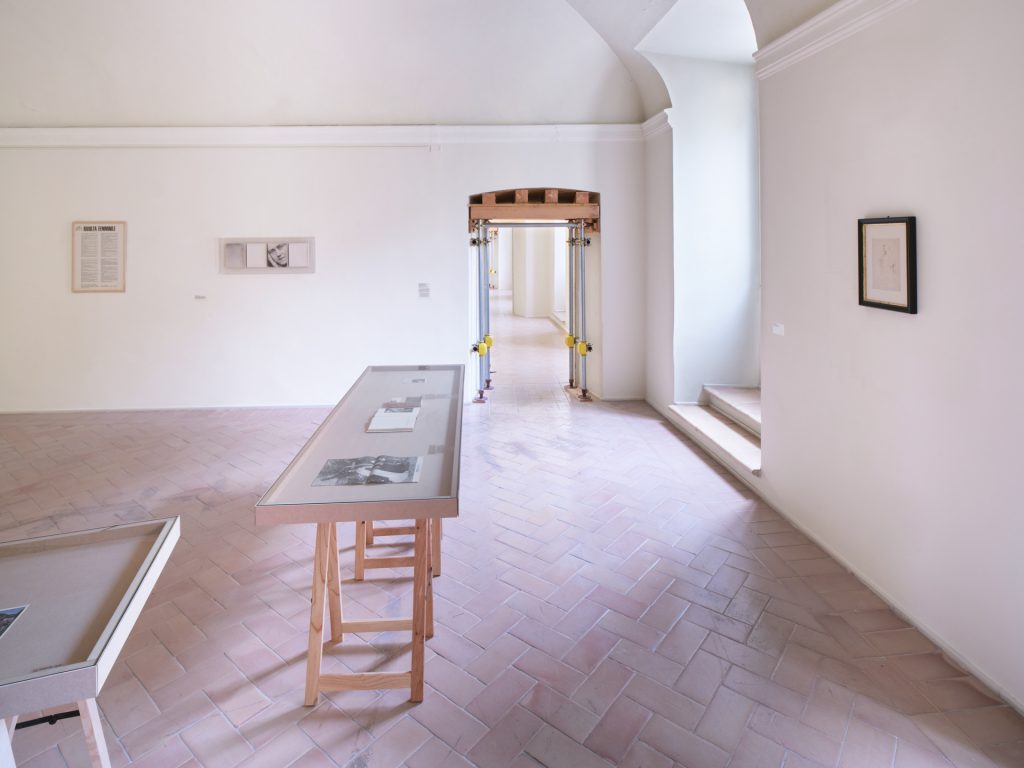
Starting from the condition of minority, in contrast to the exercise of power, the exhibition opens with the Gospels by Antonio Del Donno, twelve wooden panels on which phrases from the sacred scriptures are inscribed. At the entrance, there is a moral imperative – “Do not be conformed to this world, but be transformed by the renewal of your mind” – which clearly evokes the curatorial approach with which the exhibition was conceived, directing the gaze towards outsider and dissident, precarious, and minor existences.
The exhibition itinerary is articulated through internal shifts, where the works selected from the curators’ private collections – in dialogue with loans and site-specific creations – open concrete spaces for pausing and questioning to generate vital alternatives. Some of these layers concern the “unappealable condemnation of all money and its use” or the “praise of illiteracy,” a moment where Empty Words by John Cage serves as an auditory link between distinct practices aimed at the destruction of writing and the exaltation of scribbling. Cage’s work, in which he uses the vocal dimension through nonsense derivations, is realized with a single intention: the demilitarization of language understood as a tool for the oppression of others.
From the Western perspective, language is also the point of rupture in the relationship with other animals, whose presumed “inferiority” is sedimented in the lack of speech. Franciscanism reverses this hierarchy, shifting preaching from humans to animal alterity. Revered creatures are incorporated into the works: examples include the spiders to whom Tomás Saraceno returns authorship, or the 12 horses exhibited by Jannis Kounellis at Attico di Roma (works belonging to different places and times that would require further post-anthropocentric analysis). Gino De Dominicis also fits into this discourse of human exclusion – the perpetrator of a series of miracles that find space in the exhibition – who, on the occasion of his solo exhibition in Pescara in 1975, invited only animals to enter.
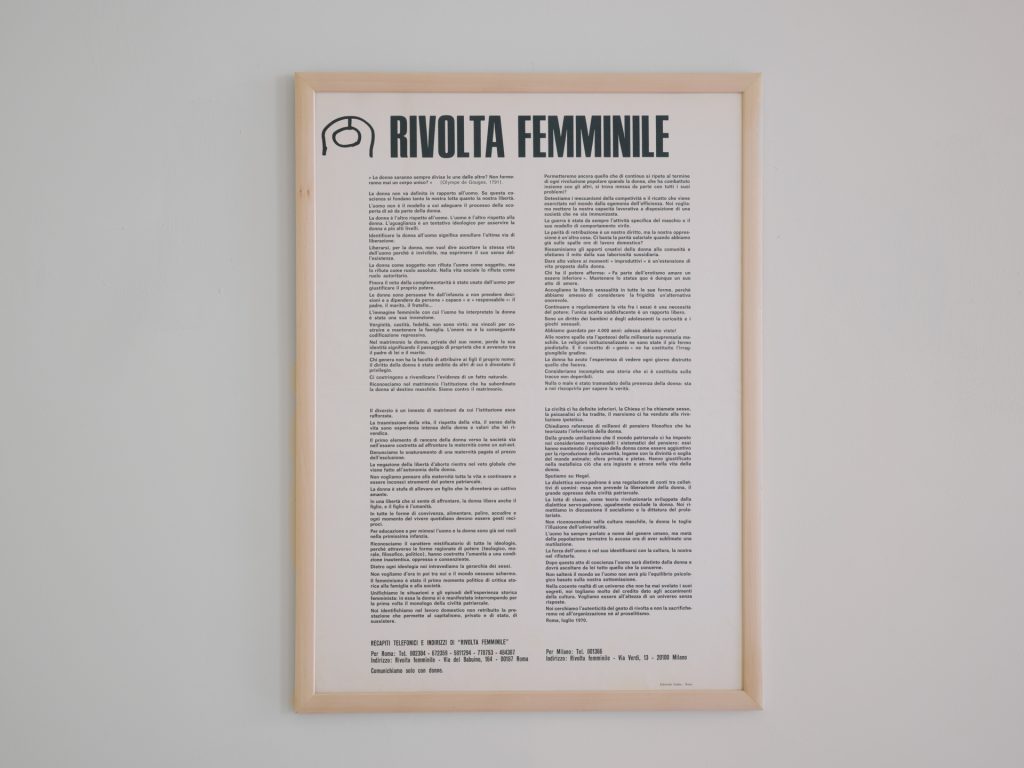
An important thematic nucleus is dedicated to the figure of Saint Clare and the feminisms that permeate Franciscan thought. Her transfiguration in contemporary times is absorbed by Carla Lonzi, art historian and separatist feminist activist, signatory along with other women of the Rivolta Femminile Manifesto. Lonzi, in turn connected to Thérèse of Lisieux, used a stratagem to insert the Saint’s face on the cover of the first edition of her Self-Portrait. The exhibition makes manifest the identity needs of this process of feminist recognition and self-awareness, made possible by the involvement of Giulio Paolini in the creation of a work containing the portrait itself, which, by achieving artistic status, would be accepted by the book’s publisher, but only in a reprint several years later.
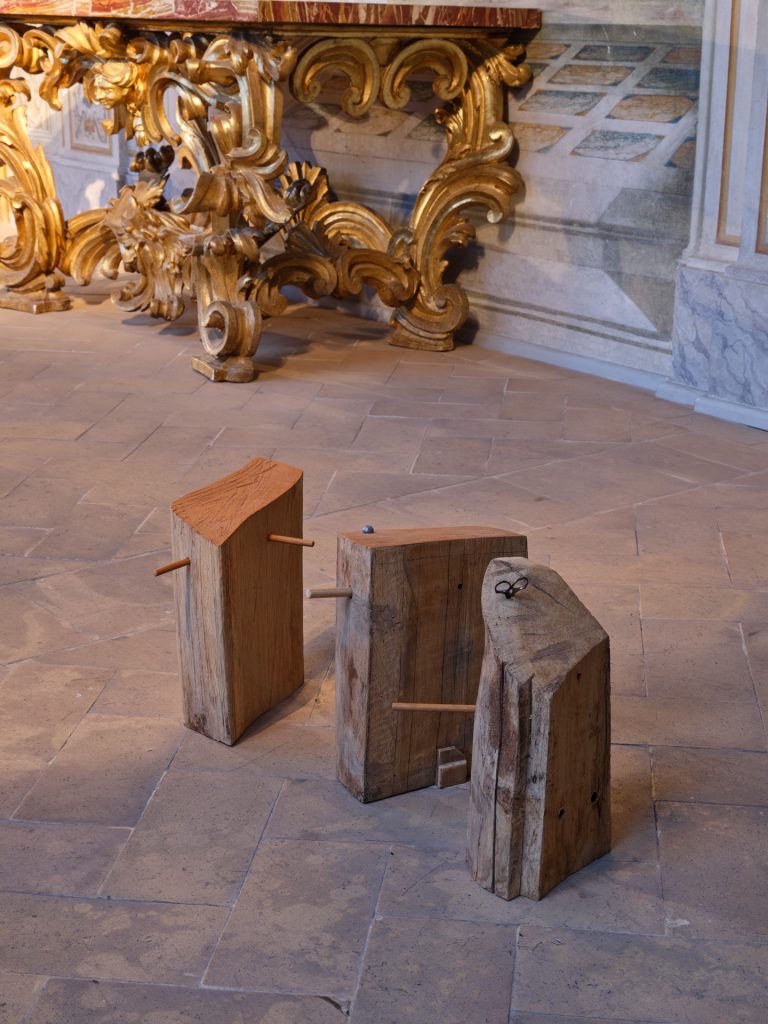
In a hybrid and contaminated zone, the entire research of Franco Troiani develops, invaded by intrusive, liturgical, and rural presences. In Agraria, an exhibition curated by Saverio Verini and hosted in the Piano Nobile, these are condensed through a targeted selection of the artist’s works. Troiani is linked to the geography of the Spoleto territory and has always woven many connections with other artists, from Sol LeWitt – already present in the local context – to personal derivations of a Futurist or Abstract nature. His imagery is guided by pure syncretism anchored to a genuinely ecological process of realization. According to this principle, the rustic component becomes significant in its most spiritual and primordial sense, as reuse and circularity correspond to the emergence of new forms of life. Wood, polished or painted a brilliant green – as in the case of The Battle of San Romano (after Paolo Uccello) – is sometimes exhibited as a frame, transforms into the body of a saint, becomes architecture, or a magic staff for travelers passing through the woods. Everything is anchored to the earth, and to the earth it cyclically returns.
Like Troiani, Barry Flanagan was also born in the first half of the 1940s, developing his practice in London. Sculpture speaks louder than words, a retrospective dedicated to him curated by Jo Melvin, is, in continuity with the other exhibitions, a sensory, intimate, and suspended experience. Approaching Flanagan’s works means entering into a one-to-one relationship with heterogeneous bodies – textile, light, sandy, shiny – that take on the semblance of otherworldly and post-organic entities capable of “speaking” directly to the observer.
Following plural trajectories, the fragments reverberate in all the research presented, traversing the eighteenth-century architecture of the museum. In doing so, they produce porous residues, guided by the tireless impulse to discover and actualize counter-hegemonic and silent modes of existence.
English Translation:
According to Susan Sontag, “silence is the ultimate consequence of that reluctance to communicate… It is the artist’s supreme otherworldly gesture: through silence, he frees himself from the servile bond with the world, which in turn takes on the guise of patron, client, consumer, antagonist, judge, or misrepresenter of his work.” (Styles of Radical Will, 1966). Tracing the fragments of sanctity and silence in contemporary art is a radical act of positioning that opens up forms of relation, distant temporalities, and oppositional narratives to the world. This operation of closeness and silence, dispersed across the floors of Palazzo Collicola in an ascending movement, begins with the collective exhibition occupying the lower floor: Minor Life. Saint Francis and the Sanctity of Contemporary Art, curated by Gianni and Giuseppe Garrera, offers a complex re-signification of the figure of Saint Francis of Assisi in the present day.
The exhibition narrative, coinciding with the eighth centenary of the Saint’s death, traces the militant practices of Franciscanism – close to anti-classist, anti-militarist, and feminist struggles – through a series of “luminous fragments” disseminated within the various theoretical nuclei of the rooms that open and intersect with each other.
Starting from the condition of minority, in contrast to the exercise of power, the exhibition opens with the Gospels by Antonio Del Donno, twelve wooden panels on which phrases from the sacred scriptures are inscribed. At the entrance, there is a moral imperative – “Do not be conformed to this world, but be transformed by the renewal of your mind” – which clearly evokes the curatorial approach with which the exhibition was conceived, directing the gaze towards outsider and dissident, precarious, and minor existences.
The exhibition itinerary is articulated through internal shifts, where the works selected from the curators’ private collections – in dialogue with loans and site-specific creations – open concrete spaces for pausing and questioning to generate vital alternatives. Some of these layers concern the “unappealable condemnation of all money and its use” or the “praise of illiteracy,” a moment where Empty Words by John Cage serves as an auditory link between distinct practices aimed at the destruction of writing and the exaltation of scribbling. Cage’s work, in which he uses the vocal dimension through nonsense derivations, is realized with a single intention: the demilitarization of language understood as a tool for the oppression of others.
From the Western perspective, language is also the point of rupture in the relationship with other animals, whose presumed “inferiority” is sedimented in the lack of speech. Franciscanism reverses this hierarchy, shifting preaching from humans to animal alterity. Revered creatures are incorporated into the works: examples include the spiders to whom Tomás Saraceno returns authorship, or the 12 horses exhibited by Jannis Kounellis at Attico di Roma (works belonging to different places and times that would require further post-anthropocentric analysis). Gino De Dominicis also fits into this discourse of human exclusion – the perpetrator of a series of miracles that find space in the exhibition – who, on the occasion of his solo exhibition in Pescara in 1975, invited only animals to enter.
An important thematic nucleus is dedicated to the figure of Saint Clare and the feminisms that permeate Franciscan thought. Her transfiguration in contemporary times is absorbed by Carla Lonzi, art historian and separatist feminist activist, signatory along with other women of the Rivolta Femminile Manifesto. Lonzi, in turn connected to Thérèse of Lisieux, used a stratagem to insert the Saint’s face on the cover of the first edition of her Self-Portrait. The exhibition makes manifest the identity needs of this process of feminist recognition and self-awareness, made possible by the involvement of Giulio Paolini in the creation of a work containing the portrait itself, which, by achieving artistic status, would be accepted by the book’s publisher, but only in a reprint several years later.
In a hybrid and contaminated zone, the entire research of Franco Troiani develops, invaded by intrusive, liturgical, and rural presences. In Agraria, an exhibition curated by Saverio Verini and hosted in the Piano Nobile, these are condensed through a targeted selection of the artist’s works. Troiani is linked to the geography of the Spoleto territory and has always woven many connections with other artists, from Sol LeWitt – already present in the local context – to personal derivations of a Futurist or Abstract nature. His imagery is guided by pure syncretism anchored to a genuinely ecological process of realization. According to this principle, the rustic component becomes significant in its most spiritual and primordial sense, as reuse and circularity correspond to the emergence of new forms of life. Wood, polished or painted a brilliant green – as in the case of The Battle of San Romano (after Paolo Uccello) – is sometimes exhibited as a frame, transforms into the body of a saint, becomes architecture, or a magic staff for travelers passing through the woods. Everything is anchored to the earth, and to the earth it cyclically returns.
Like Troiani, Barry Flanagan was also born in the first half of the 1940s, developing his practice in London. Sculpture speaks louder than words, a retrospective dedicated to him curated by Jo Melvin, is, in continuity with the other exhibitions, a sensory, intimate, and suspended experience. Approaching Flanagan’s works means entering into a one-to-one relationship with heterogeneous bodies – textile, light, sandy, shiny – that take on the semblance of otherworldly and post-organic entities capable of “speaking” directly to the observer.
Following plural trajectories, the fragments reverberate in all the research presented, traversing the eighteenth-century architecture of the museum. In doing so, they produce porous residues, guided by the tireless impulse to discover and actualize counter-hegemonic and silent modes of existence.