
A dissident by birthright, an agitator by calling, and a global influencer before the term became a profession, Ai Weiwei has transformed his own life into a political performance. On April 29th, the Chinese artist arrives at MAXXI L’Aquila with the major exhibition Aftershock, curated by Tim Marlow.
The exhibition aims to retrace Weiwei’s five-decade career, starting from his works created in New York in the 1980s and leading up to new sculptures created in Ukraine in 2025. At the heart of the exhibition will be a collection of works inspired by the 2008 Sichuan earthquake, which gain further significance when presented in the baroque spaces of Palazzo Ardinghelli, a building symbolizing rebirth after the earthquake that struck L’Aquila in 2009.
The exhibition will therefore investigate the lasting impact of natural disasters, conflicts, corruption, and collective tragedies, while always emphasizing human resilience and the power of creative action as a form of testimony and transformation. While we await Aftershock, here are five key points to help decode Ai Weiwei’s universe.
Dissent as Biological Inheritance
For Ai Weiwei, dissent is a biological inheritance: his father is the poet Ai Qing, one of China’s most important voices, who was denounced during the Cultural Revolution. When Weiwei was only one year old, the family was deported to the Beidahuang labor camp, and later exiled to Shihezi in Xinjiang, where they remained for sixteen years.
This experience left an indelible mark on the artist. His return to Beijing in 1976, at the end of the Cultural Revolution, did not erase the trauma but transformed it into the unwavering engine of his resistance. He himself recounts: “The whirlwind that swallowed my father also turned my life upside down, leaving a mark on me that I still carry today.”
Ai Weiwei and History: Destroying to Create
If Ai Weiwei today manipulates millennia-old artifacts with nonchalance, it is thanks to his years spent in New York’s East Village between 1981 and 1993. Here, he discovered Duchamp’s ready-made and understood that an object, when decontextualized, becomes a weapon.
In his famous 1995 performance, he had himself photographed dropping a Han Dynasty urn to the ground, shattering it. This was a protest against Maoist China, which for decades had destroyed its own cultural and artistic heritage to make way for violent homogenization and mass consumption.
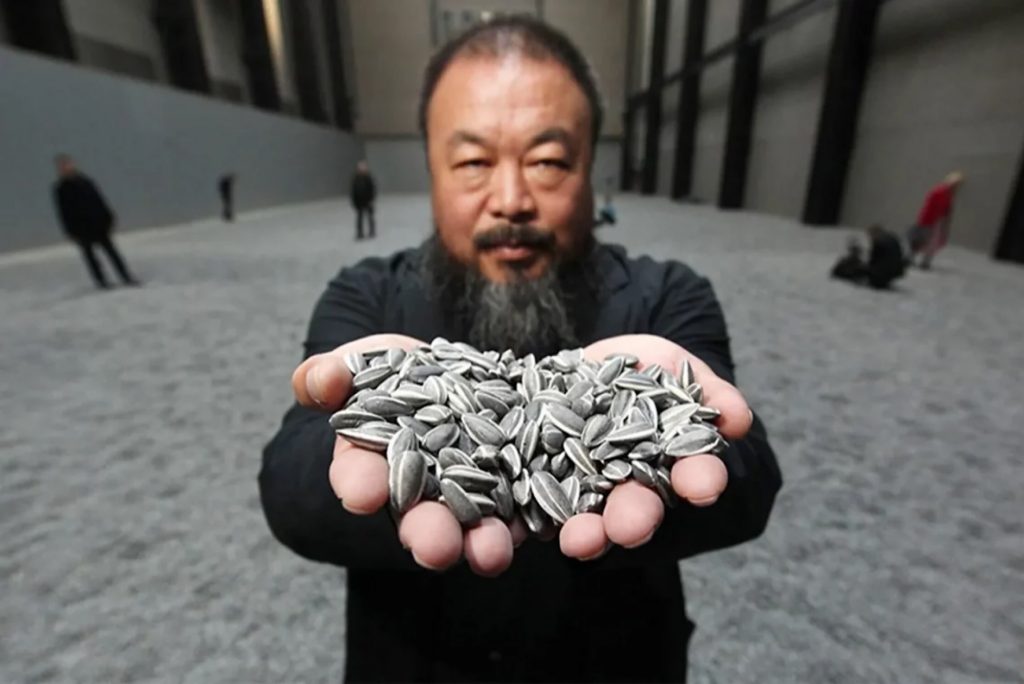
100 Million Sunflower Seeds: The Individual in the Mass
One of his most powerful images remains the Turbine Hall at Tate Modern, covered with 100 million porcelain sunflower seeds. Each of these was handcrafted and painted by artisans in Jingdezhen, the historic porcelain capital.
A titanic work, therefore, symbolizing the strength of the individual within the mass: each seed is unique, yet lost in an apparently indistinguishable gray ocean, it becomes a perfect metaphor for contemporary China—and globalization—where large-scale production hides, beneath the numbers, the artisanal gesture and the sacred value of each individual.
81 Days of Silence and the Cell as an Atelier
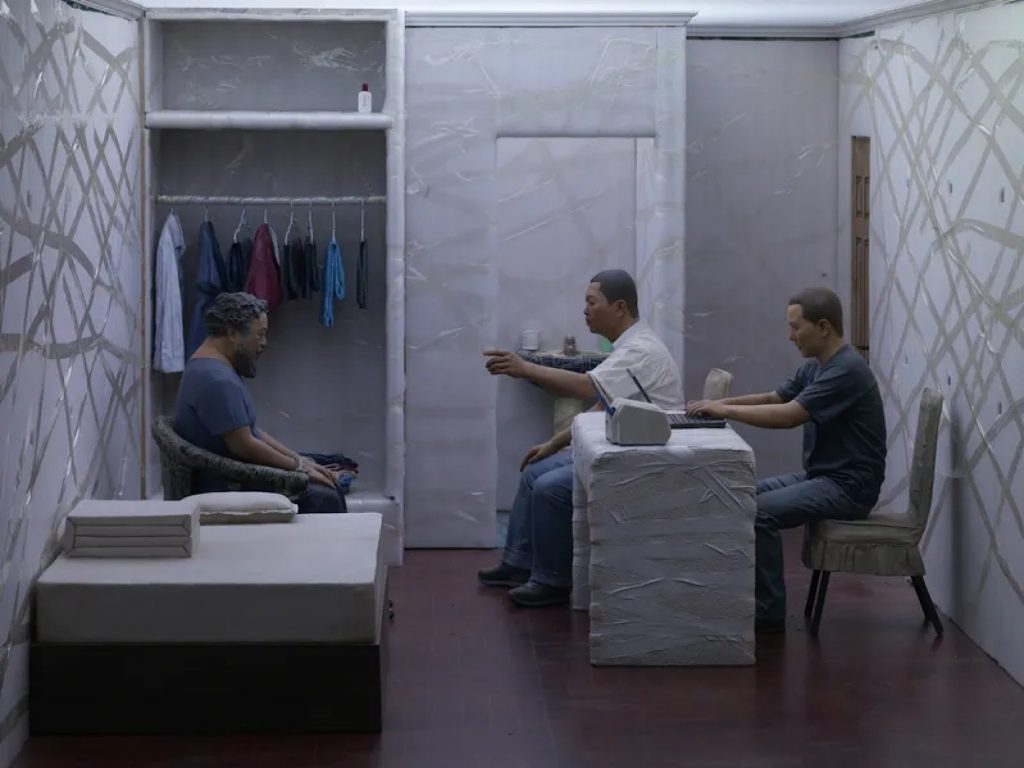
In 2011, Ai Weiwei vanished. He was taken by police at Beijing airport and held in secret detention for 81 days, under 24-hour surveillance by two guards who were not even permitted to speak to him.
For Ai Weiwei, this highly traumatic experience became a mental archive. Once free, he meticulously reconstructed that cell to scale. The resulting work, S.A.C.R.E.D., forces the viewer to look through the keyhole into the violated intimacy of a man who, even stripped of his freedom, remains more imposing than his captors.
LEGOs and the Democracy of the Brick
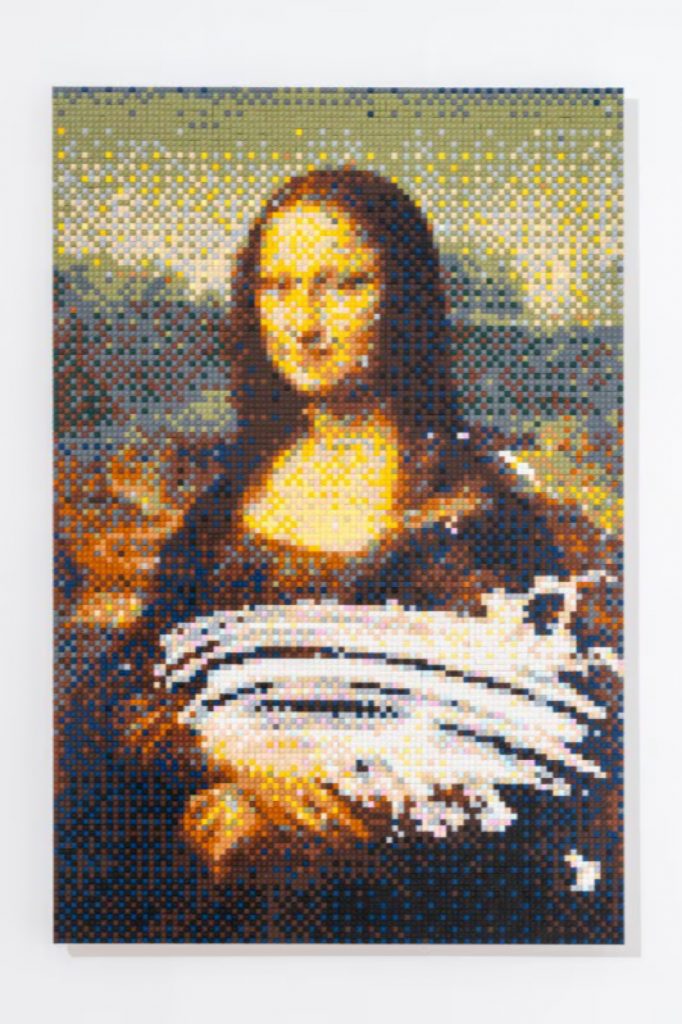
Ai Weiwei’s LEGO brick artworks have become some of the most internationally recognized icons of his artistic practice. But what is the meaning behind these colorful bricks? For Weiwei, they are “physical pixels,” easy to assemble and impossible to censor individually.
When the company refused to sell him bricks for an exhibition on dissidents, fearing economic repercussions from Beijing, fans from around the world began sending him boxes of used pieces.
With these colorful bricks, Weiwei creates enormous carpets and portraits of political prisoners and activists—art that appears like a game but speaks of human rights, using a democratic and universal language that anyone can reconstruct.