
Drawing inspiration from Susan Sontag’s assertion that silence is the artist’s ultimate otherworldly gesture, liberating them from worldly constraints, Palazzo Collicola in Spoleto presents a new exhibition cycle. This cycle delves into the fragments of sanctity and silence within contemporary art, fostering new forms of connection, distant temporalities, and oppositional narratives. This exploration of proximity and silence, ascending through the levels of Palazzo Collicola, begins with the group exhibition on the lower floor, “Minor Life. Saint Francis and the Sanctity of Contemporary Art.” Curated by Gianni and Giuseppe Garrera, it offers a profound reinterpretation of Saint Francis of Assisi in the present day.
Coinciding with the eighth centenary of the Saint’s death, the exhibition traces the militant practices of Franciscanism—aligned with anti-class, anti-militarist, and feminist struggles—through a series of “luminous fragments” distributed across various theoretical sections of the interconnected rooms.
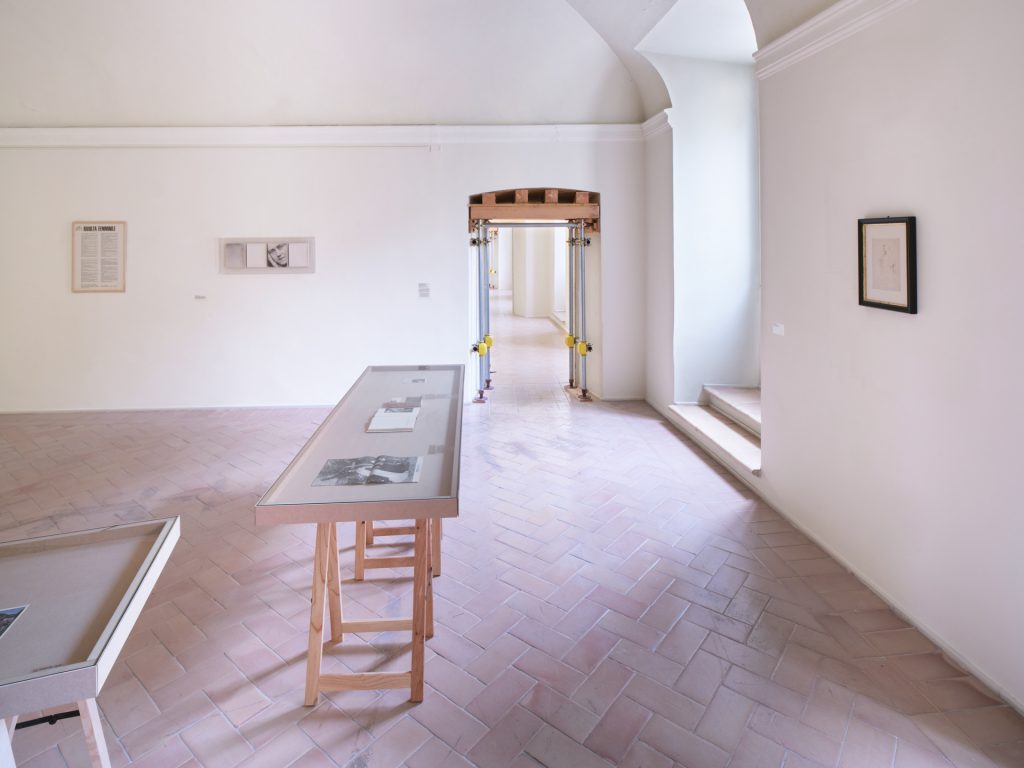
Beginning with the concept of minority, in contrast to the exercise of power, the exhibition opens with Antonio Del Donno’s Gospels, twelve wooden panels inscribed with phrases from sacred scriptures. The entrance is marked by a moral imperative—”Do not conform to this world, but be transformed by the renewal of your mind”—clearly evoking the curatorial approach, directing attention towards outsider, dissident, precarious, and minor existences.
The exhibition route unfolds through internal shifts, where artworks selected from the curators’ private collections—in dialogue with loans and site-specific creations—open spaces for contemplation and the generation of vital alternatives. Some of these layers include the “unconditional condemnation of all money and its use” or the “praise of illiteracy.” At a point where John Cage’s Empty Words serves as an auditory link between distinct practices aimed at the destruction of writing and the exaltation of scribbling. Cage’s work, employing vocal dimensions with nonsense derivations, embodies a desire: the demilitarization of language as a tool of oppression.
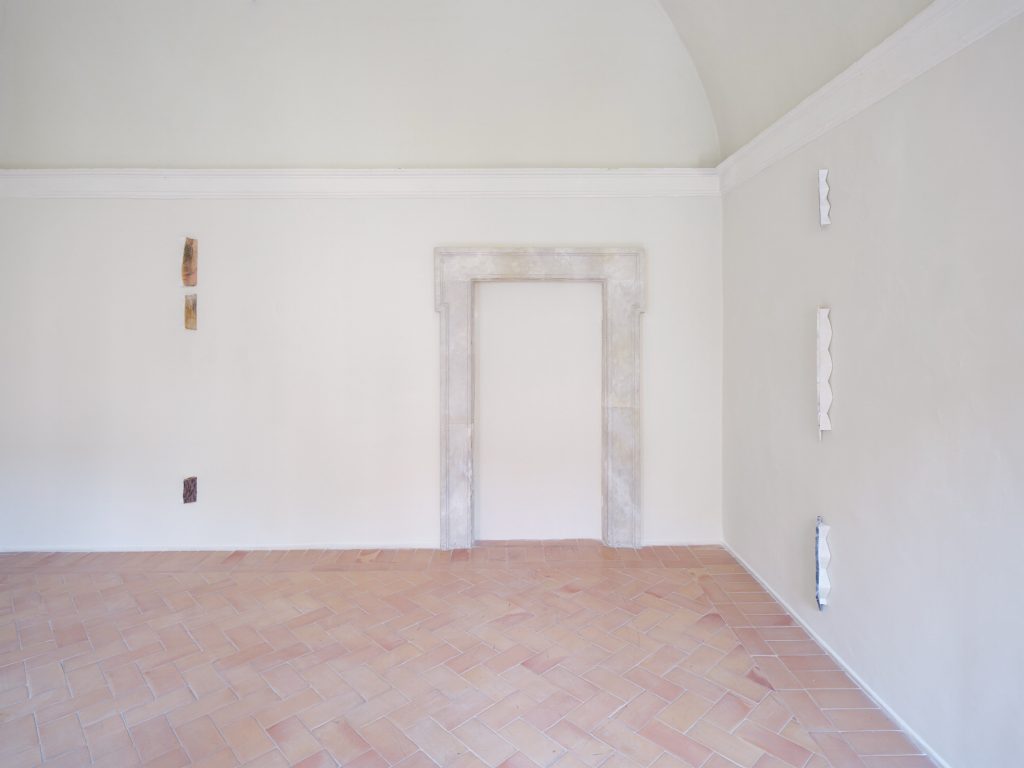
From a Western perspective, language also marks the rupture in our relationship with other animals, whose perceived “inferiority” stems from their lack of speech. Franciscanism inverts this hierarchy by shifting its preaching from humans to animal otherness. Revered creatures are integrated into the artworks; examples include spiders to whom Tomás Saraceno grants authorship, or Jannis Kounellis’s 12 horses exhibited at the Attico in Rome (works from different places and times that warrant further post-anthropocentric examination). Gino De Dominicis, a perpetrator of miracles featured in the exhibition, also fits into this discourse of human exclusion. For his 1975 solo exhibition in Pescara, he exclusively invited animals to enter.
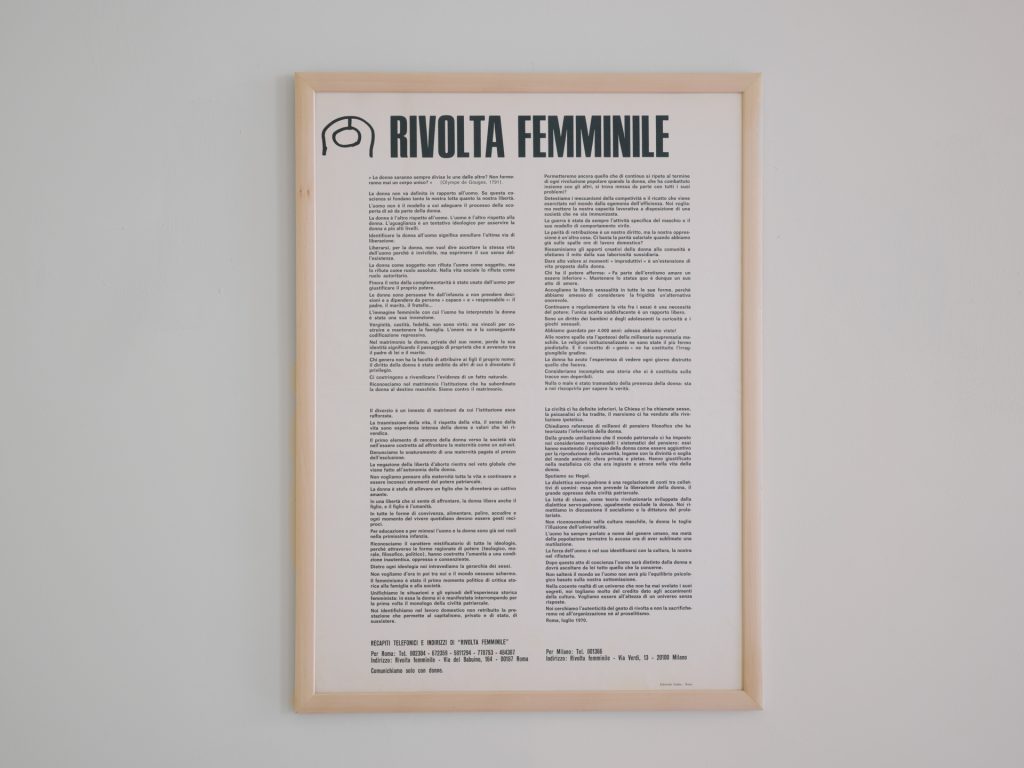
A significant thematic section is dedicated to the figure of Saint Clare and the feminisms that permeate Franciscan thought. Her transformation in contemporary times is absorbed by Carla Lonzi, an art historian and separatist feminist activist, co-signatory with other women of the Rivolta Femminile Manifesto. Lonzi, in turn connected to Thérèse of Lisieux, used a stratagem to incorporate the Saint’s face on the cover of the first edition of her Self-Portrait. The exhibition highlights the identity needs of this process of feminist recognition and self-awareness, made possible by Giulio Paolini’s involvement in creating a work containing the portrait. This piece, by achieving artistic status, was eventually accepted by the book’s publisher, albeit only in a reprint several years later.
In a hybrid and contaminated zone, Franco Troiani’s entire research develops, permeated by intrusive, liturgical, and rural presences. In Agraria, curated by Saverio Verini and hosted in the Noble Floor, these elements are condensed through a targeted selection of the artist’s works. Troiani is connected to the Spoleto region and has always forged many connections with other artists, from Sol LeWitt—already present in the local context—to his personal derivations in the Futurist or Abstract styles. His imagery is guided by a pure syncretism rooted in a genuinely ecological process. Following this principle, the agrarian component becomes significant in its most spiritual and primordial sense, as reuse and circularity correspond to the emergence of new forms of life. Wood, polished or painted a bright green—as in the case of The Battle of San Romano (after Paolo Uccello)—is sometimes exhibited as a frame, transforms into the body of a saint, becomes architecture, or a magic staff for travelers passing through the woods. Everything is anchored to the earth, and to the earth it cyclically returns.
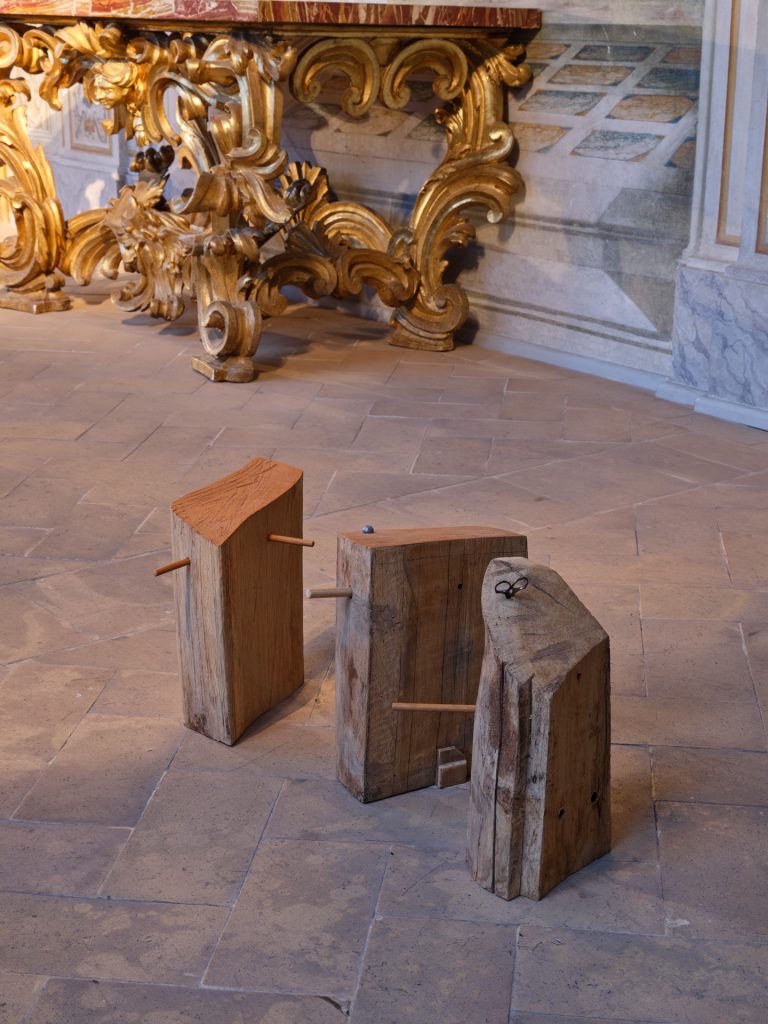
Like Troiani, Berry Flanagan was born in the first half of the 1940s and developed his practice in London. Sculpture Speaks Louder Than Words, a retrospective dedicated to him and curated by Jo Melvin, is, in continuity with the other exhibitions, a sensory, intimate, and suspended experience. Approaching Flanagan’s works means entering into a one-to-one relationship with heterogeneous bodies—textile, light, sandy, lustrous—that take on the guise of otherworldly, post-organic entities capable of “speaking” directly to the observer.
Following plural trajectories, these fragments reverberate throughout the presented research, traversing the museum’s eighteenth-century architecture. In doing so, they produce porous residues, guided by the relentless impulse to discover and actualize counter-hegemonic and silent modes of existence.