

Artist Robert Barry famously stated, “I use words because they speak out to the viewer. Words come from us. We can relate to them. they bridge the gap between the viewer and the piece.” This quote highlights his profound connection to language as an artistic medium.
Words like “Remind,” “Wonder,” “Somehow,” “Hidden,” “Another,” “Urgent,” and “Believe,” “Familiar,” “Conflict,” “Intimate” adorn the walls of Galleria Alfonso Artiaco. The gallery, which relocated late last year from Piazzetta Nilo to Piazza dei Martiri—a vibrant hub for Neapolitan contemporary art—is currently hosting “Another Time.” This sixth solo exhibition with the gallery features the work of New York artist Robert Barry, who recently celebrated his 90th birthday, and runs until May 2nd.
Robert Barry: The Versatility of Words
The exhibition traces Barry’s minimalist and conceptual artistic journey, which began with his experimental phase in the 1960s. By the late 1970s and especially throughout the 1980s, language emerged as the definitive expressive form that would characterize his entire body of work.
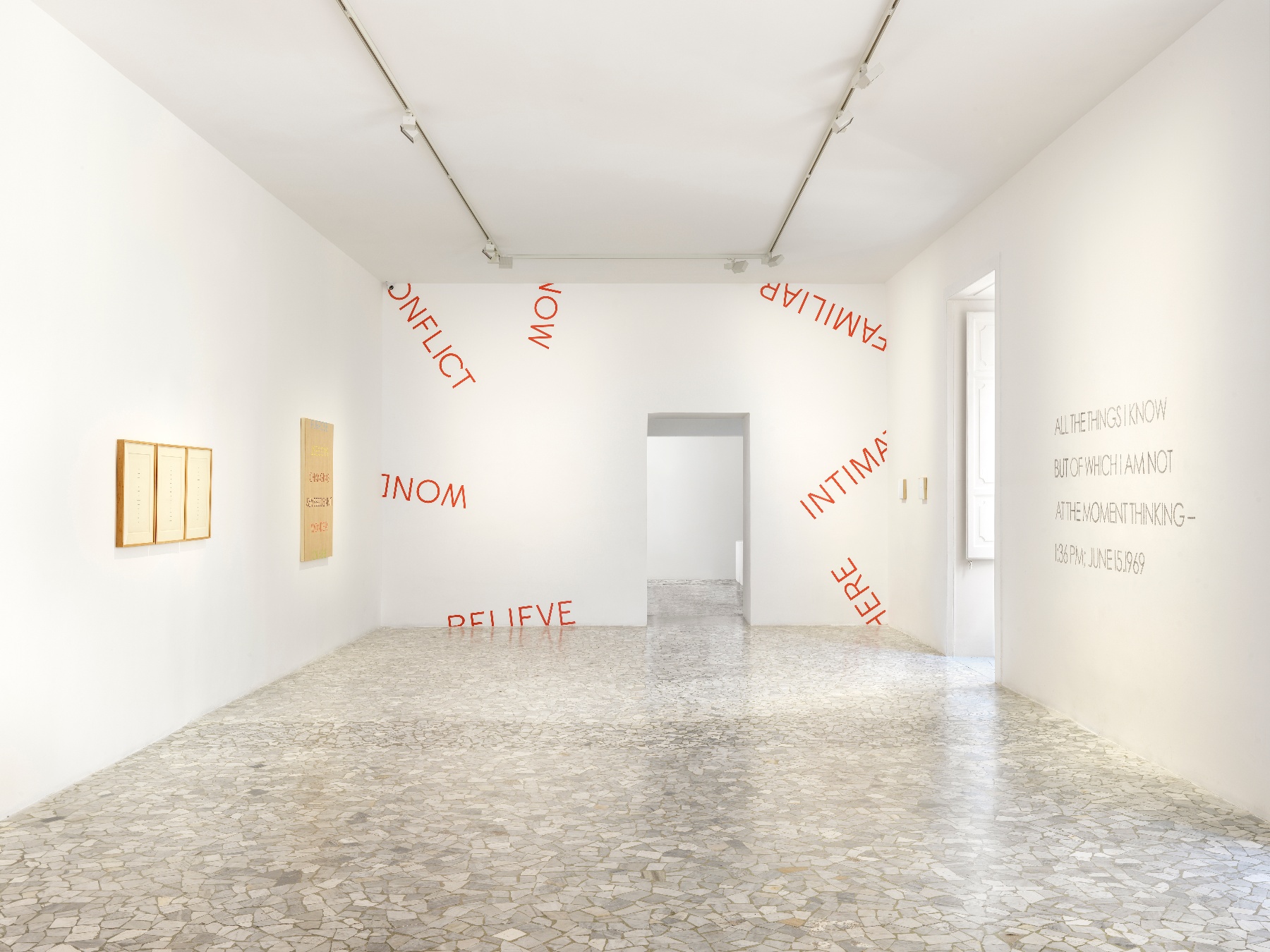
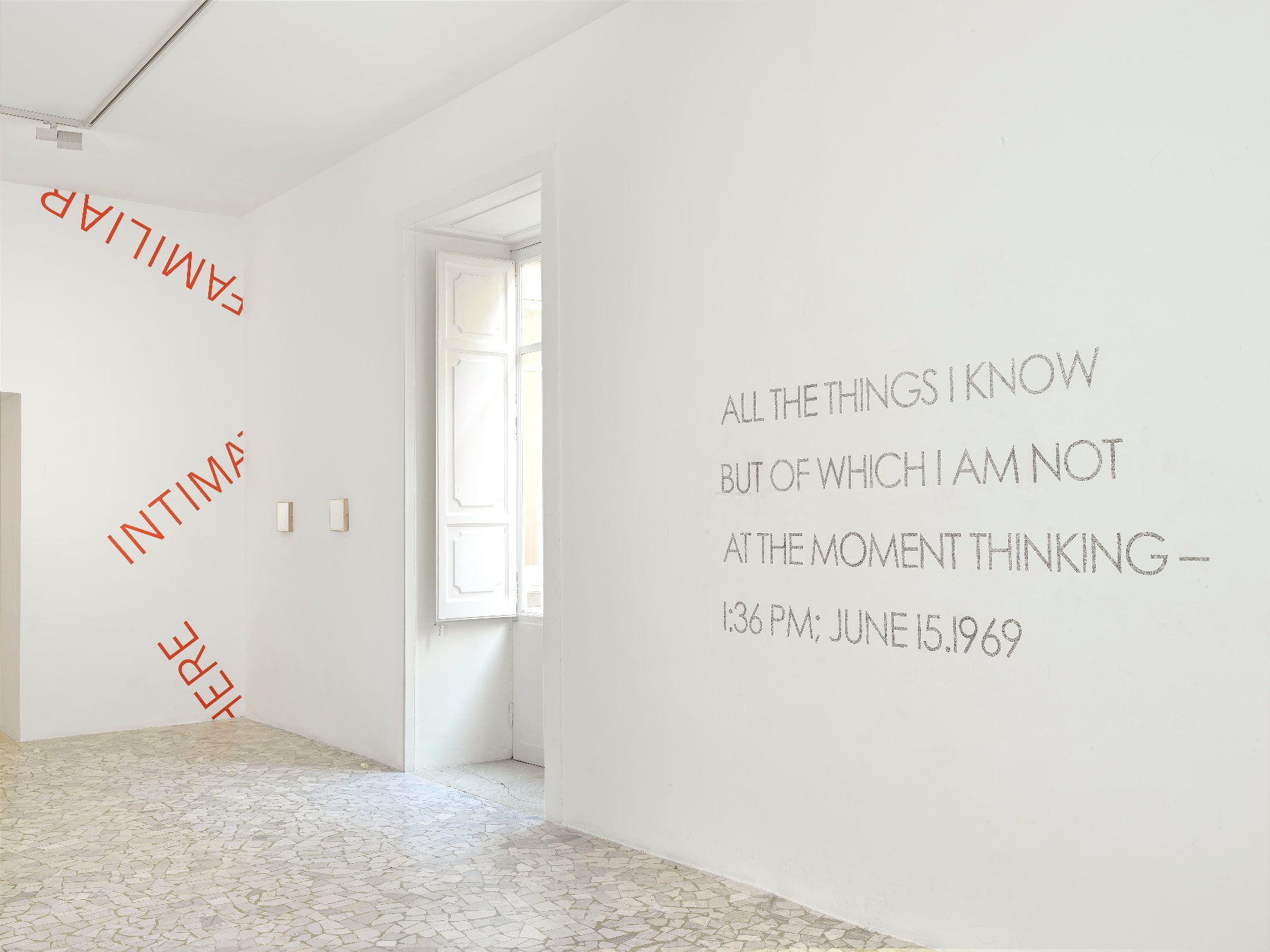
The installation “Untitled,” created specifically for this exhibition, echoes the “Untitled Ceiling Installation for the Madre Museum” from 2013, sharing similar intentions and, in part, formats. Here, too, the museum-scale room allows for a play of contrasting words across two distant, opposing walls. However, unlike the earlier version where words tended to overlap, in this current piece, words like “Somewere” (sic) or “Wonder” vividly emerge or recede on the back wall as one enters the gallery. On the opposite wall, other words, rendered in red, are only partially visible but can be mentally completed despite their truncation, as seen with “Conflict.”
Barry’s enduring versatility in employing conceptual art through his installations underscores how language remains a profoundly powerful communication tool, cyclically adapting to the era in which it is manipulated.
Interspersed among the various “Untitled” works are a series of Barry’s pieces that transform “Another Time” into a comprehensive retrospective. These range from his historical 1969 work, created for “557,087”—the inaugural concept art exhibition organized by Lucy Lippard at the Seattle Art Museum Pavilion—to more recent “Untitled” series. In some, tone-on-tone words are barely legible against the light, while in others, colorful words are arranged in diverse orientations across the surface.
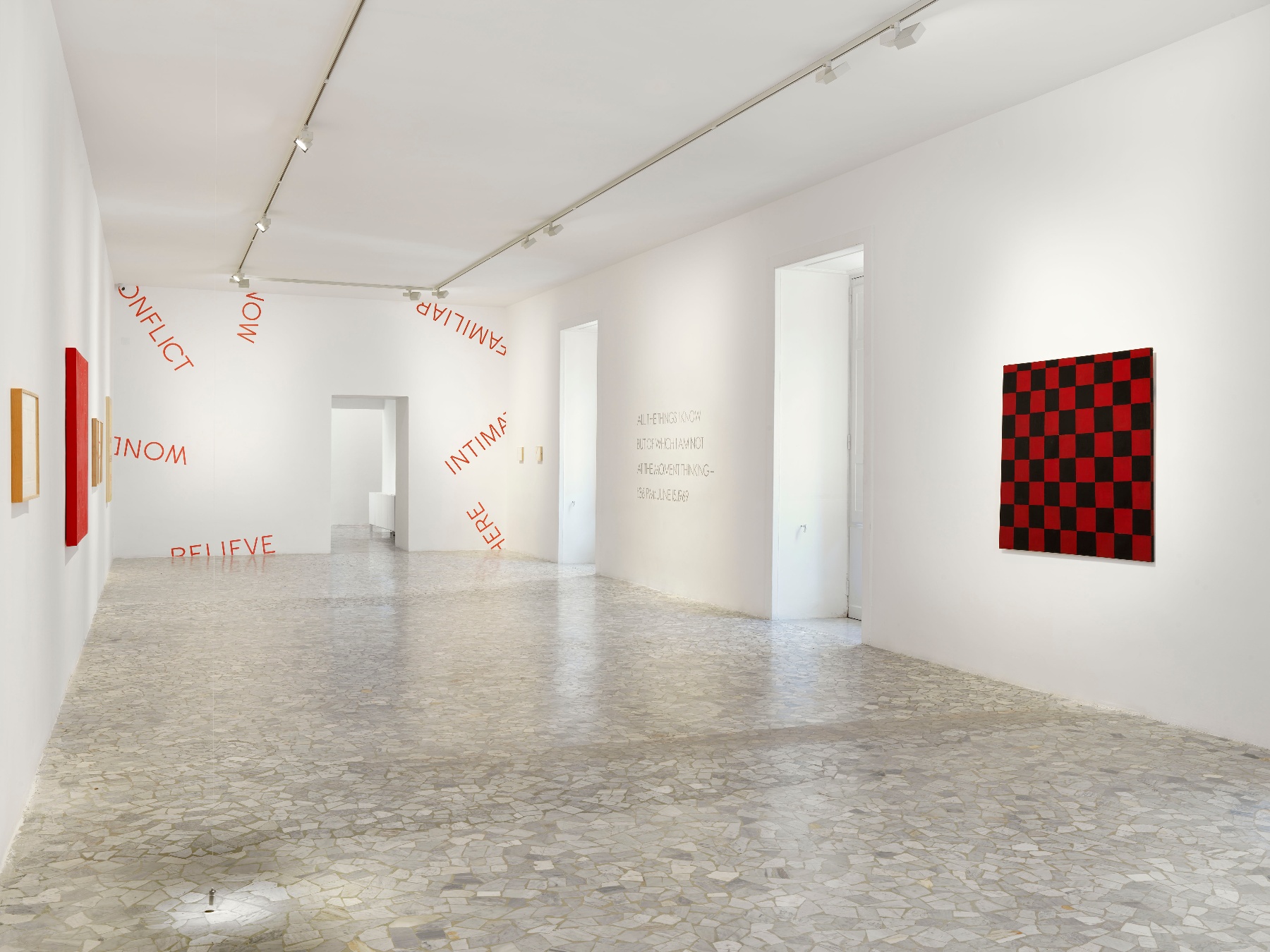
This “play on words” reveals how individual space communicates with collective space through a dynamic perceptual exchange that blends semantic distances and proximities. Barry skillfully utilizes space and void within his installations to forge new relationships between the artworks, perceptible as both visual and internal reverberations. These echoes resonate with his own words from June 1969: “ALL THE THINGS I KNOW BUT OF WHICH I AM NOT AT THE MOMENT THINKING.”
Glen Rubsamen’s Suspended Landscapes
In the more intimate room of Galleria Artiaco, an exhibition by Glen Rubsamen, titled “Sorry, Wrong Number,” presents a series of views from his hometown of Los Angeles. While these images depict a contemporary urban landscape that should feel familiar, they evoke a sense of disorientation, as if one is encountering a world that is uninhabited but not abandoned.
Rubsamen’s paintings, characterized by their typical photographic cropping, feature two main protagonists: on one side, a sunset-tinged landscape, perpetually shadowed and enveloped in a twilight glow that creates an almost artificial tension; on the other, assertive billboards that seem to convey messages far beyond simple advertisement.
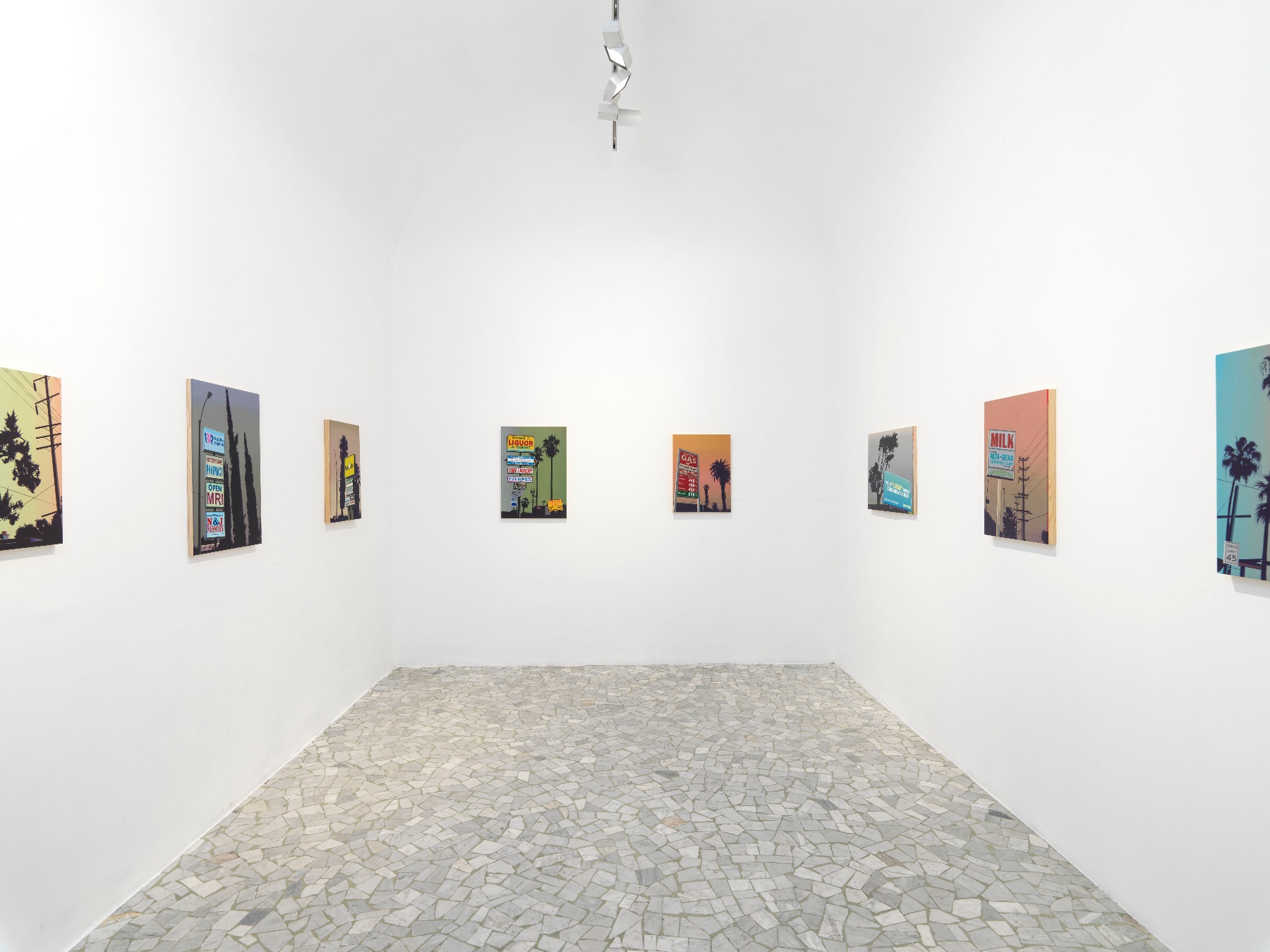
Initially, phrases like “Your ‘logo’ would look great on here” and colorful signs advertising milk, liquor, and gas, featuring sequences of numbers and large, blocky characters that fill the entire advertising space, might seem innocuous. However, they gradually reveal a dominant, somewhat intimidating nature. The viewer’s low vantage point, from which these signs are read, further suggests a position of subjugation or, at the very least, media control that charmingly monopolizes not only the available physical space but also the individually perceived space.
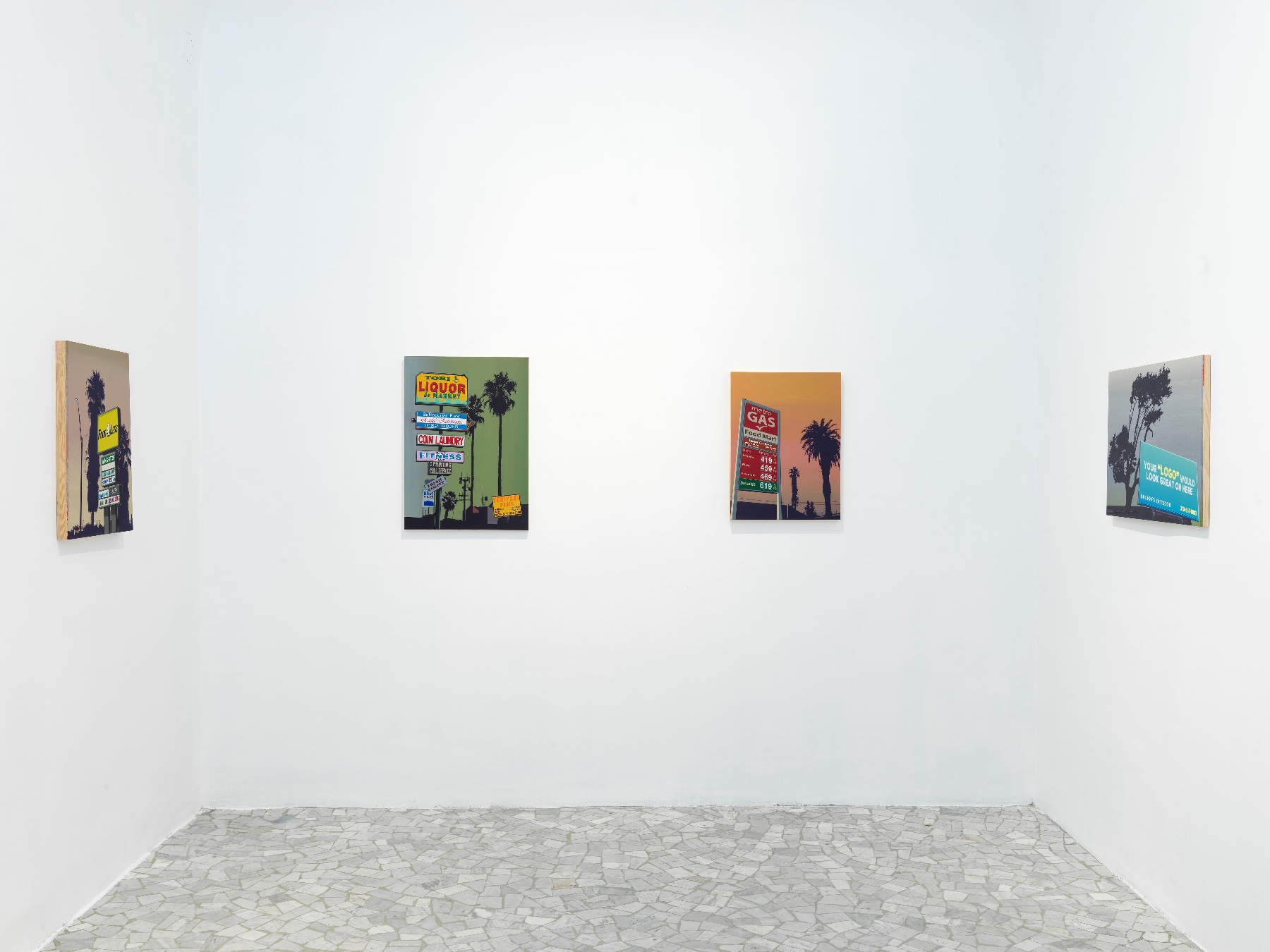
Through this finely ironic series, Rubsamen once again masterfully instills doubt about the intentions of an increasingly intrusive society. He spotlights subtle details that encourage viewers to move beyond a passive interpretation of reality.