

In Venice, the Satine exhibition space unfolds like a small jewel box, its walls, rather than velvet, exuding the industrial warmth of plywood. It’s an intimate setting, naturally suited for equally intimate exhibitions. However, in the lagoon city, size often proves irrelevant, as demonstrated by independent venues like Panorama and Aarduork, nestled within the intricate labyrinth of calli, as well as commercial galleries such as Mare Karina, known for the high quality of their projects.
Satine gallery, which opened its doors here last May, perfectly embodies this Venetian tradition, presenting intimate, meticulously curated exhibitions that effectively carve out a niche in the city’s crowded artistic calendar. This was particularly evident during our visit to “Bugie” (Lies), the solo exhibition by Roman artist and designer Valentina Cameranesi Sgroi, complemented by a critical text from Anna Franceschini.
The exhibition is a kaleidoscope of deceptive surfaces and seductive objects, a true succession of visual “lies.” Immediately striking is the screen-gate positioned at the center of the space, a piece that, like many of the works displayed, evokes the eccentricities of Lewis Carroll’s Mad Hatter’s house. Here, copper visually transforms into cardboard as it climbs and folds over its metallic support structure, creating an elegant, polished short-circuit that reappears throughout the exhibition. This material instability, far beyond a simple formal game, introduces a subtle perceptual fracture: what we see never entirely aligns with what it truly is.
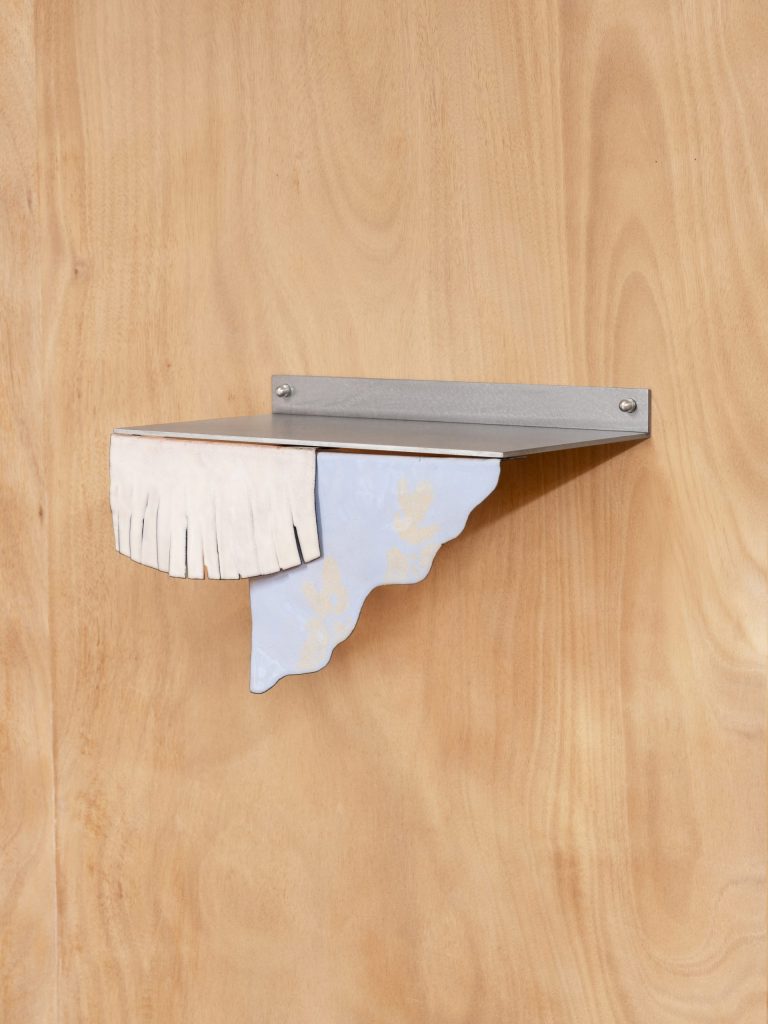
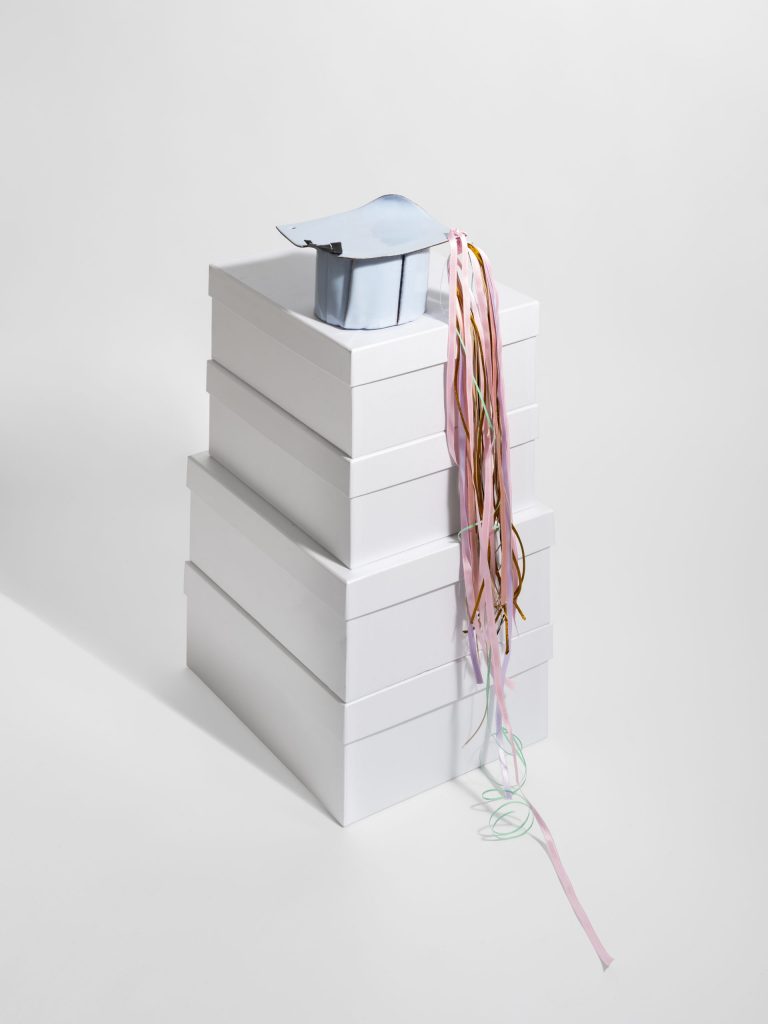
Exemplifying this are her copper side tables, with long, slender legs and pastel-colored enamel surfaces that, during firing, retain the faded motif of a silk scarf. Similarly, a copper shelf cracks as if it were ceramic; a small, sky-blue sculpture, perched atop a tower of boxes, unfurls a cascade of viscose ribbons; and glass ribbons alongside a crystalline glass appear more like a freshly bloomed rose than a functional drinking vessel. In the works presented by Satine, every element seems to betray its primary function, or rather, to suspend it, leaving it in a state of delightful ambiguity.
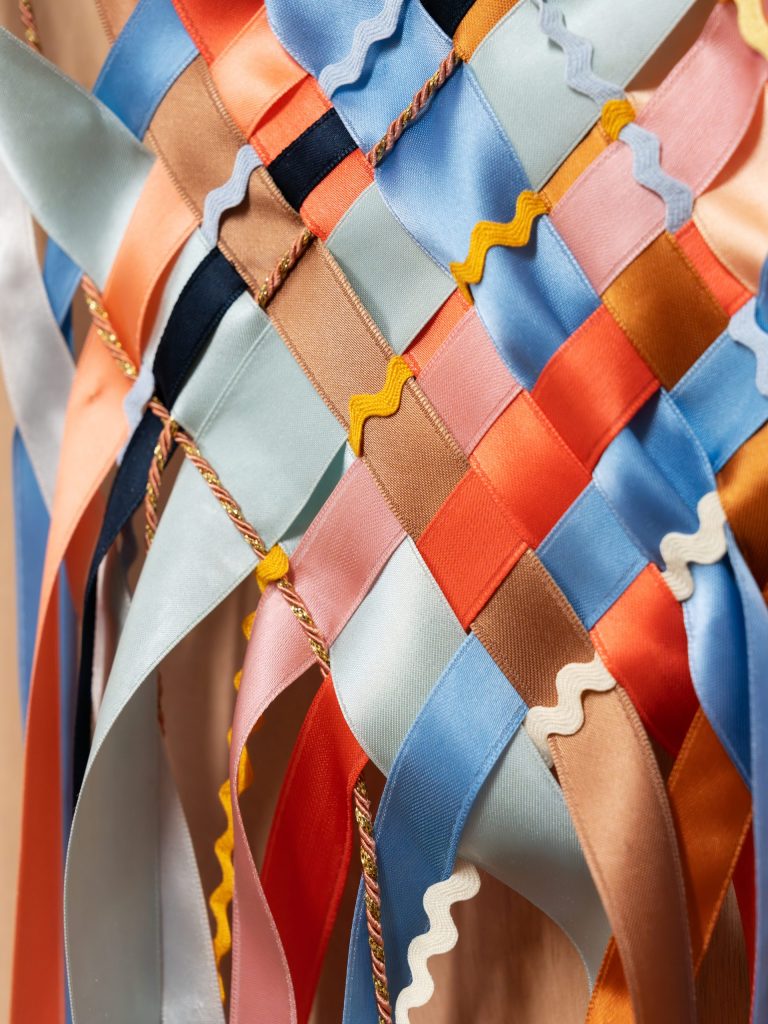
Also part of this grammar of deception is an intricate weave of satin ribbons, which Cameranesi skillfully arranged into dense, irregular patterns that, from a distance, evoke both fine weaving and a kind of soft armor. Pastel hues—shades of blue, pink, orange—alternate with darker inserts, while small, undulating elements seem to insinuate themselves among the bands like subtle interferences.
To fully grasp this collection of elegant illusions, a quote by Fleur Jaeggy, suggested by the artist and included in Anna Franceschini’s text, comes to our aid: “The future was gates opening and walls becoming carpets.” This reveals a dialectic of continuous change, where every material can transform into something else right before our eyes or beneath our touch. But there’s more: within this incessant metamorphosis, the spectator is also called to renegotiate their own position; merely looking is no longer enough. One must doubt, approach, and personally verify that they haven’t been deceived.