


“Novelist, editor, essayist, television author, columnist, pamphleteer, professor – all at the highest levels, and all with maximum international resonance. I have never known an intellectual of such breadth.” This definition by Elisabetta Sgarbi, with whom Eco co-founded the publishing house La Nave di Teseo, provides an effective starting point to revisit Umberto Eco, a decade after his passing, focusing on the relationship between his thought and art.
Placing art within the broader semiotic system of signs and their interpretation, Eco regarded it as a cultural mechanism that generates meaning. This perspective originated partly from his study of Thomas Aquinas, who viewed reality as a network of symbolic references, and evolved into a general theory of culture as a system of codes, where images, languages, and artistic forms actively construct meaning. Within this framework lies his seminal work, Opera aperta (An Open Work), published in 1962 amidst the post-World War II transformations in the arts. The book addressed a precise question: why do many contemporary artworks seem to demand active engagement from the audience for comprehension? Eco responded by demonstrating how such works are structured to allow for a plurality of interpretive pathways.
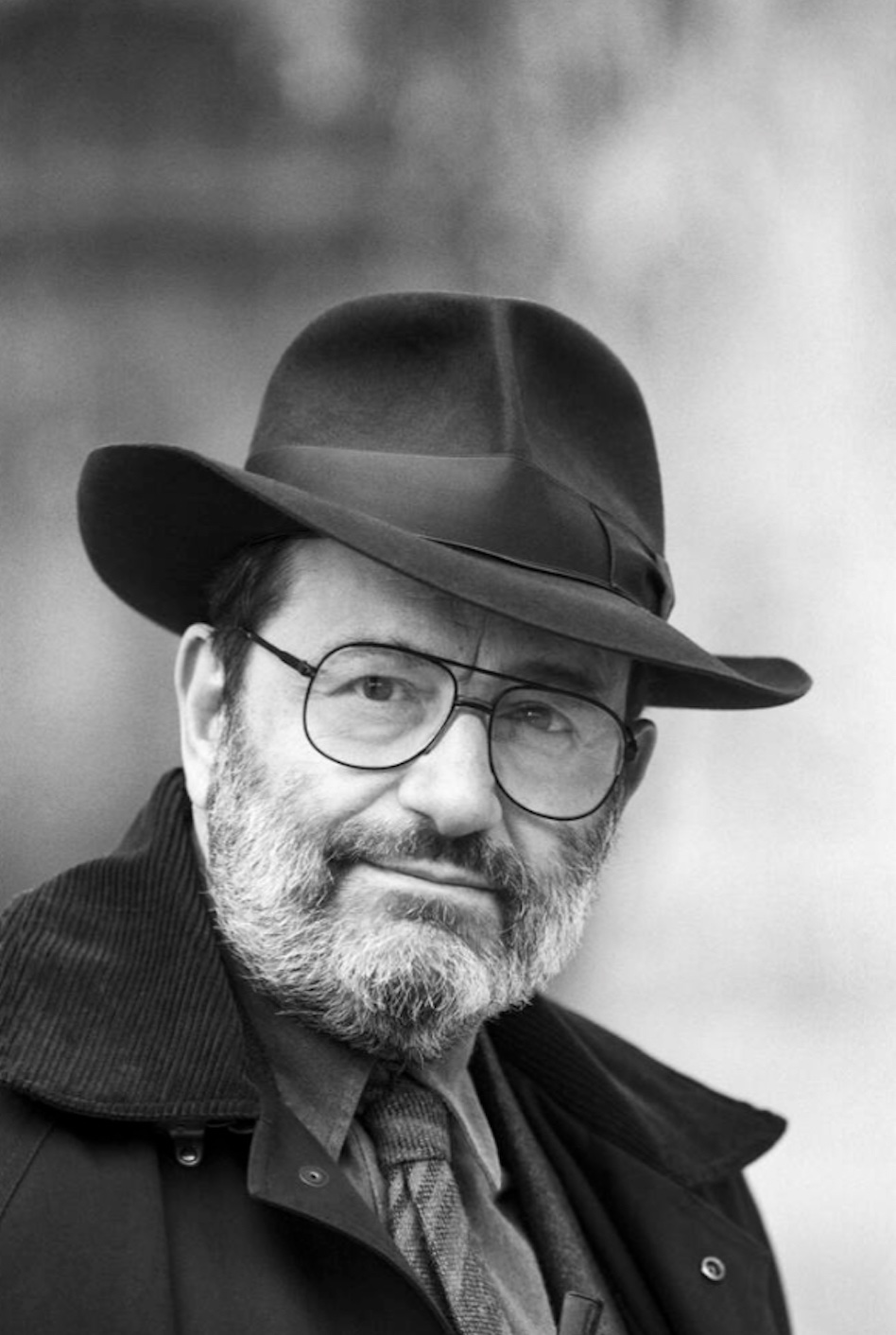
The most direct theoretical reference in this discussion is Luigi Pareyson, who had already posited the interpretive nature of artistic experience. Eco built upon Pareyson’s ideas, reformulating the problem in more analytical terms by shifting focus to the work’s structure and the active role of the interpreter, who must select, connect, and organize available elements to construct a possible meaning – an approach that is now essential for contemporary art. The main consequence concerns the spectator’s position: in the “open work,” they cease to be passive recipients and assume an active function, participating in the process of signification. This participation does not imply a loss of the work’s formal coherence, as it remains precisely designed by the author yet predisposed to be explored via diverse paths. Looking at performance art practices, which began to emerge in the 1960s, the Piedmontese philosopher’s interpretation appears as an extremely lucid precursor, allowing these experiences to be understood as artistic forms constructed to activate the public within a structure that remains defined but finds its completion only through the interaction and interpretive choices of those who participate.
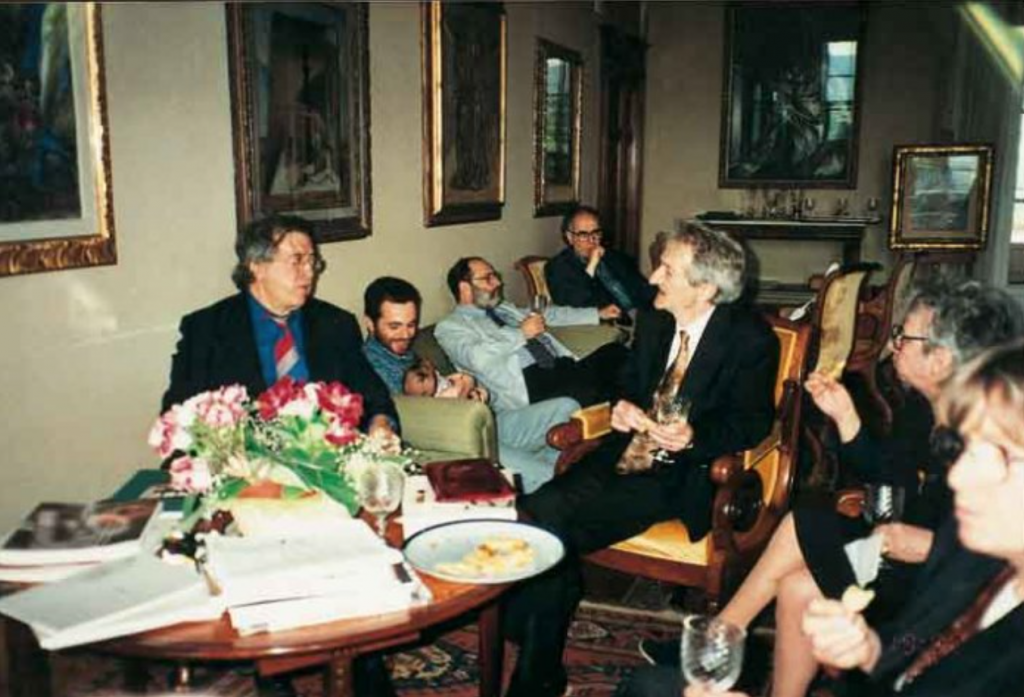
With a remarkably modern approach, as described by Roberto Cotroneo, Eco identified concrete examples of this dynamic in the avant-garde movements as early as the 1960s, particularly in the music of Luciano Berio and Karlheinz Stockhausen. Their compositions introduced margins of indeterminacy that demanded interpretive collaboration from the listener, revealing a more general shift in how art constructs and transmits meaning. This perspective directly connects to the development of semiotics, a discipline Eco helped define in the 1960s and 1970s, partly through his engagement with Charles Sanders Peirce. From Peirce, Eco adopted the idea of a potentially infinite interpretation, re-elaborating it into the notion of “unlimited semiosis,” where every sign refers to other signs without ever definitively exhausting its meaning.
In this sense, Eco’s aesthetics resided between two poles: on one side, the medieval tradition associating beauty with order, proportion, and clarity; on the other, contemporary artistic practices introducing ambiguity and multiplicity of meanings. He constantly sought to hold these elements together without reducing them to a simplified synthesis. Ten years after his passing, Eco’s contribution to the art debate retains a relevant interpretive function regarding the definition of the audience’s role and the understanding of the artwork as an open structure. It is a device that generates meaning through interaction with the observer, within a broader cultural network that continues to foster new readings and connections.