Zandomeneghi and Degas: Modernity as Dialogue – The Exhibition at Palazzo Roverella
An exhibition at Palazzo Roverella in Rovigo, running until June 28, 2026, delves into the pivotal relationship between Federico Zandomeneghi and Edgar Degas. This groundbreaking show systematically compares their artistic journeys, highlighting a personal connection, at times rough but intellectually rich, set against a period where art evolved through close interactions, creative tensions, and shared perspectives.
Curated by Francesca Dini, the exhibition traces their mutual influences and formal connections, using their Parisian friendship as a lens to examine a period of intense cultural transformation. It contrasts Degas, a pivotal and independent figure in the French scene, often critical of Impressionist simplifications, with Zandomeneghi, a Venetian expatriate in Paris who absorbed modern lessons while preserving his unique style, informed by Italian chromatic traditions. Their shared objective was a painting rooted in the present, reinterpreting composition, gesture, and urban existence through daily observation.
The exhibition begins its narrative in Florence, a crucial hub for both artists, though at different times. For Degas, his 1858 visit to the Caffè Michelangelo and interaction with the "Macchiaioli" painters proved significant, deepening his study of the Renaissance and sharpening his contemporary gaze. This phase is presented with notable loans, including a preparatory sketch for The Bellelli Family from Ordrupgaard, exhibited for the first time in Italy, alongside portraits of Thérèse and Hilaire de Gas from the Musée d’Orsay, and a collection of Macchiaioli works by Odoardo Borrani, Giovanni Fattori, and Giovanni Boldini. This segment illustrates a dynamic milieu, characterized by intricate relationships and unconventional learning processes, where the lines between national schools were far less rigid than often depicted.
The second section focuses on Zandomeneghi's formative years in Italy and his connections with artists like Giuseppe Abbati and Vincenzo Cabianca. This was a crucial period where he developed his approach to "reality painting," showing a strong sensitivity to humble subjects, prior to his definitive relocation to Paris. The exhibition underscores his independent artistic development, portraying Zandomeneghi not as a student seeking validation in Paris but as an already mature artist. He infused the Impressionist environment with his distinct visual experience and a disciplined way of seeing.
The narrative truly comes alive in Paris. Immersed in the vibrant atmosphere of the Caffè Nouvelle Athènes, Zandomeneghi engaged with a network of artists including Mary Cassatt, Forain, Rouart, Raffaëlli, and Madame Bracquemond, intensifying his dialogue with Degas. This section effectively demonstrates how his proximity to the French master led to a process of selective assimilation. Works like In Bed or Le Moulin de la Galette illustrate his adoption of Degasian techniques—such as abrupt cropping, suspended time, and attention to figures caught in foreshortened poses—yet translated into a softer, more enveloping style, with a less stark construction of space and form.
The exhibition illustrates how their relationship transcended a mere master-student dynamic, evolving into a continuous artistic dialogue within an environment where experimentation was rarely purely individual. Discussions in cafés, shared exhibitions, and the presence of figures like Diego Martelli, who in 1878 once again served as a bridge between France and Italy, become integral to the narrative, documenting a particularly lively artistic climate.
In the sections dedicated to the 1880s, a fully mature Zandomeneghi emerges. Far from being a peripheral figure in Impressionism, the Venetian painter actively participated in that era, yet forged his own distinctive path. Subjects from modern life—women in domestic interiors, cafés, dressing rooms, and everyday relationships—became the canvas for a style attentive to atmosphere but still governed by a firm and measured sense of form. A comparison with Degas's works, ranging from dance scenes to the Little Fourteen-Year-Old Dancer on loan from the Albertinum in Dresden, reveals both their proximity and their divergence: where Degas tended towards a more analytical and sometimes restless tension, Zandomeneghi sought a different equilibrium, a continuity between the modernity of the subject and the composure of the vision.
Perhaps the most compelling aspect of the exhibition's final section is this progressive artistic autonomy. After 1886, the year of the last Impressionist exhibition, Zandomeneghi remained connected to that world but developed its principles into a more personal synthesis. His forms became more compact, his narratives more understated, and his compositions more harmonious. This evolution signifies a distinct way of engaging with modernity, less reliant on confrontation and more on the internal coherence of the image.
Through the lens of the Zandomeneghi and Degas relationship, the exhibition brings into focus a pivotal era when Florence and Paris, Italian tradition and French innovation, the Macchiaioli and Impressionism, were far more dynamically interconnected than art history, often segmented by schools and nationalities, has typically suggested. It also reasserts the idea that modernity, before solidifying into masterpieces, was fundamentally a fertile ground for human interaction: a tapestry of deep friendships and bitter rivalries, shared teachings and vigorous debates, which transformed painting into a collective space for inquiry.
Novedades — Society
La participación cultural: más allá de la mera asistencia, la necesidad de compartir el poder
```html La participación cultural: más allá de la mera asistencia, la necesidad de compartir el poder La participación se ha convertido en un término ubicuo, presente en convocatorias, proyectos europeos, programas culturales y planes de regeneración urbana. Se presenta como un
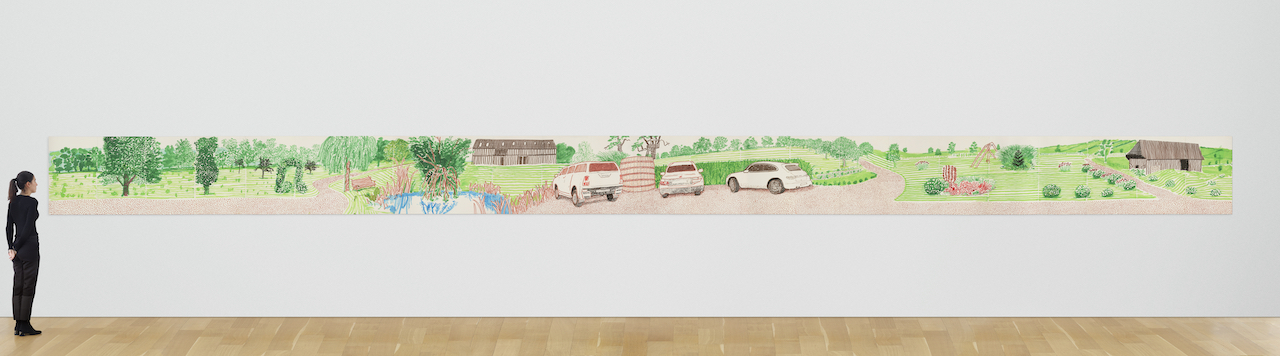
David Hockney's Monumental 12-Meter Print Heads to Christie's Auction
A truly unique lot is being offered by Christie's, available online from March 17 to 31, and on display at the major London galleries until March 31. This remarkable piece is one of David Hockney's largest creations, a staggering 12 meters long, printed on a single sheet of paper, and his most
El Greco Masterpiece Uncovered in Vatican: Hidden Under a Forgery
Art history is frequently punctuated by unexpected and serendipitous discoveries. Among these is the latest revelation from the Vatican Museums, where a routine conservation intervention has brought to light an authentic painting by El Greco, which had remained invisible for decades beneath a

Modena's Gate26A Hosts Aleksandr Nuss's Art: Where Matter Erodes and Light Reveals
Modena offers a serene escape from the vibrant chaos of nearby Bologna, presenting itself as an ordered and pristine city, a tranquil setting for everyday life. Within this calm environment, an independent space named Gate26A, founded by a collective of four individuals, injects a dynamic ener

Peggy Guggenheim's London Years: The Birth of a Collector in Venice Exhibition
Many are unaware of a crucial, often overlooked chapter in the life of Peggy Guggenheim, the visionary who transformed a palazzo on the Grand Canal into a bastion of modernism: her entrepreneurial venture with the Guggenheim Jeune gallery in London. The exhibition, Peggy Guggenheim in London: B
Selvatica 2026 in Biella: Art and Nature in Dialogue, Featuring Historical Authors and New Talents
The eleventh edition of Selvatica – Art and Nature in Festival, a biennial event held in Piazzo, Biella's historic district, has commenced and will run until July 19, 2026. The festival aims to foster a dialogue between artistic languages, scientific research, and educational practices to crea