Vermeer's Suspended Time: The Story of a Masterpiece at Palazzo Madama in Turin
Until June 29th, Palazzo Madama in Turin hosts an unmissable event: the exhibition of Johannes Vermeer's masterpiece, "Woman in Blue Reading a Letter," directly from the Rijksmuseum in Amsterdam. This exhibition, curated by Clelia Arnaldi di Balme, Anna La Ferla, and Giovanni Carlo Federico Villa, inaugurates the "Encounter with the Masterpiece" series, presenting works by great masters as conceptual windows open to dialogue with the present.
The painting depicts a pregnant woman completely absorbed in reading a letter, perhaps newly arrived. The scene is set indoors, where, true to Vermeer's style, light enters from a single external window, illuminating the subject. It is said that Vermeer preferred to paint his models always in the same studio, utilizing this consistent light to compose images characterized by minimal gestures and an intense, almost meditative, inner dimension.
In this work, the light takes on a delicate blue hue, which almost seems to emanate from the woman's garment, a blue jacket painted with the precious lapis lazuli pigment. Surrounding elements, such as books on the table and the 1621 map (by Willem Janszoon Blaeu from a drawing by Balthasar Florisz van Beckernrode), evoke an expanding world, suggesting travels and distant lands. The woman's total immersion in her action, her hands clasping the letter, and her slightly parted lips suggest a mix of tension and expectation, perhaps a quiet reading or a subtle surprise. A fold in the fabric of the chair behind her might indicate a sudden movement, perhaps a jump to grasp the message.
The painting creates an intriguing contrast: while the map and the letter refer to distances and external places, the pregnancy and the woman's intense concentration focus attention on a purely internal space and time. This intimate and personal dimension remains inaccessible to us, creating a double sense of distance—geographical and psychological—that sparks our curiosity with a charm composed of anticipation, magic, and profound intimacy.
The subtle dialectic between near and far, combined with the diffused light that evokes a mental or almost mystical space, recalls Walter Benjamin's definition of aura: "the unique apparition of a distance, however close it may be." A description that perfectly fits this painting. Furthermore, the way the folds of the woman's dress guide the gaze, inviting introspective reflection before expanding towards brighter tones, brings to mind Deleuze's analyses of the Baroque and the concept of the "fold," where the point of view oscillates between remote spaces and the deepest intimacy.
Today, handwritten letters are almost a memory, replaced by instant communications that, while effective, often lack the magic and aura of the past. Certainly, there's an abyss between the blue of Vermeer's rare pigments and the blue checkmarks of WhatsApp. Yet, contemporary humanity still recognizes that atmosphere of waiting and expectation that stimulates imagination, creating a secret and entirely interior space. This "atmosphere," understood as a space/time charged with emotion, allows Vermeer's painting to converse with today's sensibility as it did with that of his time, with the same sweetness and poetic force.
Novedades — Society
La participación cultural: más allá de la mera asistencia, la necesidad de compartir el poder
```html La participación cultural: más allá de la mera asistencia, la necesidad de compartir el poder La participación se ha convertido en un término ubicuo, presente en convocatorias, proyectos europeos, programas culturales y planes de regeneración urbana. Se presenta como un
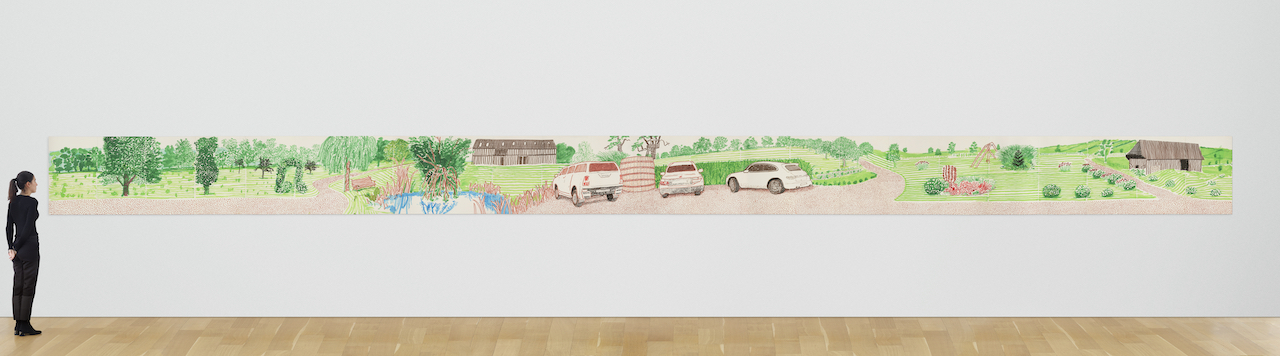
David Hockney's Monumental 12-Meter Print Heads to Christie's Auction
A truly unique lot is being offered by Christie's, available online from March 17 to 31, and on display at the major London galleries until March 31. This remarkable piece is one of David Hockney's largest creations, a staggering 12 meters long, printed on a single sheet of paper, and his most
El Greco Masterpiece Uncovered in Vatican: Hidden Under a Forgery
Art history is frequently punctuated by unexpected and serendipitous discoveries. Among these is the latest revelation from the Vatican Museums, where a routine conservation intervention has brought to light an authentic painting by El Greco, which had remained invisible for decades beneath a

Modena's Gate26A Hosts Aleksandr Nuss's Art: Where Matter Erodes and Light Reveals
Modena offers a serene escape from the vibrant chaos of nearby Bologna, presenting itself as an ordered and pristine city, a tranquil setting for everyday life. Within this calm environment, an independent space named Gate26A, founded by a collective of four individuals, injects a dynamic ener

Peggy Guggenheim's London Years: The Birth of a Collector in Venice Exhibition
Many are unaware of a crucial, often overlooked chapter in the life of Peggy Guggenheim, the visionary who transformed a palazzo on the Grand Canal into a bastion of modernism: her entrepreneurial venture with the Guggenheim Jeune gallery in London. The exhibition, Peggy Guggenheim in London: B
Selvatica 2026 in Biella: Art and Nature in Dialogue, Featuring Historical Authors and New Talents
The eleventh edition of Selvatica – Art and Nature in Festival, a biennial event held in Piazzo, Biella's historic district, has commenced and will run until July 19, 2026. The festival aims to foster a dialogue between artistic languages, scientific research, and educational practices to crea