The Sphinx's Smile: Federica Zuccheri's Sculptural Research at Villa Giulia
The National Etruscan Museum of Villa Giulia is "reaffirming a vision" – that of a dynamic, welcoming museum open to exchange and dialogue with contemporary languages. Listening to Luana Toniolo, Director of the National Etruscan Museum of Villa Giulia, one understands what it means today to direct a museum of Italian cultural and historical heritage, capable of fostering connections that create participation, inspire imitation, and encourage transversal dialogues, all while "questioning the profound relationship between the ancient and the contemporary."
The museum transforms into a "power station," a place to be experienced, not rigid or monotonous, but instead open to comparison, stimulating a safe haven for intellectual insights and exhibitions. These exhibitions, though diverse, are deeply connected by a spirit of welcoming contemporary art fermentation.
The exhibition The Sphinx's Smile, Federica Zuccheri's solo show, exemplifies a fortunate blend of intentions and talents. Set beneath the frescoed hemicycle of Villa Giulia—one of the most evocative spaces within the Renaissance complex commissioned by Pope Julius III between 1551 and 1553, designed by Jacopo Barozzi (il Vignola), Giorgio Vasari, and Bartolomeo Ammannati—the selection of works reflects the artist's research, where sculpture emerges as a complex, narrative, and symbolic language.
The exhibition, curated by Tiziano M. Todi, features ten sculptural works, chosen to create a focused and coherent journey. Crafted from precious materials like bronze, silver, stone inlays, and exquisite details, these pieces eschew mere ornamentation. Instead, they construct dense presences, seductive and unsettling figures that oscillate between grace and pain, light and shadow, attraction and unease.
This exhibition offers a re-evaluation of an artist whose work aligns with contemporary art's current openness to hybrid forms and explicitly diversified approaches, where the history of art is reinterpreted as a form of camouflage, becoming something else.
Zuccheri's practice demonstrates a breadth of perspective. Through support and form, material and surface, her works forge their own paths of invention, never abandoning their connection to art history, particularly the Baroque. It is lived experience that assembles these elements, inviting viewers to begin forming a vocabulary drawn from the known and the unknown. This emerges from a skillful mastery of her chosen medium and a solid understanding of the possibilities that arise when a material is shaped, deformed, and reinvented, continuously creating new associations with disparate influences.
In Zuccheri's work, myth is not a citation or a nostalgic refuge, but a tool for reactivating questions about the present. The artist's sculptures explore themes of desire, metamorphosis, vulnerability, seduction, and power, transforming them into images that transcend a single viewing. The elegant, refined, and often luminous form never diminishes the internal tension of the work; rather, it makes it even more apparent. It is precisely in this coexistence of beauty and disquiet that one of the most authentic traits of her research is recognized.
Bronze and silver, along with inlays and precious details, fully participate in the construction of meaning, transforming light into presence and revealing a mobile and iridescent quality of vision. The creation of these works involved the collaboration of Bottega Mortet, a historic Roman workshop, fostering a dialogue between artisanal expertise and contemporary design that imbues the sculptures with an extraordinary technical and material intensity.
The project stems from a shared dialogue between artistic research, curatorial vision, and exhibition execution, realized by Galleria Vittoria of Rome. This established entity has long supported the artist's journey, contributing to a continuous reflection on the relationship between classical language and contemporary sensibility.
Novedades — Society
La participación cultural: más allá de la mera asistencia, la necesidad de compartir el poder
```html La participación cultural: más allá de la mera asistencia, la necesidad de compartir el poder La participación se ha convertido en un término ubicuo, presente en convocatorias, proyectos europeos, programas culturales y planes de regeneración urbana. Se presenta como un
David Hockney's Monumental 12-Meter Print Heads to Christie's Auction
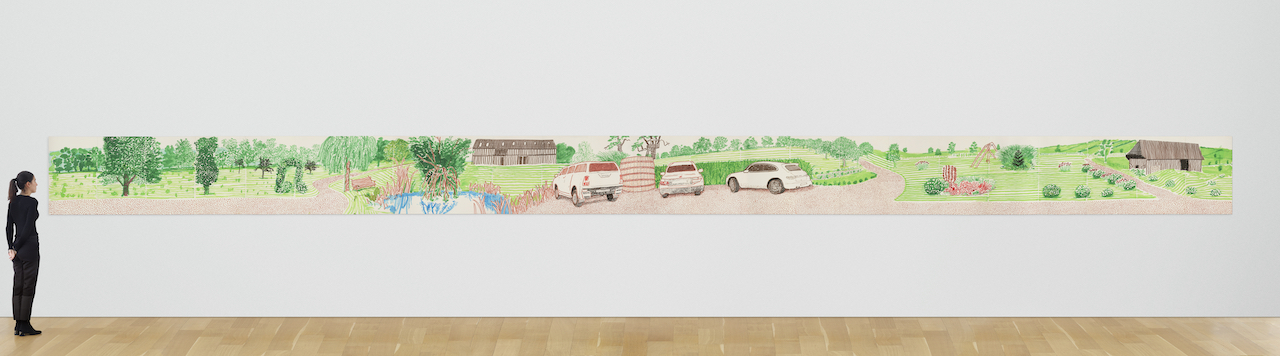
A truly unique lot is being offered by Christie's, available online from March 17 to 31, and on display at the major London galleries until March 31. This remarkable piece is one of David Hockney's largest creations, a staggering 12 meters long, printed on a single sheet of paper, and his most

El Greco Masterpiece Uncovered in Vatican: Hidden Under a Forgery
Art history is frequently punctuated by unexpected and serendipitous discoveries. Among these is the latest revelation from the Vatican Museums, where a routine conservation intervention has brought to light an authentic painting by El Greco, which had remained invisible for decades beneath a

Modena's Gate26A Hosts Aleksandr Nuss's Art: Where Matter Erodes and Light Reveals
Modena offers a serene escape from the vibrant chaos of nearby Bologna, presenting itself as an ordered and pristine city, a tranquil setting for everyday life. Within this calm environment, an independent space named Gate26A, founded by a collective of four individuals, injects a dynamic ener

Peggy Guggenheim's London Years: The Birth of a Collector in Venice Exhibition
Many are unaware of a crucial, often overlooked chapter in the life of Peggy Guggenheim, the visionary who transformed a palazzo on the Grand Canal into a bastion of modernism: her entrepreneurial venture with the Guggenheim Jeune gallery in London. The exhibition, Peggy Guggenheim in London: B
Selvatica 2026 in Biella: Art and Nature in Dialogue, Featuring Historical Authors and New Talents
The eleventh edition of Selvatica – Art and Nature in Festival, a biennial event held in Piazzo, Biella's historic district, has commenced and will run until July 19, 2026. The festival aims to foster a dialogue between artistic languages, scientific research, and educational practices to crea