The Price of Blue: How Much Did it Cost to Paint a Room in Pompeii?
Colors are never just hues; they are imbued with messages and history. For millennia, blue has been a highly esteemed color, conveying both a distinct aesthetic and a specific social status. A recent study published in npj Heritage Science investigated the economic value of Pompeii's “Celestial Room” – unearthed from the ashes in the summer of 2004 in the central region (Regio IX Insula 10) of the ancient Campanian city. Observing the Egyptian blue covering the room's walls, archaeologists immediately understood that this space was likely not a domestic area, but rather a *sacrarium*, a sanctuary dedicated to family rituals or the safekeeping of sacred objects.
But what was the cost of decorating an entire room in blue? The pigment used in this Pompeian space was exceptionally precious, being one of the oldest synthetic pigments in history. Though widely used in the Roman world, it was far from affordable.
The npj research specifically focuses on quantifying the economic value of this artistic commission. Estimates suggest that the pigment's cost significantly impacted the overall budget for the wall decoration. It's estimated that between 2.7 and 4.9 kg of Egyptian blue were applied using the fresco technique, amounting to a total cost of 93 to 168 denarii. These figures are comparable to a substantial portion of a Roman legionary's salary. The inquiry balances economic, historical, and, crucially, social aspects: it delves not only into how expensive blue was, but also *why* it was chosen despite its high cost.
The History of Egyptian Blue
Egyptian blue is not a natural pigment but the result of an artificial process combining silica, copper, calcium, and alkali, subjected to high temperatures. Its production demanded technical expertise, precise kiln control, and specific raw materials, with each step increasing the final product's cost.
Since prehistory, earth-bound colors were readily available. However, natural blue mineral pigments were extracted from hard-to-reach deposits, leading to higher costs. Characterized by considerable chemical instability, blue remained an extremely valuable color – its exact worth depending on the mineral source – at least until the 19th century, when industrialization enabled mass chemical production of dyes and pigments. It was precisely the challenges of sourcing and chemical instability that drove ancient civilizations to create artificial blue pigments, based on copper filings mixed with sand and potash.
According to texts by Theophrastus, Vitruvius, and Pliny the Elder, the first artificial blue pigment was Egyptian blue, named after the country where it was invented between 3200 and 3300 BCE. It was a copper calcium tetrasilicate, renowned for its stability and resistance to deterioration.
Its rediscovery occurred much later, in 1802, when French chemist Louis Jacques Thénard first isolated it from a fragment of Egyptian pottery, although its use continued through the Medieval and Renaissance periods. Laboratory reconstructions following its rediscovery suggest that the temperatures required for pigment production ranged between 850 and 950 degrees Celsius, with a firing time of approximately 24-48 hours.
This technical origin led to two consequences: variability, where even minor differences in the production process resulted in diverse chromatic outcomes due to the pigment being a heterogeneous, non-uniform mixture; and transmissibility, as the knowledge required for its production spread from the Egyptian world to the Greek and then Roman civilizations, maintaining technological rather than merely stylistic continuity. In the Roman context, Egyptian blue maintained a significant cost and strong physical stability, resisting light, humidity, and time. In the 1st century BCE, Vitruvius mentioned its existence using the Roman term “caeruleum”. By then, Egyptian blue was already being produced in Puteoli, a city on the Gulf of Naples.
Egyptian Blue in Pompeii
Led by Mishael Quraishi, a recent graduate of the Massachusetts Institute of Technology in materials science and archaeology, the npj Heritage Science study provides a clearer quantification not only of the pigment's presence but also its distribution on surfaces. It confirmed that the blue was not always applied uniformly but often concentrated in visually strategic areas, seemingly to maximize its effect given its high cost.
The research also reconstructs how the pigment was used. Through a combination of visible light-induced luminescence (white light), SEM-EDS, and Raman spectroscopy, scholars successfully mapped the large-scale spatial distribution of the color within the space. This revealed that Egyptian blue was not only applied in visible areas but also formed a continuous underlayer, spread over much of the walls and subsequently covered by other colors. The quantity used was far from negligible: estimates indicate between 2.7 and 4.9 kg of pigment were used for a relatively small room. The building to which the room belonged featured a thermal bath, a central courtyard, a staircase, an upper floor, and a large dining hall capable of accommodating 20 to 30 people.
The Economic Value of the Pigment
To economically quantify the expenditure for creating the Celestial Room, researchers primarily relied on the work of Hilary Becker, an ancient historian and pigment specialist who currently studies and produces this pigment at Binghamton University.
To estimate its cost, researchers started with an ancient source, Pliny the Elder, who described various types of blue pigments in use at the time, including *armenium*, *indicum*, *caeruleum*, *lomentum*, and *cylon*. In the case of *caeruleum*, which refers to Egyptian blue, variations were also distinguished by origin, ranging from Egypt to cities like Puteoli or Cyprus.
The pigment used in the Blue Sacrarium, identified as *Caeruleum Vestorianum* of Egyptian origin, had a rather high price: 11 denarii per pound (approximately 453 grams). For comparison, the most prized ochre cost 2 denarii per pound, orpiment reached 4, while chrysocolla fluctuated between 3 and 7. Starting from these values, scholars calculated the total cost by multiplying the unit price by the estimated quantity of pigment used, ranging between approximately 2.7 and 5 kilograms, resulting in an expenditure between 93 and 168 denarii.
To grasp its concrete significance, this figure can be compared with everyday prices: between the 1st and 2nd centuries CE, a loaf of bread cost between 1/16 and 1/8 of a denarius. Even considering only the higher value, the blue pigment used corresponded to hundreds of loaves of bread, specifically between approximately 744 and 1344. Even more telling is the comparison with wages: a Roman foot soldier, at the time of Vesuvius' eruption, earned approximately 187 denarii per year. This means the cost of pigment for a single room could amount to between 50% and 90% of a soldier's annual income.
Blue thus also served as a social indicator, measuring – and displaying – the class divide between those who could afford it and those who lacked the financial means. Perhaps this is what remains, even more than the numbers: the awareness that behind an seemingly uniform surface can lie an entire system of choices. And that color, ultimately, is never just color, but also an economic and cultural indicator.
Novedades — Society

La participación cultural: más allá de la mera asistencia, la necesidad de compartir el poder
```html La participación cultural: más allá de la mera asistencia, la necesidad de compartir el poder La participación se ha convertido en un término ubicuo, presente en convocatorias, proyectos europeos, programas culturales y planes de regeneración urbana. Se presenta como un
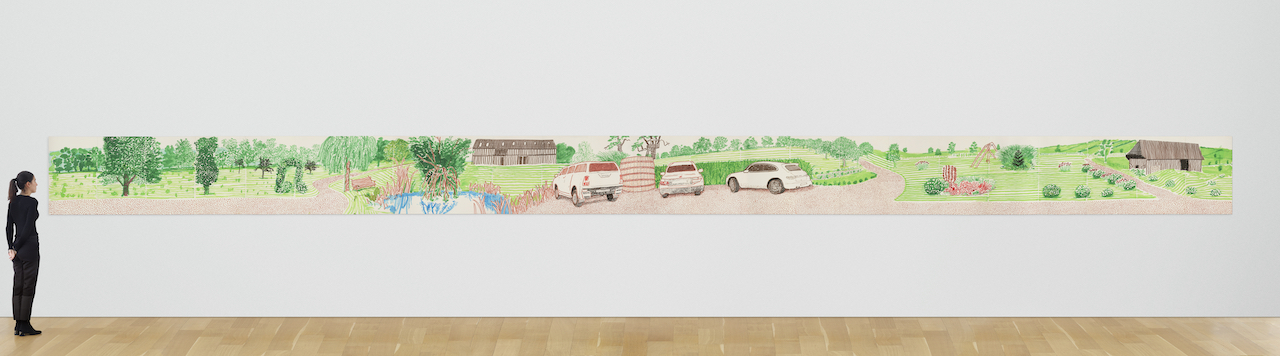
David Hockney's Monumental 12-Meter Print Heads to Christie's Auction
A truly unique lot is being offered by Christie's, available online from March 17 to 31, and on display at the major London galleries until March 31. This remarkable piece is one of David Hockney's largest creations, a staggering 12 meters long, printed on a single sheet of paper, and his most

El Greco Masterpiece Uncovered in Vatican: Hidden Under a Forgery
Art history is frequently punctuated by unexpected and serendipitous discoveries. Among these is the latest revelation from the Vatican Museums, where a routine conservation intervention has brought to light an authentic painting by El Greco, which had remained invisible for decades beneath a

Modena's Gate26A Hosts Aleksandr Nuss's Art: Where Matter Erodes and Light Reveals
Modena offers a serene escape from the vibrant chaos of nearby Bologna, presenting itself as an ordered and pristine city, a tranquil setting for everyday life. Within this calm environment, an independent space named Gate26A, founded by a collective of four individuals, injects a dynamic ener

Peggy Guggenheim's London Years: The Birth of a Collector in Venice Exhibition
Many are unaware of a crucial, often overlooked chapter in the life of Peggy Guggenheim, the visionary who transformed a palazzo on the Grand Canal into a bastion of modernism: her entrepreneurial venture with the Guggenheim Jeune gallery in London. The exhibition, Peggy Guggenheim in London: B
Selvatica 2026 in Biella: Art and Nature in Dialogue, Featuring Historical Authors and New Talents
The eleventh edition of Selvatica – Art and Nature in Festival, a biennial event held in Piazzo, Biella's historic district, has commenced and will run until July 19, 2026. The festival aims to foster a dialogue between artistic languages, scientific research, and educational practices to crea