Roberto Amoroso e il multilivello delle immagini: pittura digitale tra percezione e manipolazione
Upon entering "Controlled Origin Manipulation," Roberto Amoroso's solo exhibition at 10 & zero uno in Venice, the visitor's experience swiftly shifts from the purely iconographic to the deeply perceptual. The images presented continuously redefine themselves under observation. This dynamic reorientation allows Amoroso's work to transcend the potential pitfall of merely illustrating contemporary themes – a common risk when dealing with digital images, AI, and media streams – moving instead into a more fluid and fertile artistic realm.
The exhibition's title, therefore, functions less as a simple statement and more as an active mechanism. "Manipulation" implies an action, a grasp, a responsibility; while "controlled origin" evokes a certification system, almost a guarantee of provenance. This juxtaposition creates a short-circuit, fueling the entire exhibition. On one hand, it acknowledges that every image is inherently constructed, filtered, and layered; on the other, it explores the potential to re-activate these images without conforming to the extractive logics that dominate contemporary visual production.
This inherent divergence finds its most intense expression within the paintings. The canvases subtly retain elements of their digital creation process without explicitly revealing them: the logic of layers, assembly through accumulation, and the coexistence of different registers are not merely translated pictorially but transformed into an indivisible, distinct form. Initially, they appear compact, almost impenetrable; yet, upon closer inspection, the image articulates itself as if the surface slowly yields to an implicit depth. This depth deviates from traditional perspective, embracing a multiplicity of planes that coexist without fully merging.
It is precisely here that painting transcends its two-dimensionality without denying it. Elements seem to emerge and recede as if belonging to disparate temporalities, disrupting any notion of stable hierarchies. Anatomical fragments, animal presences, and symbolic remnants coalesce without ever resolving into a definitive image, instead organizing themselves by proximity and activating a network of cross-references that compels the viewer's gaze to wander, return, and re-evaluate.
Thus, manipulation never solely pertains to form but, more profoundly, to how images interact with one another. The digital, heterogeneous, often pre-circulating images from which the artist begins are stripped of their original function. They are then recontextualized within a system where meanings remain perpetually negotiable. No single image dominates others, nor is there a central point organizing the whole. What emerges is a constellation, a collective that finds its solidity precisely within its inherent instability.
This distinctive approach also permeates the other works on display, never merely translating into a simple linguistic variation. In the video "Behind the Curtain #2," for instance, fragmentation expands over time to become an immersive experience. Images flow, overlap, and distort, while sound contributes to creating an almost enveloping atmosphere where definitive references gradually dissipate. Rather than following a narrative, viewers find themselves within an environment that transforms as they navigate it, where visual analogies and contrasts unfold in a constant, unstable succession.
The sculptures and the "Mea Culpa" banner similarly align with this theme, though they shift the discourse onto a more explicitly symbolic plane. Here, references such as the muse figure or war imagery are recognizable, but they are immediately disarmed, as if something prevents them from functioning in their customary ways. The elements soften, contaminate one another, and acquire an unexpected fragility, reordering a system where signs persist even if they no longer yield the same effects.
The unifying thread throughout the entire exhibition is a practice that operates through subtle yet decisive interventions, eschewing both explicit denunciation and adherence to a neutral aesthetic. Painting, in this context, does not signify a return to materiality but rather a space for deceleration, where the complexity of contemporary visuals can be held, processed, and made traversable once more.
In today's landscape, where images often exhaust their impact in their immediacy, Amoroso's work introduces a different economy of perception. It doesn't demand rapid deciphering or resolution into a singular meaning. Instead, it necessitates a sustained engagement, an extended period of observation where connections gradually surface and remain, to some extent, open-ended.
It is perhaps in this very openness, this multi-layered resistance to any singular interpretation, that the exhibition's most profound core is defined – a space where the viewer's gaze is continuously provoked to re-examine its own understanding.
Novedades — Society
La participación cultural: más allá de la mera asistencia, la necesidad de compartir el poder
```html La participación cultural: más allá de la mera asistencia, la necesidad de compartir el poder La participación se ha convertido en un término ubicuo, presente en convocatorias, proyectos europeos, programas culturales y planes de regeneración urbana. Se presenta como un
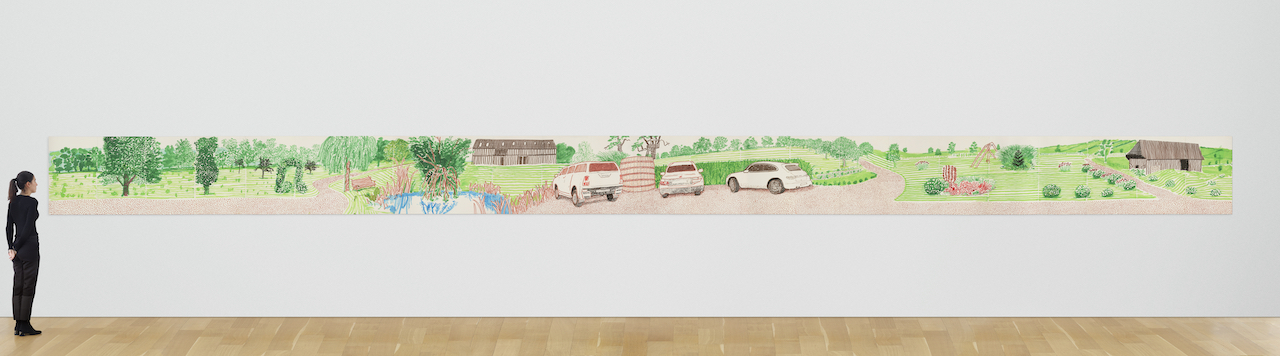
David Hockney's Monumental 12-Meter Print Heads to Christie's Auction
A truly unique lot is being offered by Christie's, available online from March 17 to 31, and on display at the major London galleries until March 31. This remarkable piece is one of David Hockney's largest creations, a staggering 12 meters long, printed on a single sheet of paper, and his most

El Greco Masterpiece Uncovered in Vatican: Hidden Under a Forgery
Art history is frequently punctuated by unexpected and serendipitous discoveries. Among these is the latest revelation from the Vatican Museums, where a routine conservation intervention has brought to light an authentic painting by El Greco, which had remained invisible for decades beneath a

Modena's Gate26A Hosts Aleksandr Nuss's Art: Where Matter Erodes and Light Reveals
Modena offers a serene escape from the vibrant chaos of nearby Bologna, presenting itself as an ordered and pristine city, a tranquil setting for everyday life. Within this calm environment, an independent space named Gate26A, founded by a collective of four individuals, injects a dynamic ener

Peggy Guggenheim's London Years: The Birth of a Collector in Venice Exhibition
Many are unaware of a crucial, often overlooked chapter in the life of Peggy Guggenheim, the visionary who transformed a palazzo on the Grand Canal into a bastion of modernism: her entrepreneurial venture with the Guggenheim Jeune gallery in London. The exhibition, Peggy Guggenheim in London: B
Selvatica 2026 in Biella: Art and Nature in Dialogue, Featuring Historical Authors and New Talents
The eleventh edition of Selvatica – Art and Nature in Festival, a biennial event held in Piazzo, Biella's historic district, has commenced and will run until July 19, 2026. The festival aims to foster a dialogue between artistic languages, scientific research, and educational practices to crea