Lucy Orta: A Community Becomes Suspended Art in Sansepolcro
More than a traditional exhibition, Trame di Comunità (Community Weavings) is an original, site-specific installation by Lucy Orta for CasermArcheologica in Sansepolcro, representing the culmination of a shared process. This project, supported by Fondazione CR Firenze, is a collaboration between CasermArcheologica and Studio Lucy & Jorge Orta, with curatorial guidance from Simonetta Carbonaro.
The exhibition emerged from the artist's residency in Valtiberina in July 2025, an experience that allowed her to immerse herself in the region’s cultural and artistic history and forge connections with the local community. This immersive period shaped the installation, which is on view until July 15, 2026, at the historic Palazzo Muglioni, home to CasermArcheologica. Trame di Comunità does not present finished works, but rather an ensemble of evolving traces: encounters, collective actions, and shared threads that become the living fabric of the exhibition.
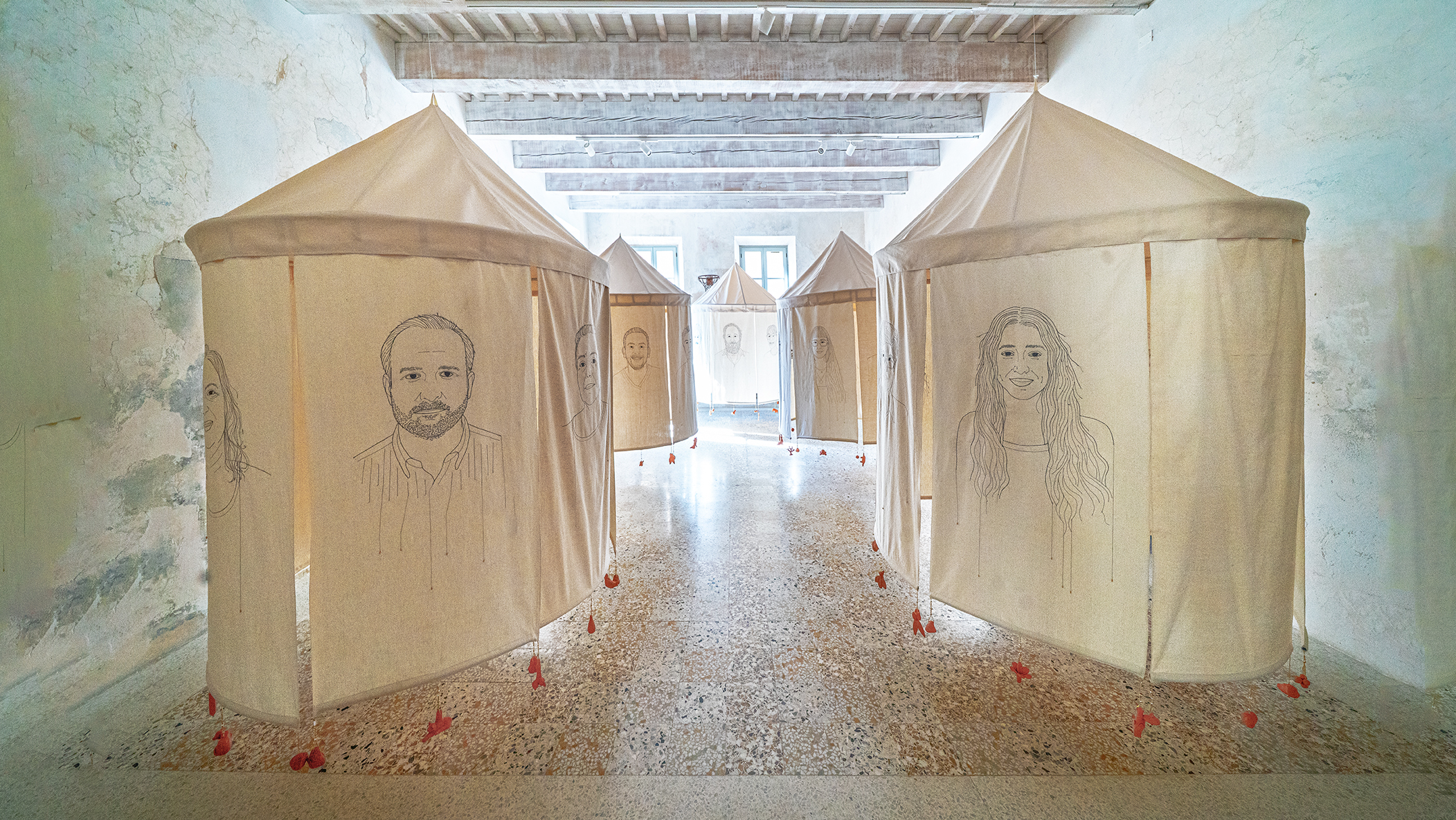
The spatial environment is defined by suspended fabrics, symbolic temporary dwellings that delineate an encampment where local individuals serve as representatives of the broader community. This often-silent community, prompted by the artist’s "provocative" question – «What attracts you to Valtiberina, and what pushes you away?» – articulates its bond with the territory. The responses reveal complex sentiments: love and a sense of belonging to their home, alongside an awareness of the slow erosion of the social fabric, and the courage required to resist it.
At the heart of the installation, a gathering space is formed around a woven field, crafted from linen and hemp cultivated in Tuscan soil, which itself becomes both a symbolic and concrete place for encounter. It is not merely a refuge but also a territory for connection and resilience.
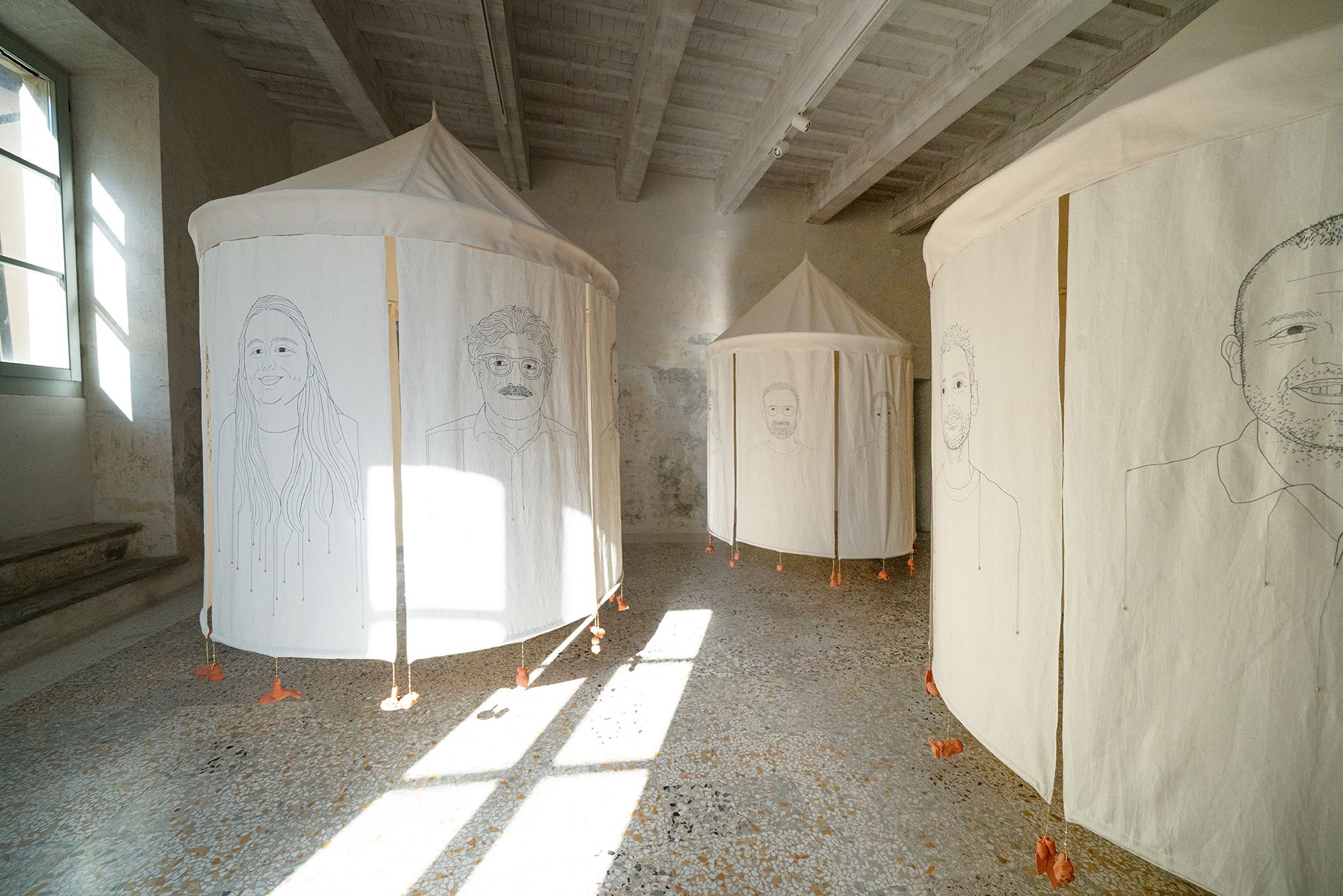
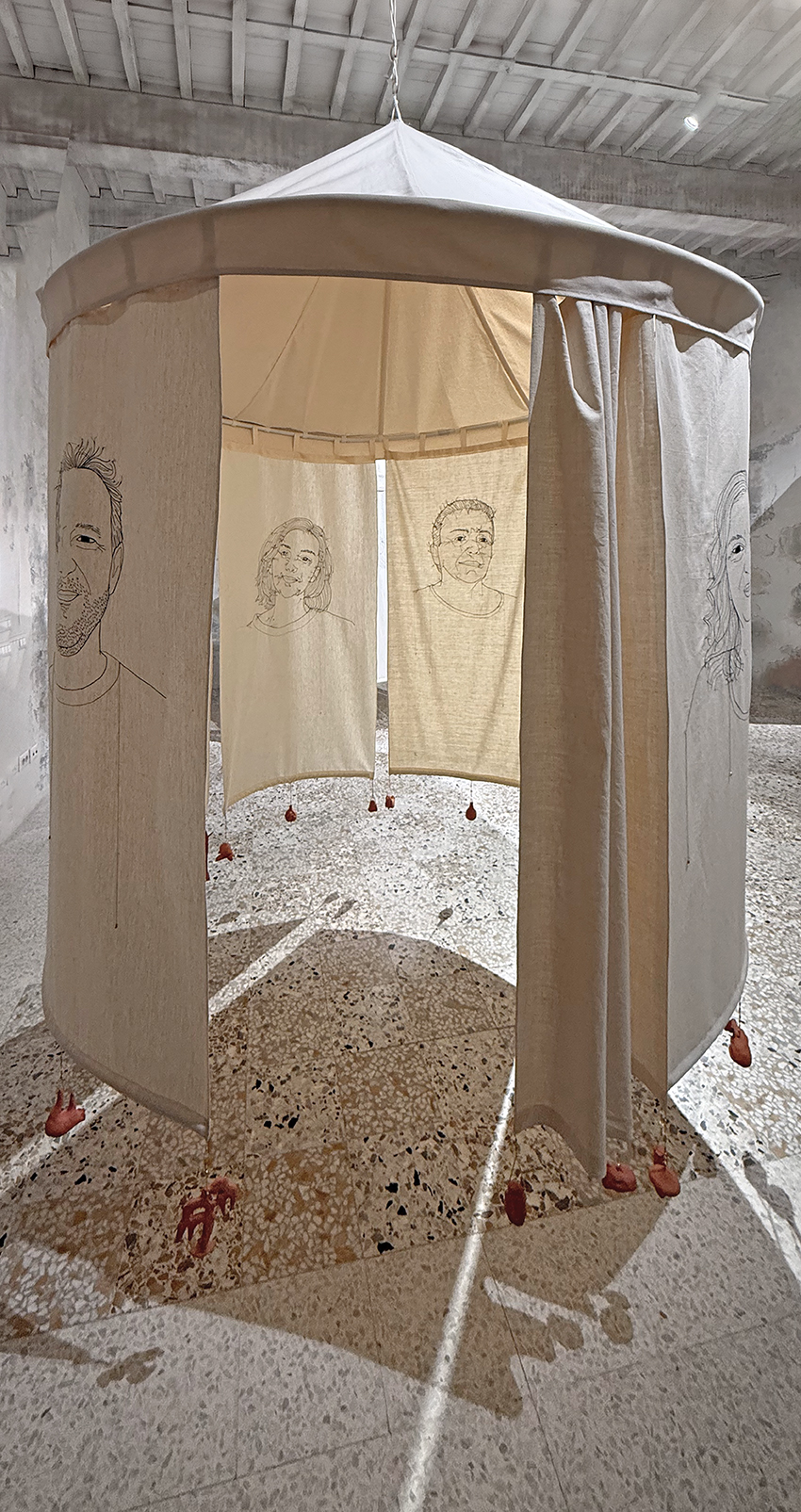
This concept references the Ohel, a Hebrew word meaning "tent," which represents the archetype of a sacred and protective space where human and spiritual dimensions converge. It also echoes deeply rooted iconographies in Italian and particularly Tuscan tradition, such as the tent of the Madonna del Parto or the cloak of Piero della Francesca's Madonna della Misericordia.
The architecture of the installation remains deliberately fragile and fluid, suspended between journey and temporary dwelling. Like any encampment, it evokes the idea of transition: a temporary space offering shelter as constant change passes through it.
In this way, the fabrics transformed by Lucy Orta assume an expansive symbolic value: a testament to human resilience and the capacity to continually weave, within the fabric of every community, the golden thread of possible and desirable futures.
The insights of curator Simonetta Carbonaro and Giuliano Corti further elucidate the exhibition's intentions. Carbonaro states: «One enters this exhibition space not to 'understand,' but to 'be': to dwell within a breathing narrative, to listen to what remains of those stories, sometimes almost confessions. To perceive how every form is the outcome of an intertwining of survivals. Works that demand not a detached view, but bodily adhesion, proximity, an empathetic approach.»
Corti adds that «Often it happens that by delving into words and cultivating language in search of fruitful meanings, unexpected provisions of sense are discovered,» emphasizing how art is always about «participation.» He notes that this concept has a long history and a clear etymology, reminding us that it «has its roots in Platonic theory of Ideas and was used to indicate the magical moment when the sensible reality of concrete things 'participates' in the universal reality of universal principles.»
To further explore the project, we posed some questions to Lucy Orta herself.
How did the collaboration and subsequently the installation project with CasermArcheologica come about?
«I was immediately inspired by CasermArcheologica's invitation to create a work rooted in the voices of the valley. During my first meeting with the founders, Ilaria Margutti and Laura Carusi, and with the curator Simonetta Carbonaro, I perceived a strong alignment with my research and practice: collective narration, identity, and textiles as an expressive medium.
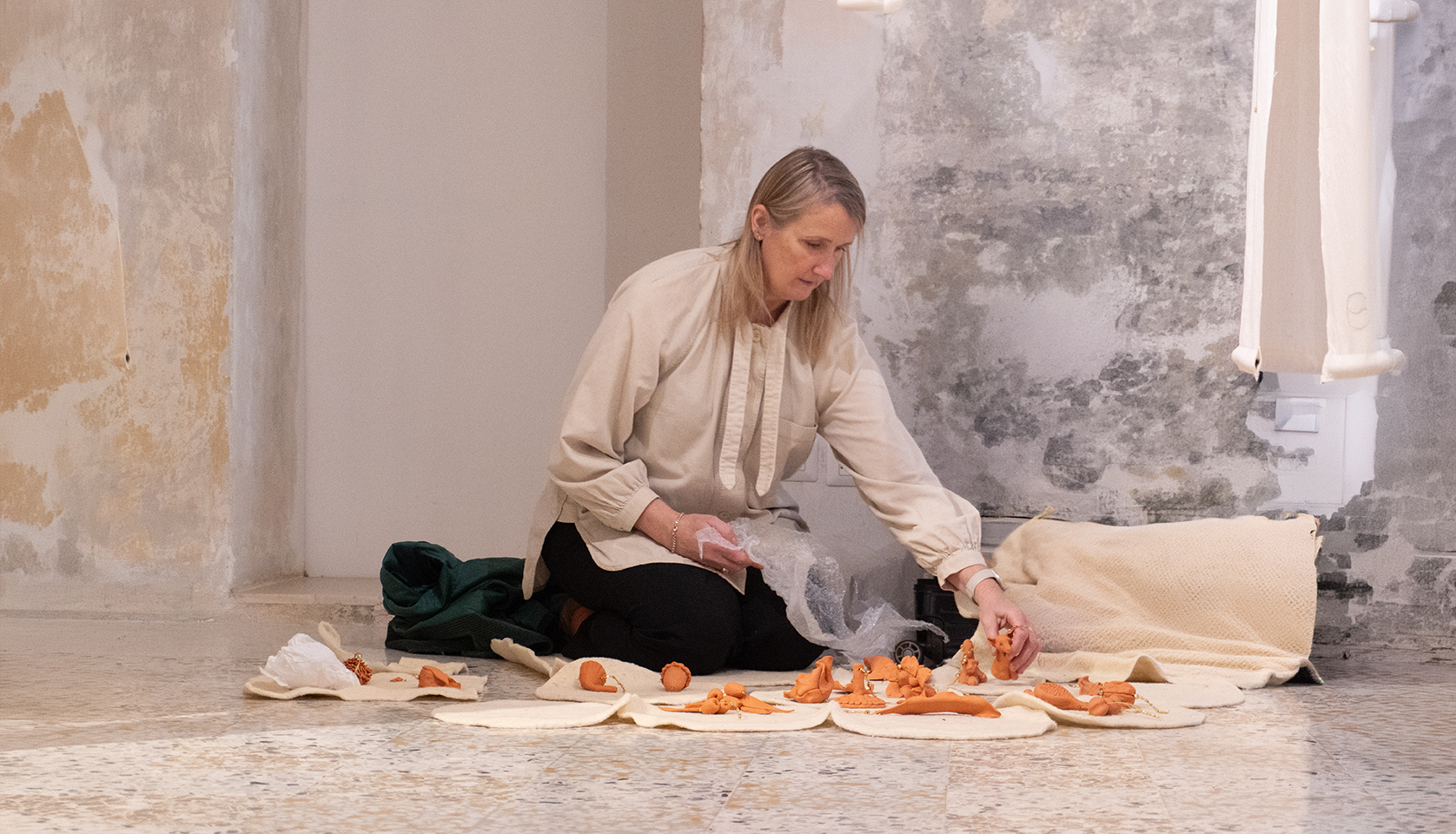
The residency in Valtiberina, in August 2025, was fundamental in shaping the Trame di Comunità project. On a human level, it was invaluable to meet and engage in dialogue with diverse people from the community; more generally, fieldwork among the churches, museums, and historical sites of the area allowed for a better understanding of the place's history and its inhabitants. From these encounters, the project's symbolic vocabulary emerged: linen, gold threads, terracotta amulets, and the Ohel – the tent.
The challenge of the project was to create a work that resonated on a personal level with the community, but also had universal and transmissible meaning. Inspired by the experience of the Traces: Stories of Migration (2022–2024) project, I proposed gathering personal testimonies around a question: «What threads attract or push you away from the valley?»»
«Each participant was invited to imagine this identity of belonging as if it were a mineral, a plant, or an animal. CasermArcheologica set up a recording studio and, during a weekend, 33 people—artisans, artists, teachers, entrepreneurs, activists, and citizens of all ages—came to tell their stories, translating their connection with the territory into concrete symbols.
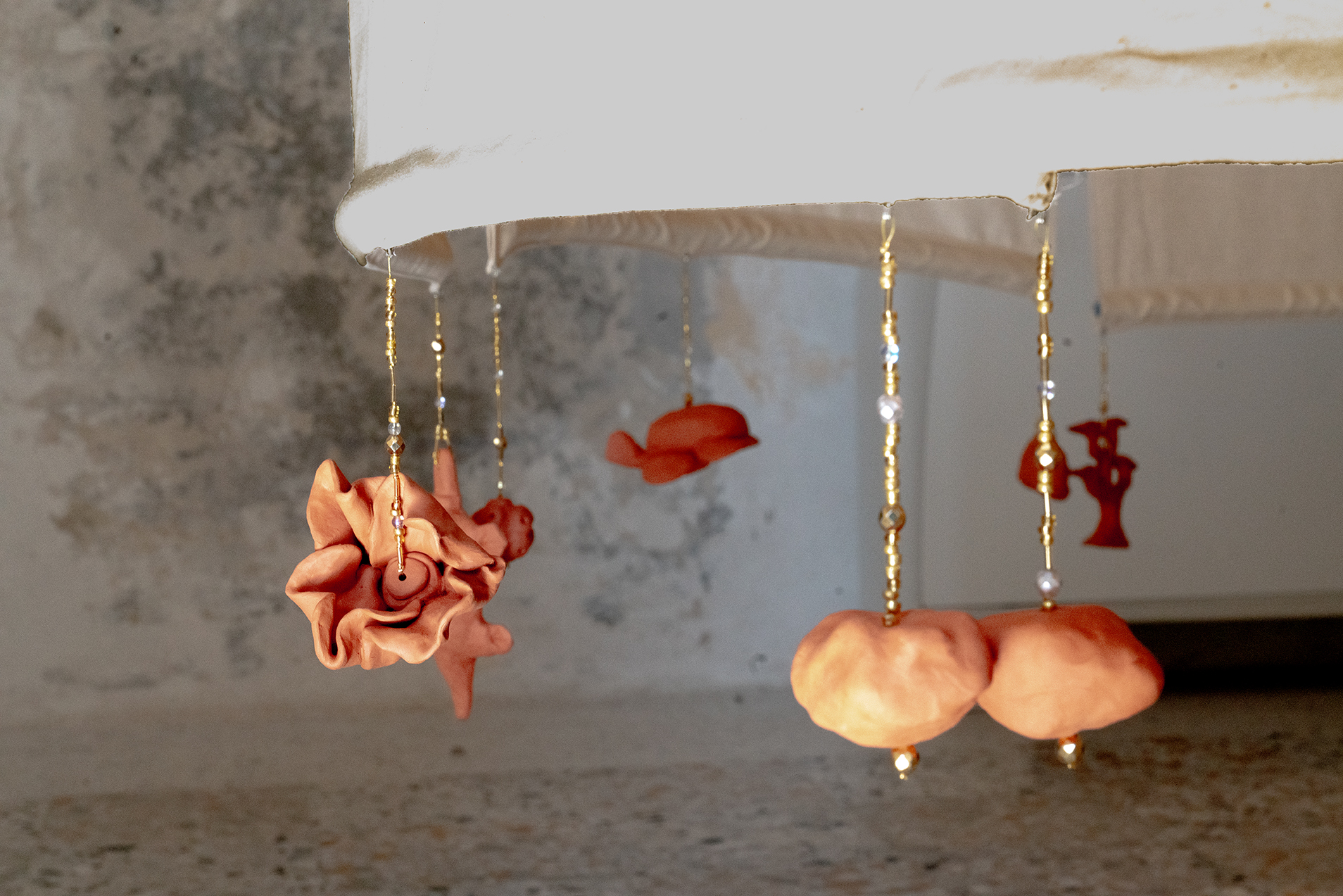
The intimacy of this listening is reflected in the portraits of each individual and in the terracotta amulets that I embroidered and modeled upon returning to the studio. The portraits were sewn onto long panels of linen and hemp, assembled to form the fabric walls of the five Ohels. The amulets, suspended from the fabrics, symbolically anchor the work to the territory.
In the final installation, the tent-sculptures unite the community, both metaphorically and physically. A community that looks outward and invites visitors to participate, posing them the same question: «What threads attract or push you away from the valley?»»
In your research, why is staying in contact with the territory so important? How much can art influence a place?
«Community-based artistic projects generate indirect effects, subjective transformations, slow and non-linear processes, difficult to measure, which continue to resonate even after the exhibition ends. The challenge is to capture these resonances. With the collaboration of Simonetta Carbonaro and sociologist Paola Conti, we are developing two methods to observe and understand these effects.
A narrative ecology framework will be employed to gather qualitative understanding of how Trame di Comunità stimulates imagination, reflection, and awareness among exhibition visitors, workshop participants, and people involved in CasermArcheologica's cultural activities.
Simonetta Carbonaro and Paola Conti are also developing a community-building project under the patronage of the Municipality of Anghiari and in collaboration with the Libera Università dell’Autobiografia di Anghiari. The results will be made public after the exhibition.
What truly matters is that Trame di Comunità sets a process in motion: the work that I create in relation to a community becomes a catalyst upon which others can build.»
Novedades — Society
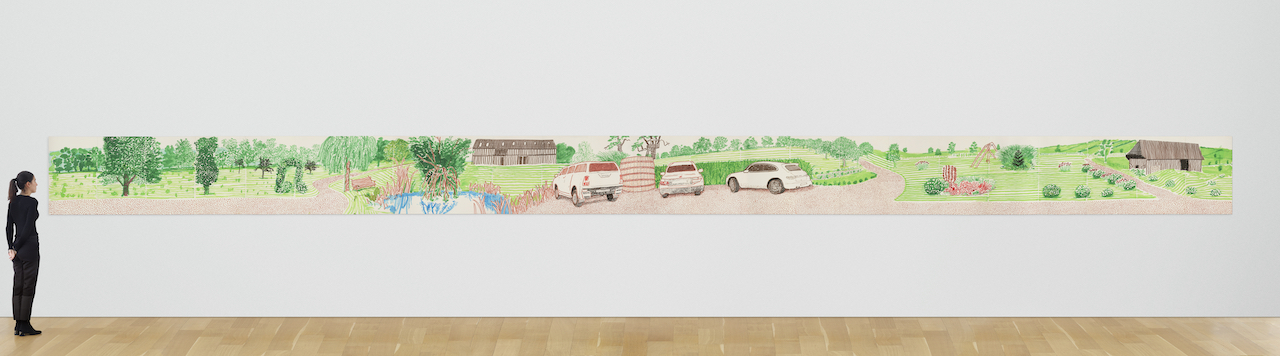
David Hockney's Monumental 12-Meter Print Heads to Christie's Auction
A truly unique lot is being offered by Christie's, available online from March 17 to 31, and on display at the major London galleries until March 31. This remarkable piece is one of David Hockney's largest creations, a staggering 12 meters long, printed on a single sheet of paper, and his most

El Greco Masterpiece Uncovered in Vatican: Hidden Under a Forgery
Art history is frequently punctuated by unexpected and serendipitous discoveries. Among these is the latest revelation from the Vatican Museums, where a routine conservation intervention has brought to light an authentic painting by El Greco, which had remained invisible for decades beneath a

Modena's Gate26A Hosts Aleksandr Nuss's Art: Where Matter Erodes and Light Reveals
Modena offers a serene escape from the vibrant chaos of nearby Bologna, presenting itself as an ordered and pristine city, a tranquil setting for everyday life. Within this calm environment, an independent space named Gate26A, founded by a collective of four individuals, injects a dynamic ener

Peggy Guggenheim's London Years: The Birth of a Collector in Venice Exhibition
Many are unaware of a crucial, often overlooked chapter in the life of Peggy Guggenheim, the visionary who transformed a palazzo on the Grand Canal into a bastion of modernism: her entrepreneurial venture with the Guggenheim Jeune gallery in London. The exhibition, Peggy Guggenheim in London: B
Selvatica 2026 in Biella: Art and Nature in Dialogue, Featuring Historical Authors and New Talents
The eleventh edition of Selvatica – Art and Nature in Festival, a biennial event held in Piazzo, Biella's historic district, has commenced and will run until July 19, 2026. The festival aims to foster a dialogue between artistic languages, scientific research, and educational practices to crea
Lorenzo Castore: Exploring Other Forms of Cultural and Public Identity
The series "OTHER IDENTITY – Other forms of cultural and public identity," conceived by artist and independent curator Francesco Arena, serves as a barometer for the evolving landscape of contemporary visual language. It showcases the work of artists and authors who utilize photography, video,