Losing Oneself in Color: The Grand Mark Rothko Exhibition in Florence
Visiting the Mark Rothko exhibition in Florence, spread across Palazzo Strozzi, the Museo di San Marco, and the Biblioteca Medicea Laurenziana, offers an experience of profound tranquility – a space where violence and sacrifice, fate and ecstasy converge. Until August 23, 2026, the master of Abstract Expressionism is featured in a chronological journey exploring his artistic evolution: from his early works in the 1930s and 40s, still influenced by Expressionism and Surrealism, to his iconic abstract canvases of the 1950s and 60s. Curated by Christopher Rothko and Elena Geuna, the exhibition creates a unique dialogue with its host venues: at the Museo di San Marco, Rothko's lighter-toned works interact with the spirituality of Fra Angelico's frescoes; at the Biblioteca Medicea Laurenziana, they find a striking placement in Michelangelo's Vestibule, amplifying the meditative dimension of the experience. Over 70 works are on display, many never before shown in Italy, with loans from prestigious international institutions such as MoMA, the Metropolitan Museum, the Tate Gallery, the Centre Pompidou, and the National Gallery of Art.
How to Observe Mark Rothko's Works?
On February 25, 1970, the same day nine of his paintings arrived at London's Tate Gallery, Mark Rothko's body was found lifeless. His art reflects this deep interiority, that fragile territory where thought becomes a dizzying abyss and silence condenses. While the external world rushed forward with Andy Warhol, Roy Lichtenstein, and rock and roll, Rothko's painting demanded contemplation. Even today, to truly grasp its essence, one must withdraw from noise, turn off distractions, and accept a suspension. Before Rothko, one does not merely observe; one gets lost. Color transcends the surface, becoming an enveloping and guiding space beyond the two-dimensional.
The brushstroke remains a nuanced trace; light doesn't illuminate but envelops autonomously. One enters without knowing where they will arrive, traversing chromatic fields that seem to hold their breath. It is an uncertain, at times disorienting, yet essential experience, for only by crossing this threshold does something slowly unfold. Christopher Rothko, the exhibition curator, states: "My father wished that those who observed his paintings would experience the same religious experience he felt while creating them." At Palazzo Strozzi, Room No. 5, dedicated to "Sketches for the Seagram Murals and Classic Canvases" (1958-1962), offers insight into his thought process. Here, red and black colors seek balance, forms attract and repel like listening presences. The material is alive, absorbing and returning light; proportions stretch and release, creating spaces that are not visible architectures but internal perceptions. It is significant that these works coincide with Rothko's trips to Italy in 1950 and 1959, and his immersive experiences in Rome and Florence.
If Rothko Were to Return to Florence?
Let's imagine Rothko in Florence in 1950, during his first trip, exploring Piazza della Repubblica and the city's narrow streets. We know that, with his wife Mell, he was deeply struck by Fra Angelico's paintings at the Museo di San Marco and the architecture of Michelangelo's Vestibule in the Biblioteca Medicea Laurenziana. One wonders how happy he would have been to know that, right here, in 2026, the city would dedicate an exhibition to him. Not to keep his memory alive, which certainly needs no prompting, but rather to offer once again a direct encounter with his works in one of the largest exhibitions dedicated to him.
His paintings demand precisely this: to be seen live, in dim light, on neutral walls that foster contemplation, as is the case today in the halls of Palazzo Strozzi. It is also said that Rothko returned to visit the Laurenziana Vestibule in 1966 and that this very space became a source of inspiration for the *Seagram Murals* series, created in the late 1950s. A small, confining, and exitless space where he was forced to confront the wall itself: a sensation the artist had always sought and which finally resonated with his unconscious.
Novedades — Society
La participación cultural: más allá de la mera asistencia, la necesidad de compartir el poder
```html La participación cultural: más allá de la mera asistencia, la necesidad de compartir el poder La participación se ha convertido en un término ubicuo, presente en convocatorias, proyectos europeos, programas culturales y planes de regeneración urbana. Se presenta como un
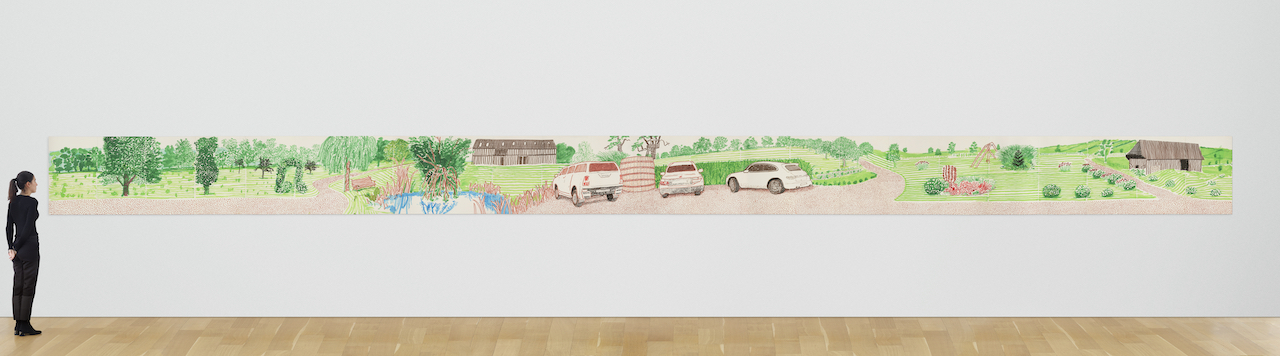
David Hockney's Monumental 12-Meter Print Heads to Christie's Auction
A truly unique lot is being offered by Christie's, available online from March 17 to 31, and on display at the major London galleries until March 31. This remarkable piece is one of David Hockney's largest creations, a staggering 12 meters long, printed on a single sheet of paper, and his most
El Greco Masterpiece Uncovered in Vatican: Hidden Under a Forgery
Art history is frequently punctuated by unexpected and serendipitous discoveries. Among these is the latest revelation from the Vatican Museums, where a routine conservation intervention has brought to light an authentic painting by El Greco, which had remained invisible for decades beneath a

Modena's Gate26A Hosts Aleksandr Nuss's Art: Where Matter Erodes and Light Reveals
Modena offers a serene escape from the vibrant chaos of nearby Bologna, presenting itself as an ordered and pristine city, a tranquil setting for everyday life. Within this calm environment, an independent space named Gate26A, founded by a collective of four individuals, injects a dynamic ener

Peggy Guggenheim's London Years: The Birth of a Collector in Venice Exhibition
Many are unaware of a crucial, often overlooked chapter in the life of Peggy Guggenheim, the visionary who transformed a palazzo on the Grand Canal into a bastion of modernism: her entrepreneurial venture with the Guggenheim Jeune gallery in London. The exhibition, Peggy Guggenheim in London: B
Selvatica 2026 in Biella: Art and Nature in Dialogue, Featuring Historical Authors and New Talents
The eleventh edition of Selvatica – Art and Nature in Festival, a biennial event held in Piazzo, Biella's historic district, has commenced and will run until July 19, 2026. The festival aims to foster a dialogue between artistic languages, scientific research, and educational practices to crea