Lorna Simpson's "Third Person" Exhibition at Punta della Dogana
In Venice, situated on the landmass separating the Grand Canal from the Giudecca Canal, the historic Dogana da Mar—for nearly two decades an Italian cultural outpost for François Pinault—is divided this year. Instead of a single grand exhibition as seen with the solo shows of Thomas Schütte and Pi
In Venice, situated on the landmass separating the Grand Canal from the Giudecca Canal, the historic Dogana da Mar—for nearly two decades an Italian cultural outpost for François Pinault—is divided this year. Instead of a single grand exhibition as seen with the solo shows of Thomas Schütte and Pierre Huyghe, two distinct projects are presented within the spaces restored by Tadao Ando. The upper floor hosts Algebra, a sophisticated solo exhibition by Brazilian artist Paulo Nazareth, while the ground floor features Lorna Simpson: Third Person.
Curated by Emma Lavigne, this exhibition, featuring over fifty works including paintings, collages, and installations, is the most extensive presentation of Lorna Simpson's art in Europe in the last decade. Developed in collaboration with the Metropolitan Museum of Art in New York, where a version titled Source Notes was shown in Spring 2025, the Venice project continues the exploration of the American artist's oeuvre, with a particular emphasis on her painting production.
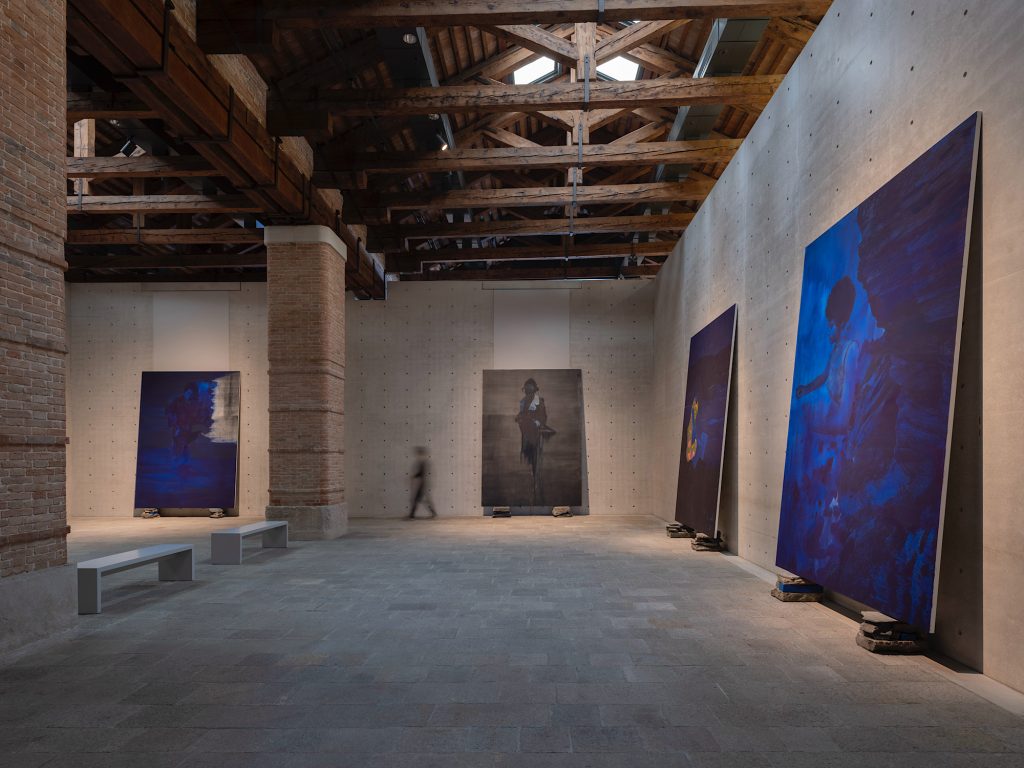
Despite the striking visual impact of the paintings displayed at Punta della Dogana until November 22nd, collage remains the exhibition's undisputed focal point. It is not merely an artistic technique but a critical stance—a modus operandi that informs and revitalizes every medium Simpson engages with. She wrote in 2018: "The notion of fragmentation, especially of the body, is prevalent in our culture and is reflected in my work. We are fragmented not only by the way society regulates our bodies but also by the way we think about ourselves."
To better grasp this approach, let's rewind to the mid-1980s. Inspired by African-American feminist artists like Adrian Piper and Lorraine O’Grady, Simpson began to treat photography as a construct to be disassembled and deconstructed. In these early works, she combined images and text to reflect on the perception of the Black body, particularly the female form. Even in this initial phase of her research, an attention to fragmentation—whether verbal or photographic—is evident.
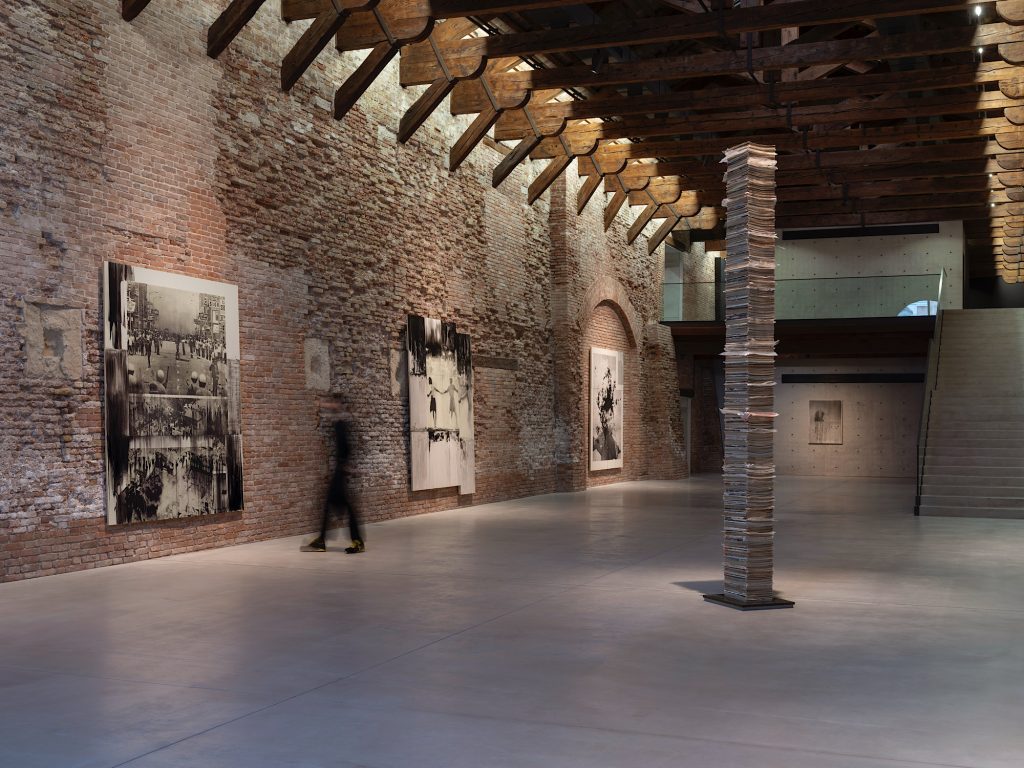
Over time, these reflections evolved into highly refined collages, many of which are displayed at Punta della Dogana, side-by-side like tesserae of a single worldview. By cutting and pasting found images, Simpson manages to evoke unexpected associations and create composite, unsettling figures.
A significant portion of the images Simpson works with are sourced from Ebony and Jet magazines, rooted in her childhood memories. These magazines form a rich archive of symbols and memories that also nourish other works in the exhibition. This is the case with Black Totem: an assembly of vintage magazine pages that form a tall, slender column, a true secular totem that references the collective memory of the African American community. More modest versions of these columns can be found in other sculptures, such as 5 Properties, Missing Film and Tried by Fire, where magazines are merged with other objects like glass cubes and sculpted busts.
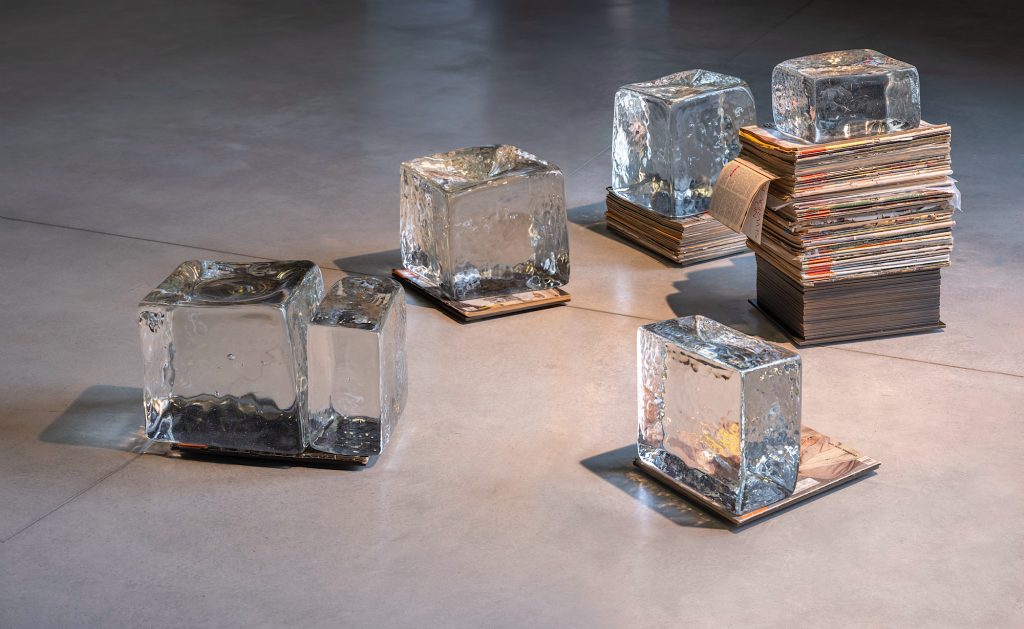
The logic of cutting and photographic recomposition reappears in larger-format works: fragments move from the page and coalesce into videos and installations. The sculpture Woman on Snowball, for example, is a large-scale transposition of a collage from the Unanswerable series—a female figure sits on an enormous snowball, creating an apparently absurd image.
The same approach also imbues the paintings, presented here both hung on the wall and resting on the floor. Simpson, in this case too, begins with faces from advertisements and archival material, which she then blurs, rotates, overexposes, and reconfigures. Vibrant colors and smudges disrupt the clarity of the images, introducing fissures that reflect the complexity and multiplicity of the identities represented.
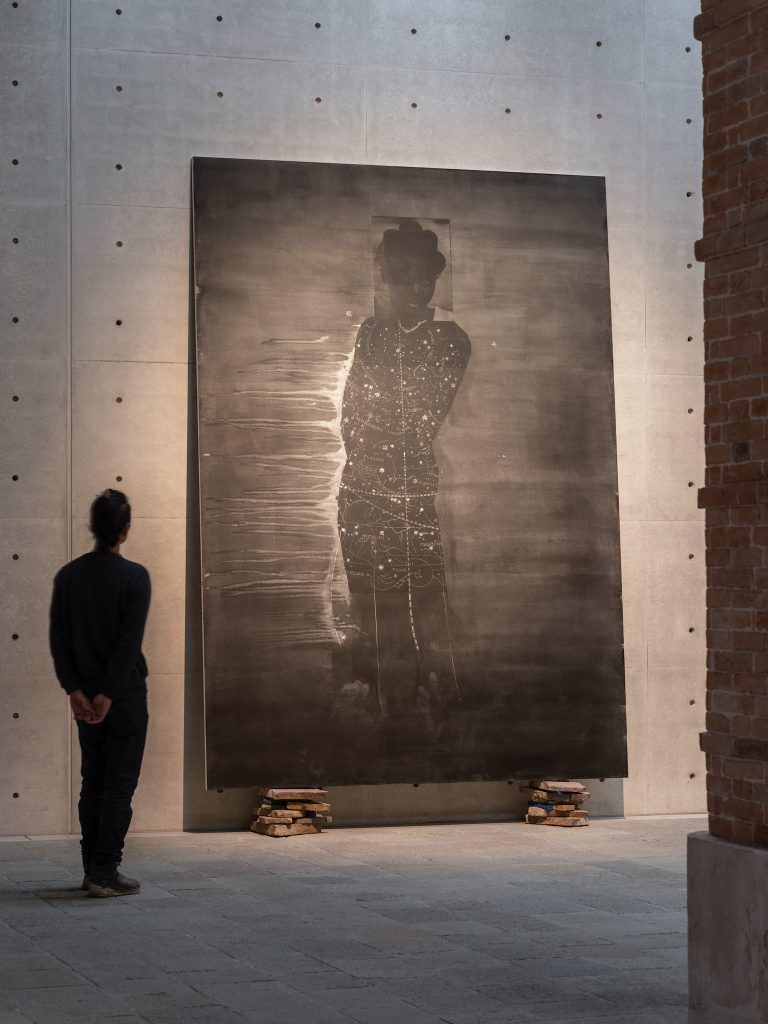
Within this palimpsest of cutouts and superimpositions, Simpson reminds us that identity is not a given but a precarious montage of external gazes. The body is dismembered and reassembled not for exhibition, but to be finally liberated from the dictatorship of representation. From this emerges a "third person" that observes us from the edge of the frame.
Novedades — Society
La participación cultural: más allá de la mera asistencia, la necesidad de compartir el poder
```html La participación cultural: más allá de la mera asistencia, la necesidad de compartir el poder La participación se ha convertido en un término ubicuo, presente en convocatorias, proyectos europeos, programas culturales y planes de regeneración urbana. Se presenta como un
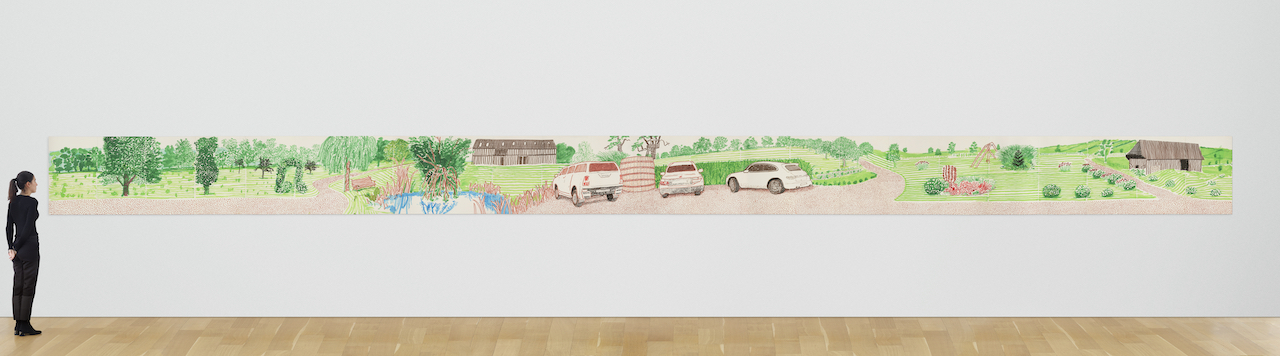
David Hockney's Monumental 12-Meter Print Heads to Christie's Auction
A truly unique lot is being offered by Christie's, available online from March 17 to 31, and on display at the major London galleries until March 31. This remarkable piece is one of David Hockney's largest creations, a staggering 12 meters long, printed on a single sheet of paper, and his most
El Greco Masterpiece Uncovered in Vatican: Hidden Under a Forgery
Art history is frequently punctuated by unexpected and serendipitous discoveries. Among these is the latest revelation from the Vatican Museums, where a routine conservation intervention has brought to light an authentic painting by El Greco, which had remained invisible for decades beneath a

Modena's Gate26A Hosts Aleksandr Nuss's Art: Where Matter Erodes and Light Reveals
Modena offers a serene escape from the vibrant chaos of nearby Bologna, presenting itself as an ordered and pristine city, a tranquil setting for everyday life. Within this calm environment, an independent space named Gate26A, founded by a collective of four individuals, injects a dynamic ener

Peggy Guggenheim's London Years: The Birth of a Collector in Venice Exhibition
Many are unaware of a crucial, often overlooked chapter in the life of Peggy Guggenheim, the visionary who transformed a palazzo on the Grand Canal into a bastion of modernism: her entrepreneurial venture with the Guggenheim Jeune gallery in London. The exhibition, Peggy Guggenheim in London: B
Selvatica 2026 in Biella: Art and Nature in Dialogue, Featuring Historical Authors and New Talents
The eleventh edition of Selvatica – Art and Nature in Festival, a biennial event held in Piazzo, Biella's historic district, has commenced and will run until July 19, 2026. The festival aims to foster a dialogue between artistic languages, scientific research, and educational practices to crea