In Iain Andrews' Art, Color Transforms into Healing
Encountering Iain Andrews' paintings, one's perception is profoundly altered. It's not the typical artistic dazzle induced by technical mastery, nor the aesthetic thrill manufactured by the international market. Instead, it's a deeper, more primal sensation: gazing into a wound gracefully transformed into light. His first Italian solo exhibition, 'Whispers from the Red Room,' at Galleria Gaburro in Milan, showcases over thirty recent works created with palpable urgency. Curated by Cesare Biasini Selvaggi, the exhibition, running until May 30, 2026, immerses viewers in a pictorial cosmos where polarities like good and evil, beauty and horror, narrative and fragmentation coexist in a disquieting, unstable balance.
Iain Andrews: Stages of Profound Human Drama
Andrews' canvases act as two-dimensional Shakespearean sets, exploring an unsettling, layered depth – 'flatnesses' that refuse to remain merely planar. Their seemingly lush, almost Rococo surfaces conceal an abyss of meaning, revealing itself only to those who pause and look closer. Like in the Bard's plays, events unfold on a stage where characters' identities are already in crisis before the story begins. Forms fray at the edges, figuration dissolves without ever vanishing entirely, lingering like a stubborn memory or an unspoken word that continues to resonate.
In this, Andrews resonates with Francis Bacon's 'soul X-rays,' exposing human fragility and existential solitude, where contradiction often leads to inevitable drama. Yet, Andrews' approach is more veiled, built through both chromatic accumulation and subtraction, crafting enigmatic, baroque cosmologies where evil manifests as a void, a silent corruption acting through absence, never heroic or seductive.
The Grammatical Force of Color in Expressing Pain
Andrews constructs his paintings through layers of color that build, contradict, and echo each other in a perpetual metamorphosis. Ochres and carmines, sulfuric greens and chalky whites, midnight blues and egg-yolk yellows: each tone carries a precise emotional temperature and narrative role within the overall story. The chromatic spectacle in his works is syntax before it is beauty. Here, the influence of Rococo painters—Fragonard, Boucher, Watteau—explicitly acknowledged and filtered through Disney films like Sleeping Beauty (watched with his daughters), is absorbed and inverted. The decorative grace of 18th-century French art becomes an elegant shell, containing its opposite: a sophisticated style that makes otherwise overwhelming content bearable. Andrews understands and deftly employs this mechanism with sharp awareness.
Art Therapy and the Healing Power of Painting
One cannot fully grasp Iain Andrews' art without acknowledging his dual identity. As an art therapist, he has dedicated years to working with children who have experienced abuse, trauma, self-harm, and violence. Through this daily practice—a blend of clinical work, listening, presence, and witness—he has developed a profound relationship with imagery as a tool for survival, a space for processing, and a means to transform pain into something that can be observed, articulated, and shared. This profound experience permeates every inch of his canvases, not as mere illustration or autobiography, but as concrete physicality. His painterly gesture carries the traces of someone who has learned to confront pain without being consumed by it.
The connection to Chaïm Soutine's poignant painting is illuminating here; in both, the pictorial material vibrates with an urgency related to survival, a physical need to transform personal history into something permanent and visible. However, in Andrews, this tension is filtered through the care for others even before his own, lending his work a rare ethical depth. Amidst this drama of disquiet, Andrews never abandons narrative. Through his painterly gesture and color used as a living language, he reclaims the profound possibility of storytelling: to bear witness, to give form to experience, and to restore humanity to its complexity without censorship or simplification.
The resulting images activate timeless visions, belonging to all eras yet concerning no one specifically. There's an archetypal quality to these works, a resonance that traverses centuries of iconography—from Greek myths to Northern European painting, from Grimm's fairy tales to animated cartoons—making them simultaneously familiar and irreducibly mysterious, open to multiple interpretations that multiply with each visit. The experiential metamorphosis they induce is tangible: viewers enter with their defenses, accustomed to aesthetic consumption, and emerge transformed—not necessarily consoled, but more aware, more alive in their capacity to feel. Andrews' canvases offer no easy answers but never abandon; they remain, silent and tenacious presences, whispering something truly worth hearing.
Novedades — Society
La participación cultural: más allá de la mera asistencia, la necesidad de compartir el poder
```html La participación cultural: más allá de la mera asistencia, la necesidad de compartir el poder La participación se ha convertido en un término ubicuo, presente en convocatorias, proyectos europeos, programas culturales y planes de regeneración urbana. Se presenta como un
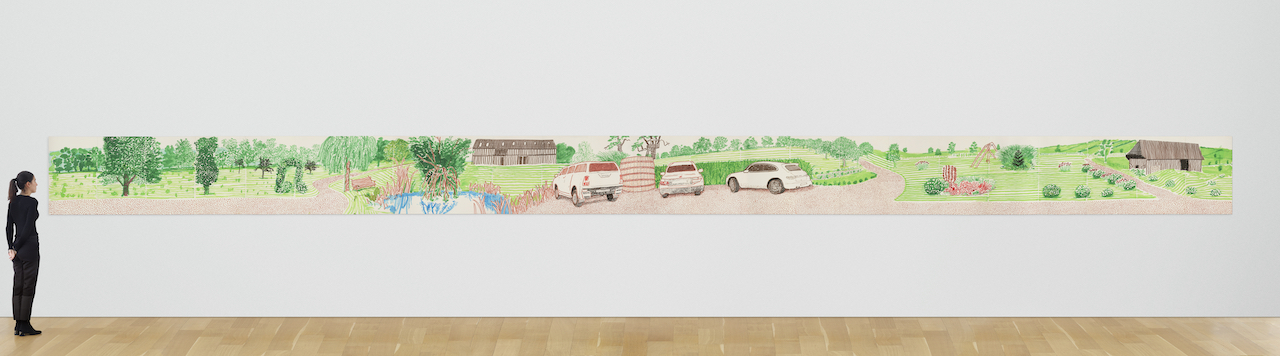
David Hockney's Monumental 12-Meter Print Heads to Christie's Auction
A truly unique lot is being offered by Christie's, available online from March 17 to 31, and on display at the major London galleries until March 31. This remarkable piece is one of David Hockney's largest creations, a staggering 12 meters long, printed on a single sheet of paper, and his most

El Greco Masterpiece Uncovered in Vatican: Hidden Under a Forgery
Art history is frequently punctuated by unexpected and serendipitous discoveries. Among these is the latest revelation from the Vatican Museums, where a routine conservation intervention has brought to light an authentic painting by El Greco, which had remained invisible for decades beneath a

Modena's Gate26A Hosts Aleksandr Nuss's Art: Where Matter Erodes and Light Reveals
Modena offers a serene escape from the vibrant chaos of nearby Bologna, presenting itself as an ordered and pristine city, a tranquil setting for everyday life. Within this calm environment, an independent space named Gate26A, founded by a collective of four individuals, injects a dynamic ener

Peggy Guggenheim's London Years: The Birth of a Collector in Venice Exhibition
Many are unaware of a crucial, often overlooked chapter in the life of Peggy Guggenheim, the visionary who transformed a palazzo on the Grand Canal into a bastion of modernism: her entrepreneurial venture with the Guggenheim Jeune gallery in London. The exhibition, Peggy Guggenheim in London: B
Selvatica 2026 in Biella: Art and Nature in Dialogue, Featuring Historical Authors and New Talents
The eleventh edition of Selvatica – Art and Nature in Festival, a biennial event held in Piazzo, Biella's historic district, has commenced and will run until July 19, 2026. The festival aims to foster a dialogue between artistic languages, scientific research, and educational practices to crea