Alfredo Accatino on the Paralympic Ceremony at Verona Arena: Art, Movement, and Inclusivity
The Paralympic Opening Ceremony, orchestrated by Filmmaster on March 6 at the historic Arena of Verona, placed a strong emphasis on contemporary art, showcasing works by notable artists such as Jago, Emilio Isgrò, and Marina Apollonio.
The musical landscape of the event was equally impressive, featuring Stewart Copeland, the iconic drummer from The Police, whose compositions have inspired generations, alongside Meduza, the acclaimed Italian house music trio known for their global reach and influence.
This ceremony marked a historic milestone, being the first Paralympic event ever held within a UNESCO World Heritage site. Titled Life in Motion, it paid tribute to life's inherent dynamism and transformation, drawing inspiration from art's capacity to interpret our ever-changing contemporary world. This approach sought to introduce a fresh perspective on disability, fostering a novel harmony between individuals and their surroundings. Following the ceremony, we had the opportunity to speak with Alfredo Accatino, one of Italy's most renowned and awarded creative minds, who serves as the artistic director for ceremonies and president of Filmmaster.
Marina Apollonio
"Life in Motion" was the chosen theme for the Opening Ceremony in Verona. How was the concept of "movement" transformed into a narrative that conveys a universal message?
Accatino explained, "Both Beauty in Action, the title for the Olympic Closing Ceremony, and Life in Motion are distinct expressions of a single underlying idea: movement as a form of identity. Every ceremony 'narrates' through a specific journey—a narrative thread that speaks to Italian heritage while also embodying shared values, uniting both ceremonies. It's all about dynamism, motion, and evolution. The concepts developed with creative director Adriano Martella illustrate that, as Italians, our strength lies in our traditions and roots, but also in our capacity for evolution. The Paralympic 'movement' specifically transforms perceptions in every place it touches, leaving a lasting impact."
The ceremony was structured around three pillars: Art, Dance, and Music. How were such diverse artists—from Emilio Isgrò to Marina Apollonio, from Meduza to Stewart Copeland—selected and integrated to construct a cohesive visual and auditory experience?
Accatino detailed their approach: "We deliberately embraced differences. We brought together artists like Jago and Isgrò, despite a nearly fifty-year age gap, or Copeland, the 73-year-old founder of The Police, collaborating with the young world drumming champion Helly Montin. Each artist offered a unique creative vision. I also recall that for the Olympic closing, we involved artists like Quayola and photographer Marco Delogu. I value this kind of artistic cross-pollination. For instance, at the Turin 2006 Olympics, we had Roberto Bolle dance alongside Boccioni's 'Unique Forms of Continuity in Space', effectively 'democratizing' Futurism with electronic music by Richie Hawtin."
Emilio Isgrò, photo by Luisa Porta
The press release for the event stated that sport possesses the power to unlock "unprecedented possibilities." How does one effectively translate athletic performance into a powerful expression of freedom and resilience for a global audience?
Accatino's response was succinct: "I'll tell you just one thing: go and witness a Paralympic competition. You already know that an image speaks louder than a thousand words."
In your books, you often dedicate space to individuals who operate outside conventional frameworks. If you were to select an "outsider" artist from the past to encapsulate the energy of "Life in Motion," who would it be and why?
Accatino chose: "Yamashita, whom I discussed in my book 'Sparks,' often called the 'Van Gogh of Japan.' He was proud of his 68 IQ and always wore a sleeveless shirt, earning him the nickname 'the naked general.' He traveled his entire life, sleeping wherever possible, eating with those who offered hospitality, and drawing everything he saw. Possessing what's known as eidetic memory, he could recreate entire scenes from memory, despite his condition being akin to autism. The Paralympic world exemplifies what true excellence means, transcending conventional norms. My 'Outsiders' series, which I've developed with Giunti for ten years (with a new volume due in May), explores these perfect yet dissonant voices, much like what often happens in sports."
Alfredo Accatino, Outsiders, cover
As a communication expert deeply involved in the visual arts, how do you interpret the absence of Italian artists from the upcoming Art Biennale?
Accatino responded, "I am generally in favor of 'shaking the tree' from time to time—of altering perspectives, especially because the world itself has changed. With my 'Outsiders' project, I've actively sought out art in countries too long overlooked, from Armenia to Ghana, to present an alternative vision of the world. However, if this became a habitual trend, I would be among the first to walk through the Venetian alleys advocating for Italy."
Novedades — Society
La participación cultural: más allá de la mera asistencia, la necesidad de compartir el poder
```html La participación cultural: más allá de la mera asistencia, la necesidad de compartir el poder La participación se ha convertido en un término ubicuo, presente en convocatorias, proyectos europeos, programas culturales y planes de regeneración urbana. Se presenta como un
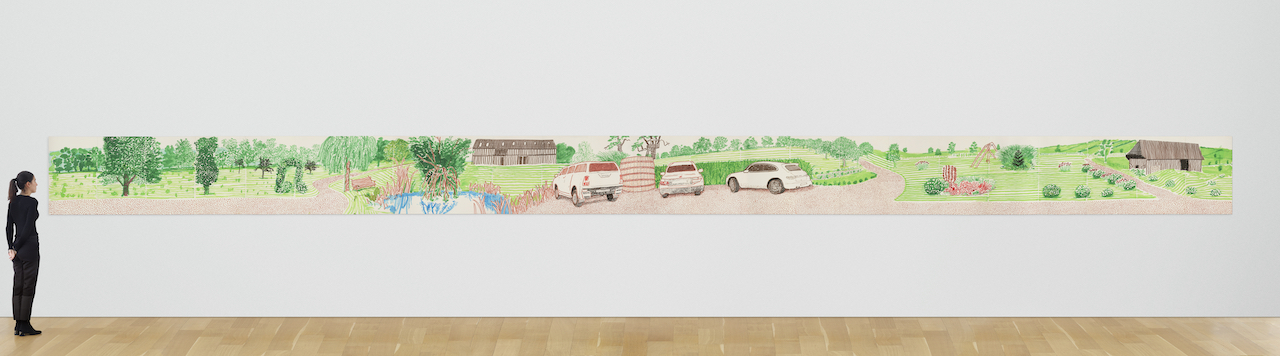
David Hockney's Monumental 12-Meter Print Heads to Christie's Auction
A truly unique lot is being offered by Christie's, available online from March 17 to 31, and on display at the major London galleries until March 31. This remarkable piece is one of David Hockney's largest creations, a staggering 12 meters long, printed on a single sheet of paper, and his most

El Greco Masterpiece Uncovered in Vatican: Hidden Under a Forgery
Art history is frequently punctuated by unexpected and serendipitous discoveries. Among these is the latest revelation from the Vatican Museums, where a routine conservation intervention has brought to light an authentic painting by El Greco, which had remained invisible for decades beneath a

Modena's Gate26A Hosts Aleksandr Nuss's Art: Where Matter Erodes and Light Reveals
Modena offers a serene escape from the vibrant chaos of nearby Bologna, presenting itself as an ordered and pristine city, a tranquil setting for everyday life. Within this calm environment, an independent space named Gate26A, founded by a collective of four individuals, injects a dynamic ener

Peggy Guggenheim's London Years: The Birth of a Collector in Venice Exhibition
Many are unaware of a crucial, often overlooked chapter in the life of Peggy Guggenheim, the visionary who transformed a palazzo on the Grand Canal into a bastion of modernism: her entrepreneurial venture with the Guggenheim Jeune gallery in London. The exhibition, Peggy Guggenheim in London: B
Selvatica 2026 in Biella: Art and Nature in Dialogue, Featuring Historical Authors and New Talents
The eleventh edition of Selvatica – Art and Nature in Festival, a biennial event held in Piazzo, Biella's historic district, has commenced and will run until July 19, 2026. The festival aims to foster a dialogue between artistic languages, scientific research, and educational practices to crea