


For its 16th edition, Manifesta is transforming 12 disused or abandoned churches in Germany’s Ruhr region (Bochum, Essen, Duisburg, Gelsenkirchen) into operational hubs. Over 100 artists and collectives will explore new possibilities for communal living spaces. Scheduled from June 21 to October 4, 2026, this edition marks 30 years since the nomadic biennale’s founding, reaffirming its adaptive approach to context.
The selection of participants directly reflects the project’s geopolitical and social framework. Artists from approximately 30 countries are featured, with a strong European presence—notably German, Polish, and Turkish. This aligns with the migratory and industrial history of the Ruhr, one of Europe’s largest urban areas, home to 5.3 million inhabitants across 4535 square kilometers.
Recognizable artists include Mona Hatoum, Alicja Kwade, Luc Tuymans, Nil Yalter, and SUPERFLEX. They are joined by figures long engaged with memory, migration, and public space, such as Marina Naprushkina, Mikołaj Sobczak, and Mykola Ridnyi. Established Eastern European artists like Mirosław Bałka and Katarzyna Kozyra will also participate, alongside a younger generation and collectives including Constructlab, Bureau Baubotanik, and Penique Productions. The roster also features artists from regions marked by recent conflicts and transformations, such as Šejla Kamerić, Navid Nuur, Abbas Zahedi, and Ming Wong.
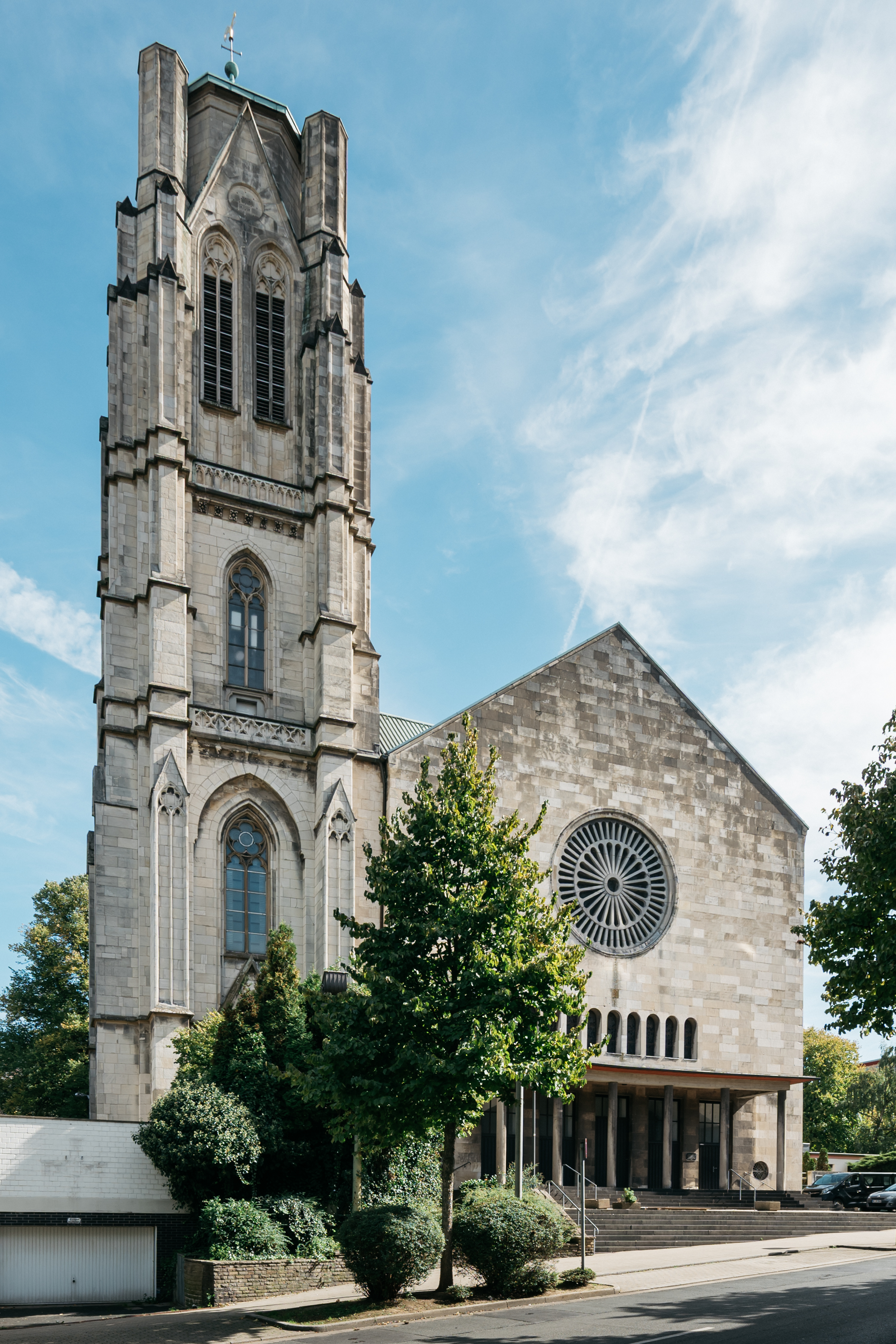
This plurality reflects a curatorial approach that eschews a singular narrative. As noted by creative mediator Michael Kurtz (using Manifesta’s specific terminology), the biennale operates on a dual temporal axis: confronting the past—the ruins of war, post-war German reconstruction, and migration stories—while simultaneously envisioning new forms of coexistence. The churches, built after WWII as symbols of democratic rebirth and now largely empty, serve as sites to question the loss of public space and, concurrently, explore its potential for reactivation.
It is no coincidence that Manifesta focuses on these spaces to reflect on community: ‘ecclesiae’ etymologically links back to the Greek ‘ekklesia,’ the assembly of citizens in ancient poleis where collective matters were debated and decided. This implicit reference to the roots of Western culture strengthens the project’s aim to reactivate forms of participation and coexistence.
The project will unfold through over 50 new commissions, complemented by an extensive network of participatory interventions and mediation programs. The selected venues will host reading rooms, communal kitchens, gardens, workshops, performance spaces, and social activities, blurring the lines between artistic production and social infrastructure.
A central role is given to the education and mediation program, engaging mediators, schools, and local communities. Initiatives include Youth Shift, dedicated to empowering young people in the Ruhr as active observers of the biennale, and Walks, shared exploratory journeys through the sites and their meanings.
In this context, it is hard not to draw parallels with documenta, a globally significant contemporary art exhibition and long a flagship of the German cultural system, which has recently faced controversy and increasing political pressure. It will be interesting to observe how the system reacts to this new Manifesta edition, which, from a different perspective, re-examines the relationship between art, public space, and institutional responsibility.
Manifesta 16: Complete Artist List
Below is the complete list of artists participating in Manifesta 16, scheduled from June 21 to October 4, 2026:
Emre Abut, Mehmet Aksoy, Havîn Al-Sîndy, Begzada Alatović, Bettina Allamoda, Özlem Altın, Halil Altındere, Atiye Altül, Mirosław Bałka, Bureau Baubotanik, Mehtap Baydu, Akbar Behkalam, Mabe Bethônico, Sara Bichão, Cana Bilir-Meier, Ayzit Bostan, Aline Bouvy, Cabosanroque, Vlassis Caniaris, Fatma Ceylan, Curro Claret, İsmail Çoban, Pele Collective, Constructlab, Bérénice Gaça Courtin, Yıldırım Denizli, Jason Dodge, Dúo Barber-Palacios, İhsan Ece, William Engelen, Ayşe Erkmen, Robert Fleck, Katharina Fritsch, Füruzan, Niklas Goldbach, Zuza Golińska, Nicolas Grospierre, Philipp Gufler, Gülbin Ünlü, Hava Güleç, Mehmet Güler, Abuzer Güler, Cihangir Gümüştürkmen, Nejla Gür, Albe Hamiti, Mona Hatoum, Judith Hopf, Cudelice Brazelton IV, Julian Irlinger, Pravdoliub Ivanov, Annika Kahrs, Šejla Kamerić, Merve Kaplan, Muhlis Kenter, Azade Köker, Eva Koťátková, Athina Koumparouli, Jarosław Kozłowski, Katarzyna Kozyra, Gašper Kunšič, Alicja Kwade, Christine Sun Kim, Lilli Lake, Justin Lieberman, Julia Logothetis, Kateryna Lysovenko, Miedya Mahmod, Olaf Metzel, Małgorzata Mirga-Tas, Mihály Moldvay, Marina Naprushkina, Donja Nasseri, Julia Nitschke, Navid Nuur, Pınar Öğrenci, Asimina Paradissa, Elizabeth Price, Penique Productions, Jannis Psychopedis, Pedro Cabrita Reis, Judith Raum, Mykola Ridnyi, Mesut-Sabuha Salaam, Coumba Samba, Anka Sasnal, Wilhelm Sasnal, Augustas Serapinas, Dennis Siering, Mikołaj Sobczak, SUPERFLEX, Metin Talayman, Nesrin Tanç, Cassidy Toner, Rıza Topal, Nasan Tur, Luc Tuymans, Yıldız Tüzün, Evita Vasiljeva, Emil Walde, Weberei Kai, Ming Wong, Mira M. Yang, Nil Yalter, Serpil Yeter, Hanefi Yeter, Abbas Zahedi, Amanda Ziemele.