

The Musée du Luxembourg in Paris is currently hosting a major exhibition dedicated entirely to the artist Leonora Carrington (1917 – 2011). Organized in collaboration with GrandPalaisRmn and MondoMostre, the exhibition runs until July 19, 2026. It brings together 126 works, aiming to present Carrington as a multifaceted artist and to narrate her artistic and intellectual universe through “inner and outer journeys.” The retrospective traces her life from her early years in native Lancashire, through Florence, Paris, southern France, and Spain, eventually leading to New York and finally Mexico, her last home.

As French journalist Philippe Dagen highlighted in Le Monde, Carrington has been gaining significant recognition over the past decade, especially following the 2022 Venice Biennale, which took its title, The Milk of Dreams, from her fairy tale collection. Dagen noted that while captivating, “It is not truly a retrospective, as many of Carrington’s major canvases are missing.” Indeed, some of her most famous works, such as L’Auberge du cheval d’aube. Autoportrait (1937-38), are absent. Nevertheless, the exhibition path is engaging precisely because it reveals the artist in a more human and less mythical light.

The exhibition is curated by Tere Arcq, an art historian specializing in Surrealism in Mexico and former curator at the Museo de Arte Moderno in Mexico City, and Carlos Martín, an art historian and expert in modern art and Surrealism, formerly a curator at Fundación Mapfre in Madrid. Their curatorial approach reinterprets Leonardo da Vinci’s concept of ‘man as the measure of all things,’ formalized in the Vitruvian Man, by presenting Carrington as a ‘Vitruvian Woman’ – a model of innovation and harmony.

The exhibition narrative gracefully interweaves two threads: a chronological and factual journey, enhanced by historical photographs, and a thematic exploration across six sections. These themes delve into Carrington’s research based on metamorphosis and the dreamlike and ancestral dimensions, reflecting the places she experienced—from her Celtic and post-Victorian origins, through the discovery of classical art in Florence, to embracing Surrealism in France and later sailing overseas.
Even the exhibition’s scenography, designed by Véronique Dollfus, meticulously mirrors the artist’s work, creating a fluid and ethereal spatial experience. The central walls are subtly oblique, allowing visitors to always glimpse the next space, fostering continuity and dissolving boundaries. The walls change color to match the palette of the artworks, and each section is accompanied not only by an introductory colophon but also by famous quotes from the artist: «Je n’avais pas le temps d’être la muse de qui que ce soit ; j’étais trop occupée […] à apprendre à devenir une artiste», translated as “I didn’t have time to be anyone’s muse; I was too busy […] learning to become an artist.”
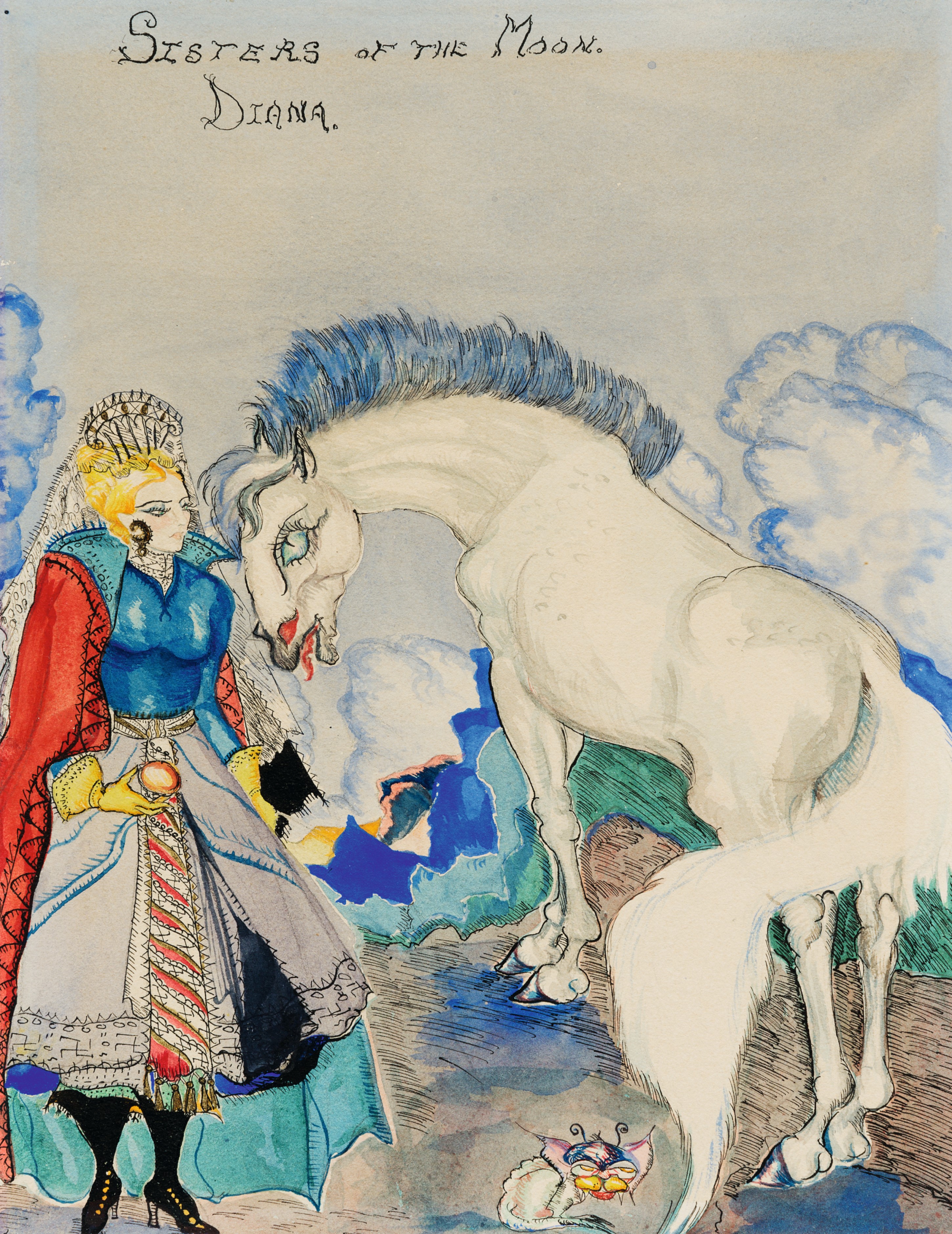
The exhibition opens in an expansive space. To the right, a series of watercolors from 1932-33, created when Carrington was just 15 and studying in Florence, are displayed. During this period, attending a school for high-society girls, she encountered the masters of the Trecento and Quattrocento. This series, titled Sisters of the Moon, already demonstrates her fervent imagination and a well-defined visionary style, showing that “Carrington was a Surrealist without knowing it.” To the left of the room are black and white images of her parents, her as a child with her brother and governess, and finally, a young Carrington, immortalized while “feeding the doll for the first time!”—a proud parental annotation on the image.

Carrington’s family envisioned a conventional upper-bourgeois life for her, but she quickly rebelled against these expectations. In 1936, she moved to London to continue her studies at the Chelsea School of Art and Amédée Ozenfant’s Academy of Art. It was in the English capital that she visited the International Surrealist Exhibition, and the following year, she met Max Ernst at a dinner organized by fellow students, thus beginning their relationship.
Soon after, Carrington and Ernst were forced to flee when her father, Harold Carrington, reported Ernst for creating a pornographic work. They left for Cornwall, where photographs capture their moments: Ernst in a tender embrace, covering Carrington’s breasts, as well as other shots with friends Roland Penrose and Lee Miller, and artists Nusch Éluard and Man Ray, alongside model Ady Fidelin.

Titled ‘Mariée du Vent’ (Bride of the Wind), an Expressionist-inspired phrase Ernst used in a prologue to one of her stories, this section marks the second chapter of the exhibition. The couple soon moved to Paris, settling in an apartment in Saint-Germain-des-Prés. In 1938, Carrington participated in the Surrealist exhibition at the Beaux Arts de Paris, where Peggy Guggenheim acquired one of her works.
Shortly after, the couple relocated to Saint-Martin d’Ardèche, where, with financial support from her mother, Carrington bought a 17th-century house in the countryside. They quickly transformed it into their “total work of art,” a true metamorphosis. While Ernst adorned it with sculptures and bas-reliefs, Carrington painted the doors and windows. On display in the exhibition are Window in Saint-Martin-d’Ardèche (1938), in which a flaming red unicorn is trapped within the four panes of a small window, while in the center of the room, wardrobe doors are inhabited by feminine creatures with horse muzzles and wings that follow the sinuosity of their female bodies.

The dreamlike world the couple had built shattered in September 1939 with the declaration of World War II. Max Ernst was interned by French authorities as a potential enemy. He was released at the end of the year only to be imprisoned again. Carrington then decided to attempt an escape to Spain, hoping to reach Lisbon and then the United States. In Madrid, the artist suffered violence at the hands of Francoist soldiers, which triggered a profound psychotic crisis. For this reason, her family decided to have her interned in a clinic in Santander, where she was administered Cardiazol, a drug known for inducing epileptic seizures. She would later recount her experience in the publication En bas (1945).
In July 1941, Carrington traveled to New York, joining the diaspora of European artists like André Breton and Marcel Duchamp. Her stay was brief, as she soon left for Mexico with Mexican poet and journalist Renato Leduc. Their relationship was very short; the artist separated from Leduc in 1943 to marry photographer Chiki Weisz shortly thereafter, also a refugee and former assistant to Robert Capa. The early years in Mexico correspond to the work The Elements (1946), also known as Les Emigrants, which depicts a collective journey in search of home. The elongated format of the painting recalls Italian predellas, while the subjects are very similar to those in Flemish painting: “It combines horizontal narration and esoteric symbolism in a metaphor of exile, transformation, and refuge in which the central figure, rising from a literally uprooted territory, seems to bring the fire of life to a hermit.”

The exhibition emphasizes Mexico’s crucial role as another surrealist homeland, often overlooked in art history narratives in favor of New York. This is evident in the presence of painter Remedios Varo and her partner, poet Benjamin Péret, one of Surrealism’s founders. From the mid-1940s onwards, Carrington established her home and family in Mexico, and with the birth of her two sons, Gabriel and Pablo, her painting underwent a “radical transformation” shaped by her experience of motherhood, particularly in its representational aspects.

A celebrated work from this period is Le Bon Roi Dagobert (Elk Horn) (1948), also featured as the exhibition’s main image. The work references the 7th-century Merovingian sovereign. Here, the king, adorned with long horns, wears a fur coat whose trim echoes a fish’s tail. The royal couple appears to come from a fantastical world, depicted as hybrid figures within a sparse house, with an infant cradled in the woman’s arms in a large drape, and another child standing beside them. The scene presents itself as a distant visual reminiscence of the Christian nativity.
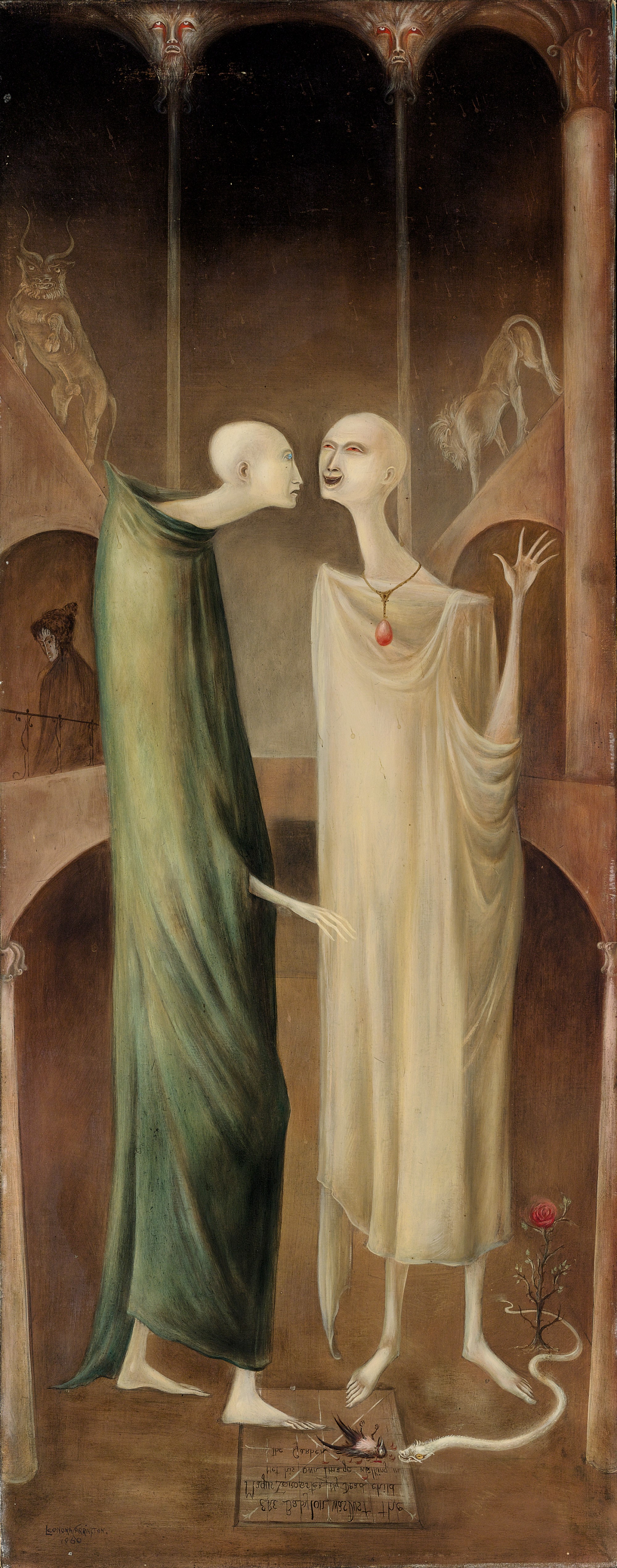
Approaching the exhibition’s conclusion, visitors encounter the ‘Heroine’s Journey,’ representing a quest for self-awareness. It is no coincidence that her son Gabriel said of his mother that she was “Always searching for interior maps to help her navigate her visionary life and her inner demons.” Thus, the artist began studying the history and mythology of various cultures, as seen in the work The Magus Zoroaster Meeting his Own Image in the Garden (1960), where Zoroaster encounters his inner double—a clear reference to Jungian psychology and the concept of individuation of the true self.
Beyond mythology, Carrington was deeply interested in occultism – doctrines founded on religious, physical, and metaphysical visions that presuppose the existence of unknowable dynamic forces. Indeed, André Breton famously called her “La sorcière,” the witch. Many of her works operate on multiple levels, and even today, their full meaning remains elusive, though it is known that she incorporated spells, cabalistic signs, diagrams, and other magical symbols into many of her creations.

The painting Dando de comer a una mesa (Feeding a Table) (1959), which graces the catalog cover, introduces the exhibition’s final theme: the ‘alchemical kitchen.’ A woman is depicted in a domestic setting, caught in the act of feeding a table.
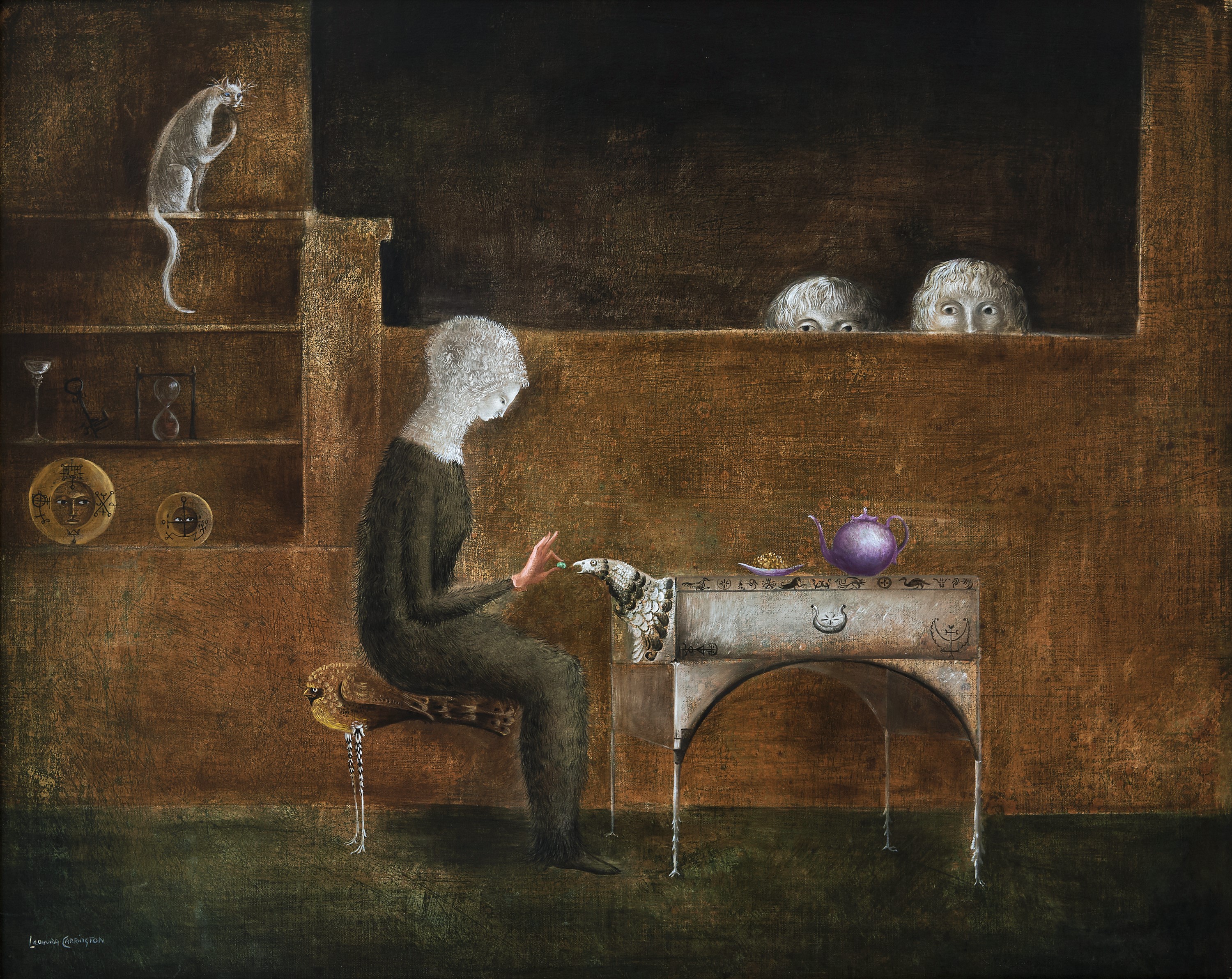
This work blurs the line between inanimate object and living being, reflecting an animistic worldview. Moreover, the woman appears alone, except for a mouse behind her and two partially hidden faces in the background. The table takes on the appearance of a bird with a voracious beak, though its structure retains the semblance of furniture, filled with symbolic inlays. The kitchen thus becomes a metaphor for female liberation, as it transforms from a place of constraint into “a space where women can reclaim their power through alchemy, magic, and witchcraft,” much as Carrington did in her art.