


The National Gallery in London has chosen a prominent name for its upcoming refurbishment: Kengo Kuma. The Japanese architect, renowned for his mastery in blending architecture, material, and nature, has been selected to lead the ambitious redesign project for the Sainsbury Wing. He will collaborate with the firms BDP and MICA Architects. The museum describes this assignment as “historic,” as it will usher the prestigious collection into its third century of existence.
The Sainsbury Wing and Venturi’s Legacy
To fully appreciate the challenge awaiting Kuma, it’s essential to revisit London’s architectural history. The Sainsbury Wing, opened in 1991 and designed by postmodern architects Robert Venturi and Denise Scott Brown, has always been a subject of debate. Even before its construction, the then Prince Charles (now King Charles III) famously described it as a “monstrous carbuncle on the face of a much-loved friend.”
The existing building stands as an emblematic example of postmodern classicism, with its classical columns ironically reinterpreted and an almost theatrical modernity. Kuma’s mission is to intervene on a monument of Postmodernism – now subject to strict conservation regulations – preserving its essence while simultaneously resolving the long-standing issues concerning visitor flow management and reception that plague the entrance to this wing.
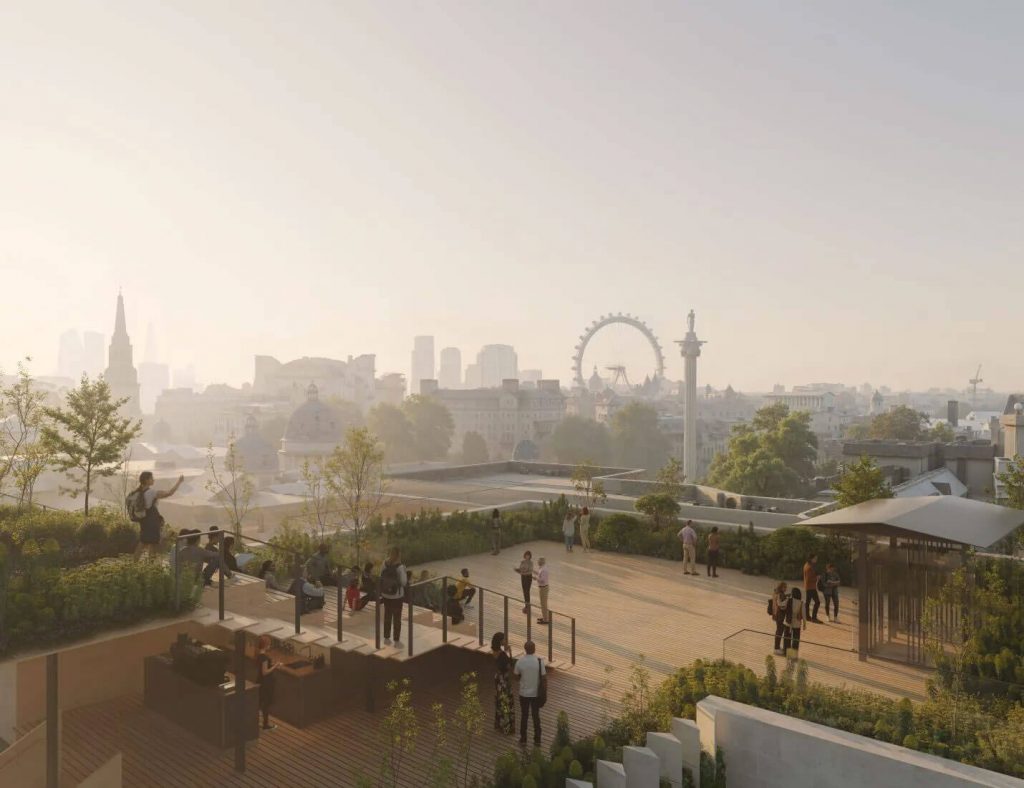
Kuma’s Philosophy: “Dissolution” in the Heart of London
Kengo Kuma will bring his renowned philosophy of “dissolution” (or “anti-object”) to Trafalgar Square, where architecture should not stand as an isolated entity but rather blend with its surroundings to enhance the human experience. While the original Sainsbury Wing was characterized by the solidity of stone, Kuma excels in the use of natural materials, the modulation of light, and the art of layering.
This is not the first time the acclaimed Japanese architect has tackled a British context. His Victoria & Albert Dundee in Scotland, a structure reminiscent of an artificial cliff of concrete and light stretching over the River Tay, has already demonstrated his ability to reinterpret the landscape’s power into modern architecture. This rigorous approach is also evident in the Tokyo Olympic Stadium, where industrial gigantism was replaced by wood and greenery, and in the Bamboo Wall in China, where architecture acts as a mediator between humanity and the environment.
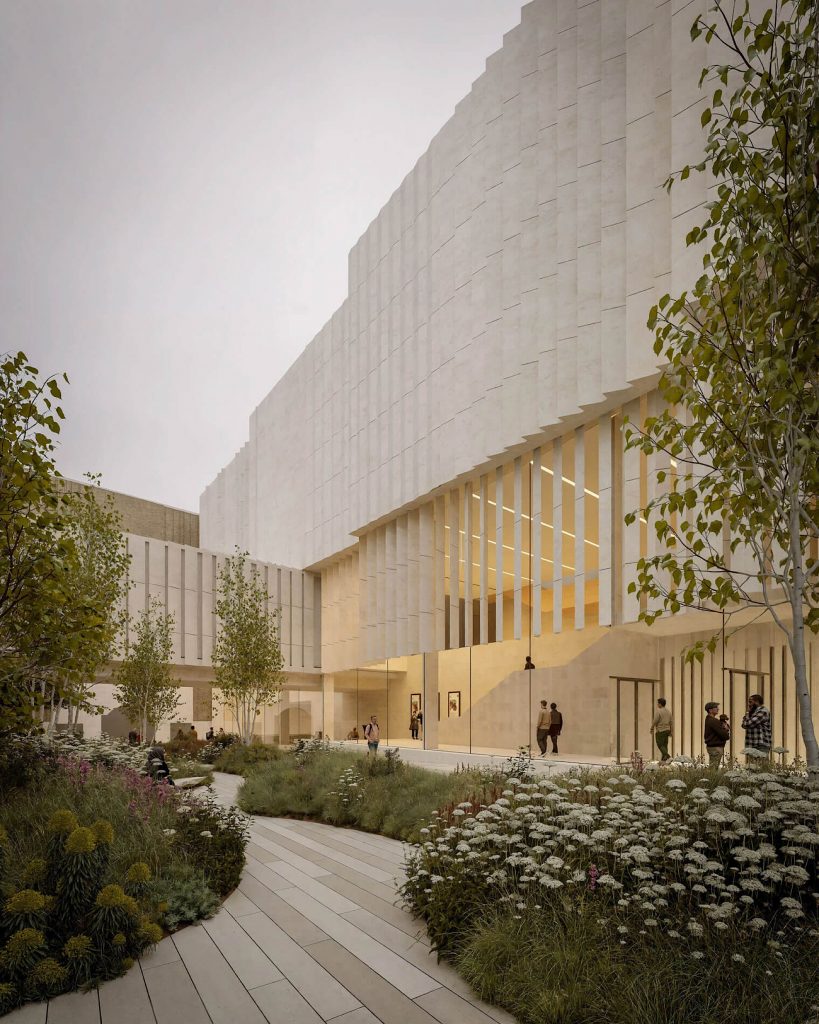
Beyond Aesthetics: A New Research Hub
The National Gallery project extends far beyond mere external beautification. The plan, developed under the guidance of BDP and MICA Architects, envisions a profound refunctionalization of the museum’s interior spaces.
The core of the intervention will be the establishment of a state-of-the-art Research Centre, designed to transform the National Gallery from a mere custodian of masterpieces into a vibrant hub of cultural production. Here, restorers and art historians will be able to collaborate in environments designed for maximum efficiency and public accessibility.
Educational spaces will also be expanded, and the fluidity of the main atrium, which currently struggles to manage millions of annual visitors, will be optimized. The ultimate goal is to create a “covered piazza” that acts as a connector between the austere solemnity of the exhibition halls and the dynamism of Trafalgar Square.