

In the 1920s, Aby Warburg, through the adage “The good Lord is in the detail” (an attribution debated, with Panofsky tracing it to Flaubert), outlined a fundamental interpretive method. Seventy years later, Daniel Arasse went further, identifying a “Religion of Detail” in certain modern artistic movements. Both expressions, though stemming from different theoretical and analytical foundations, have become undisputed cornerstones for understanding and observing painting in its meaningful dimensions, placing it on an intellectual and semiotic plane that complements the purely visual experience. This conceptual dualism finds significant resonance in both the artworks and the title of Ignazio Gadaleta’s current retrospective exhibition at the Diocesan Museum of Molfetta.
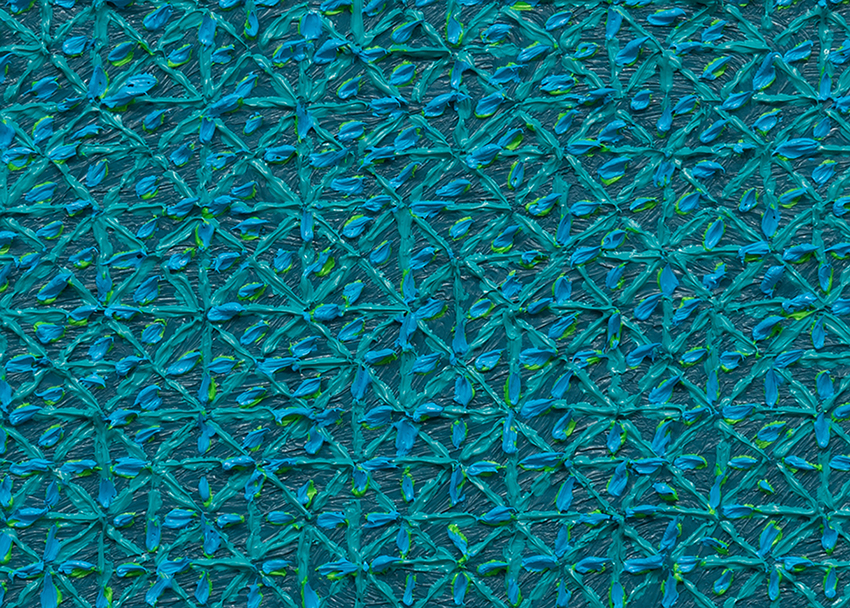
The title “Anxious Infinite Prayer” embodies an absolute devotion to color, summarizing over forty years of the artist’s career. Gadaleta has meticulously investigated the chromatic element with rigorous expertise, aiming to reveal its perceptive and phenomenological qualities. This perspective, transcending mere intuition, has shaped his entire body of work, conceiving painting as a dynamic process that unfolds to the observer. For Gadaleta, each artwork possesses the dignity of an autonomous subject with its own physiognomy, although the 23 pieces on display are united by profound compositional implications and a structured thought process, ensuring coherence across his various series.
The artwork, therefore, is not conceived as a formal object in its completed finitude, but rather as a plastic-corporeal expression of color, revealed as a principle of absolute yet multifaceted truth. The artist has comprehensively explored this field of research, delving into its most visceral aspects, especially the pathos of light, a driving force of suggestion. His analysis of the chromatic world recalls the approach of a Renaissance treatise writer. Yet, one also discerns a Flemish methodology in the lenticular rendering of details, transforming color into an epistemic experience. This practice is evident from the late 1970s and is documented in his early 1980s works, which open the exhibition.
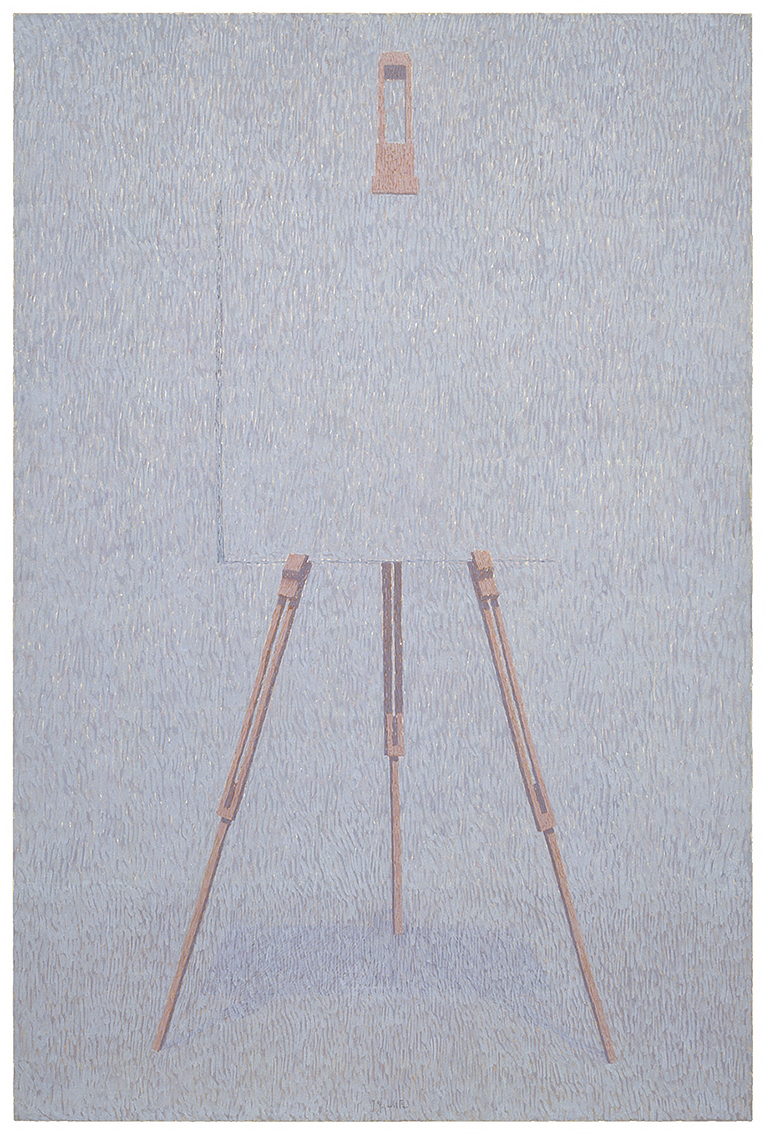
The 1980 work, “Suspended Image or Imagined Suspension,” intensifies its dreamlike dimension. This quality, already evoked by “Mimesis” (an installation presented the same year at the “Laboratorio Puglia” exhibition, curated by Mimmo Conenna, and marking the first meeting between Gadaleta and Crispolti, which initiated a long and fruitful dialogue), is enriched by pastel gray brushstrokes. These create an even more compelling optical illusion of superposition between the background and the easel in the foreground. The intent to dignify the tools of painting also appears in Tela-io, where the artist and his instrument merge, almost a self-portrait expressing deep fidelity to the art of painting.
In “Blue Beyond the Sea” from 1983, considered a precursor to “Beyond Blue Beyond” from 2003, the palette incorporates a seashell within the transparency of swirling nuances. This kinetic dynamism, evoking Van Gogh’s energy, permeates the entire triptych, creating a homage to the Mediterranean in its elements and colors, and producing a synesthetic effect. Gadaleta himself has expressed his fascination with blue, defining it as “a chromatic reality characterizing the cosmic dimension” and adding that “the pigment has always stimulated my imagination and my analyses.” This work is thus an anticipation of a research that has evolved over time, establishing a direct connection between the cosmic and the infinitesimal, uniting these two poles, no longer antithetical, in results of sophisticated magnetism.
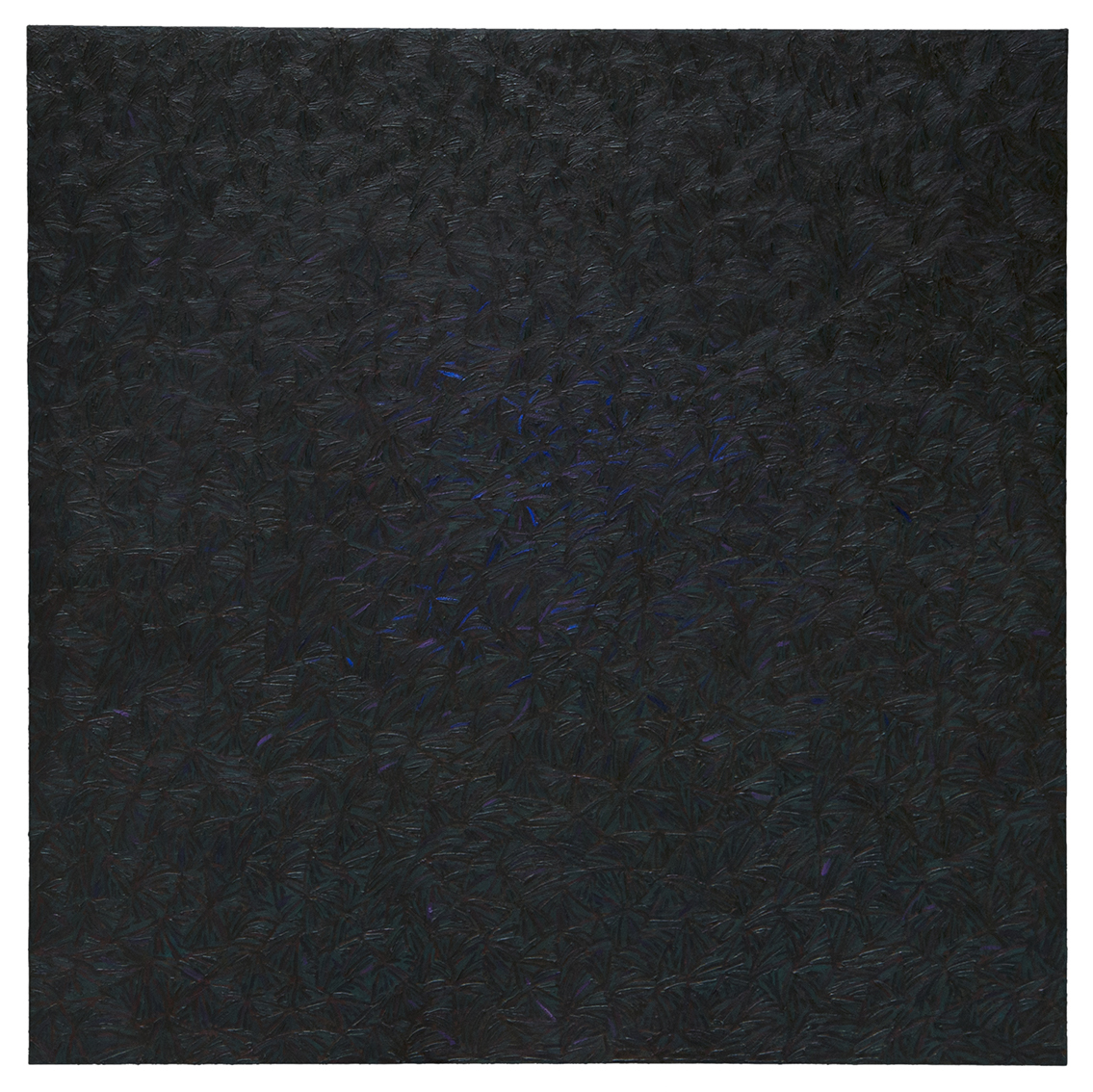
The 1985 work “For Eyes That Vibrate” is a clear example. Within its seemingly impenetrable blackness, it encloses a vivid dialectic of signs resembling teeming unicellular organisms organized into molecular structures, weaving a tapestry of biological patterns. Chromatic reflections interact with light, generating a cause-and-effect relationship that extends across the entire painting surface. From it emerge the changing iridescences of a labradorite, initially fostering empathy with the viewer, then captivating their gaze into a state of deep contemplation.
As the painterly substance reveals its anatomy, color deconstructs into modular units, almost embryonic creatures endowed with individuality. They activate in an interdependence between micro and macro, through the structures of strokes and lines that define and enrich the visual field of the artwork.
In “Eccentric Concentration” from 1988, these micro-systems of signs organize into interlocking triangular architectures, forming a painterly tapestry. In the same year, in “Beyond Sea,” the dense concentration of acute angles and points elevates the triangle to a specular apparition that transfigures into an intertwining of echoes and dissolutions. The decorative motifs, generated by the capillary perpetuation of material fibers, also evoke, with a sense of déjà vu, the Apulian tradition with Byzantine influences. They metaphorically recall the archetype, symbolized by the traces that probe the canvases, dissected by signs to which Gadaleta perhaps attributes a memorial and primordial value, an absolute root.
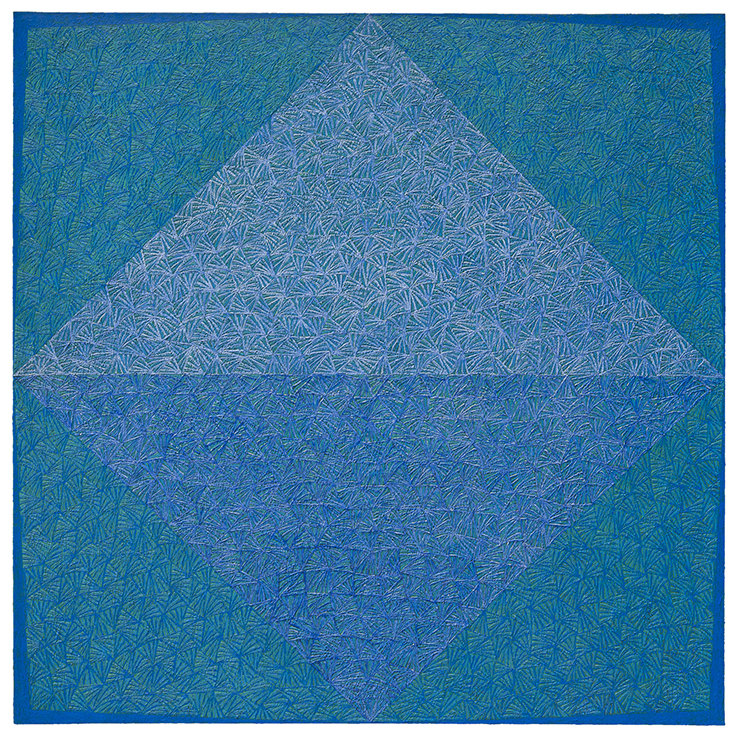
While much of the chromatic process manifests allusively, the artist’s intention to present painting as a meditative act is unequivocal. His dedication is comparable to that of a skilled miniaturist, not for mere scribal execution, but for the profound transmission of knowledge and craftsmanship. The application of brushstrokes, almost obsessively employed in a network of permanent traces – which nonetheless doesn’t delimit but rather internalizes an impulse, projecting it beyond the painting – assumes a spatio-temporal connotation distant from the ephemeral “here and now,” instead settling into a dilated time stretched towards an eternal imaginary.
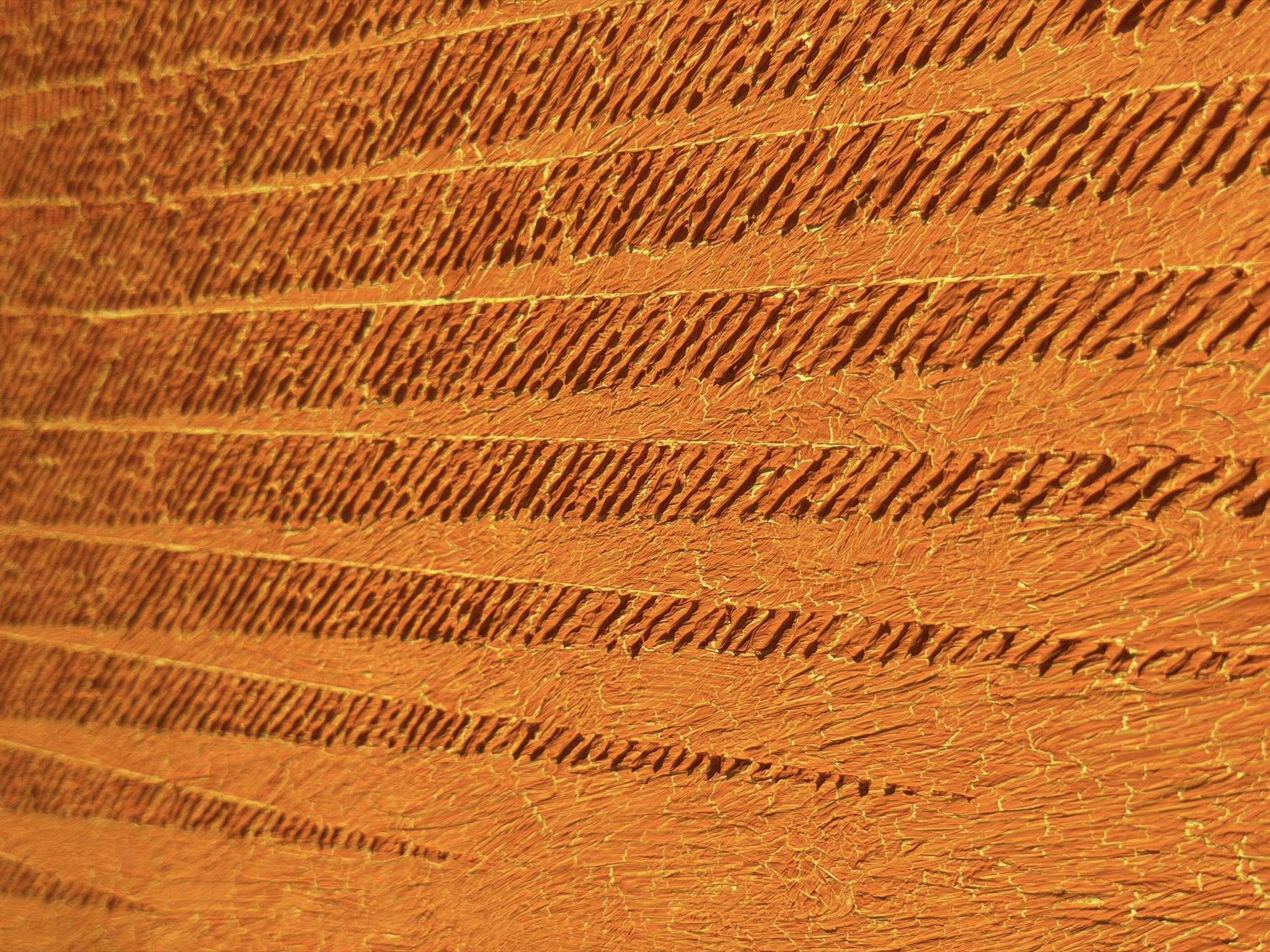
In the “Virtuals” series (1992-2002), spirituality becomes even more intense, materializing in the accentuation of a rhythmic tension marked by sequences of lines that stand out against the background. This gesture, while blending into the painterly act, is always meticulously calculated, as demonstrated by the harmonious balance of shadows created by the density of the chromatic paste in “Celestial Solar” from 1997. Even the interstitial spaces between aggregations of signs – themselves contained within tiny propagating squares – in “Anxious Infinite Prayer” from 2020 do not escape the viewer, who is captivated by the breath of light that functions as a device for introspection, prompting the observer to develop an ethics of looking.
This approach, subtly suggested by the artist, invites a reevaluation of how one engages with painting. It is in the detail that the attempt to grasp a possible truth, or an answer, about the nature – and origin – of things, within the order of their intrinsic dynamics, is condensed.
The exhibition, organized by Cooperativa FeArt with the patronage of the Diocese of Molfetta and the Diocesan Museum Foundation, will be open to the public until April 19.