


Il gruppo Gelitin, composto da Wolfgang Gantner (1968), Ali Janka (1970), Florian Reither (1970) e Tobias Urban (1971), ha mosso i primi passi nel 1978 durante un campo estivo. La loro collaborazione, divenuta ufficiale con le prime mostre pubbliche nel 1993, li ha affermati come pionieri nell’arte contemporanea internazionale. Oggi i quattro artisti vivono e operano a Vienna, e hanno rappresentato l’Austria alla 54ª Biennale di Venezia con l’opera Gelatin Pavilion – Some Like It Hot.
La pratica dei Gelitin si colloca nell’alveo dell’Estetica Relazionale, teorizzata da Nicolas Bourriaud nel suo saggio del 1998. Il collettivo concentra il proprio lavoro sulle relazioni interpersonali e sul coinvolgimento diretto del pubblico, mirando a ridefinire il legame tradizionale tra opera e fruitore. Il pubblico, infatti, è invitato a divenire parte attiva del processo creativo, assumendo il ruolo di co-autore e collaboratore. Questo approccio ha radici in Austria, ad esempio nei lavori di Franz West (1947-2012), al quale i Gelitin hanno dedicato Gelatin Sofa (2019), un imponente divano esposto nel cortile del MAK – Museum of Applied Arts di Vienna. Fin dalle prime opere, come Die totale Osmose (Biennale di Venezia, 2001) e l’iconica installazione Hase / Pink Rabbit (2005) sulle Alpi piemontesi, o performance quali Human Elevator (Los Angeles, 1999) e Democratic Sculpture 7 (Chicago, 2023), i Gelitin hanno costantemente esplorato la collaborazione tra corpi, materiali e pubblico, fondando la loro arte sull’esperienza condivisa e collettiva.
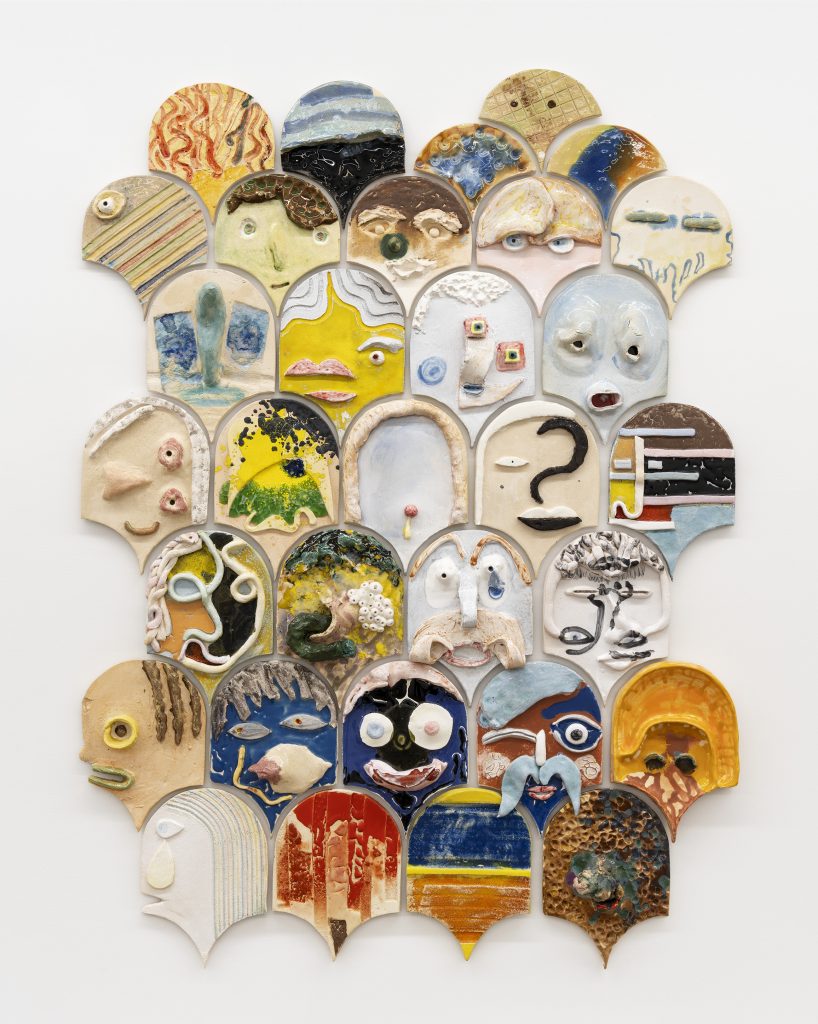
Nel 2025, questa ricerca si è evoluta in progetti che intensificano la dimensione esperienziale e partecipativa. Tra questi spiccano Gelatin Hütte, creata con gli abitanti del 22º distretto di Vienna, e Am Asphodeliengrund 29, presentato allo Steirischer Herbst di Graz. Quest’ultima era un’installazione in una ex distilleria dove i visitatori accedevano al percorso performativo a bordo di una piccola imbarcazione. A luglio dello stesso anno, l’azione collettiva TUTTO STUCCO a Roma ha concluso la loro mostra Nimbus Limbus Omnibus, seguita a novembre da Frohes Fest 2, una reinterpretazione dell’albero di Natale per la Heidi Horten Collection di Vienna.
Ciononostante, i Gelitin non idealizzano la comunità come una struttura armonica, bensì la rappresentano come un organismo instabile, imperfetto e transitorio, sempre sul punto di dissolversi. Questa precarietà è un elemento centrale della loro indagine artistica: la capacità di generare contesti in cui individui diversi possano sperimentare, anche per breve tempo, la costruzione condivisa di qualcosa.
In quest’ottica si inserisce All for All, la mostra inaugurata il 5 marzo presso la galleria Perrotin di New York. L’esposizione presenta due gruppi di opere distinte ma concettualmente interconnesse: la serie di ceramiche intitolata anch’essa All for All e una raccolta di disegni ispirati all’opera pubblica WirWasser.
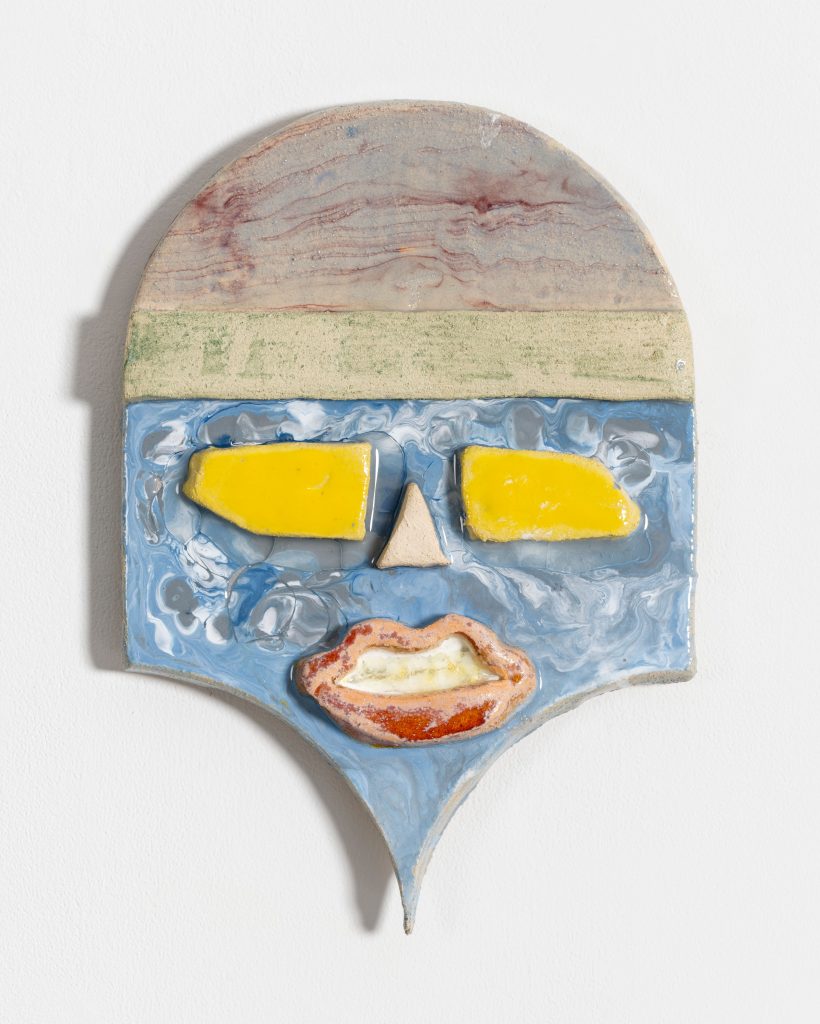
Entrambe le serie esplorano il tema della comunità e le relazioni che la definiscono. Fulcro della mostra sono le piastrelle in ceramica di All for All, una collezione in espansione di volti modellati a mano. Ciascun pezzo è realizzato, smaltato e cotto individualmente, senza l’uso di stampi, enfatizzando l’unicità. I volti, con espressioni che spaziano dalla gioia alla malinconia, dal grottesco all’enigmatico, rappresentano la ricchezza emotiva della vita collettiva, formando una “piccola società” eterogenea.
L’origine di questa serie risale al 2022, come progetto per una nuova scuola pubblica a Monaco di Baviera. Qui, oltre trecento volti in ceramica sono stati installati su una grande parete lungo una scala circolare, accompagnando gli studenti nei loro spostamenti e creando una presenza plurale che evolve nel tempo. Alla galleria Perrotin, le opere sono esposte in due modi: in gruppi compatti in una sala e come sequenza lineare di individualità isolate in un’altra. Questa doppia configurazione evoca la metropoli contemporanea, dove la prossimità fisica coesiste con la solitudine, e le vite scorrono parallele. L’idea di comunità si estende anche alla possibilità di acquisire singoli elementi, rendendo l’opera una struttura aperta e condivisibile.
Unframed : 40 3/16 x 28 3/8 inches Framed : 44 3/16 x 32 3/8 inches. Photographer: Guillaume Ziccarelli. Courtesy of the artists and Perrotin.
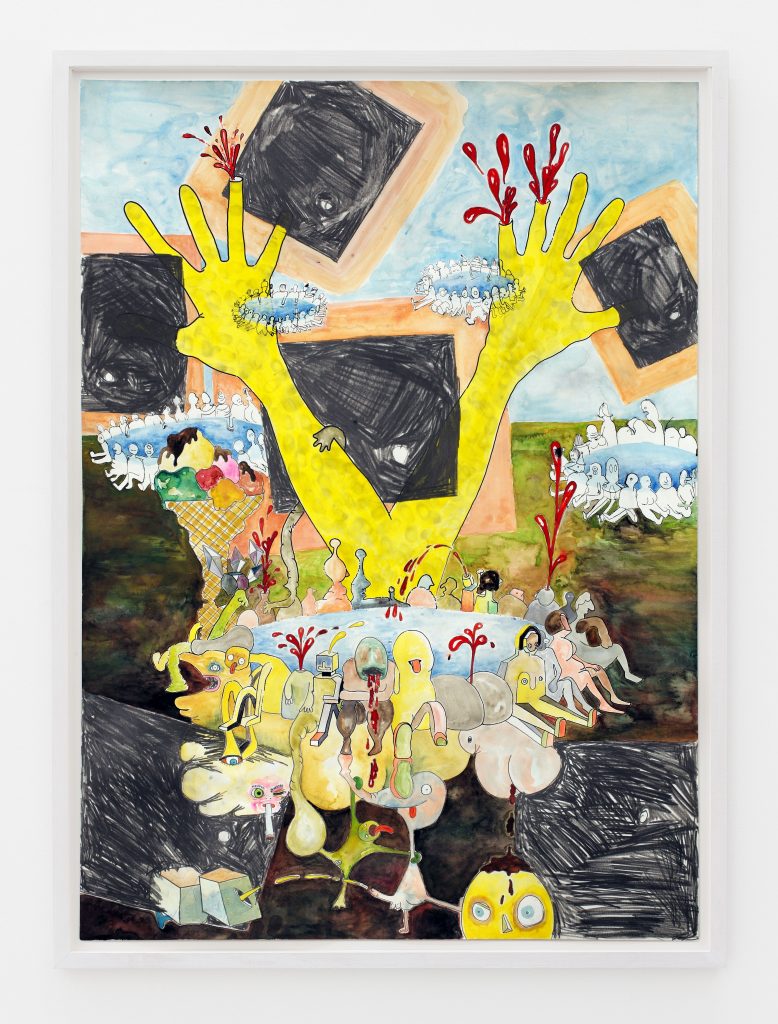
In dialogo con le ceramiche, la mostra include disegni ispirati a WirWasser (“Noi acqua”), la controversa fontana pubblica permanente che i Gelitin hanno realizzato a Vienna nel 2023. Commissionata per il 150° anniversario della Erste Wiener Hochquellenleitung – il sistema idrico che rifornisce Vienna con l’acqua alpina attraverso 150 chilometri di condotte – l’opera ha suscitato un vivace dibattito fin dalla sua inaugurazione.
Situata all’incrocio tra Gundrunstrasse e Sonnwendgasse, la fontana WirWasser è un anello di figure umanoidi volutamente goffe ed esagerate, i cui corpi formano il bacino. L’acqua sgorga dalle loro mani, bocche o arti e ritorna nella vasca centrale, creando un sistema circolare che dipende dalla loro vicinanza. Queste figure ibride, tra umano e astratto, simboleggiano la pluralità sociale. La loro unione rappresenta un patto di solidarietà per sostenere e preservare l’acqua, richiamando la responsabilità collettiva. I disegni in mostra a New York rielaborano frammenti di queste figure, esplorando nuove interazioni e composizioni grafiche.
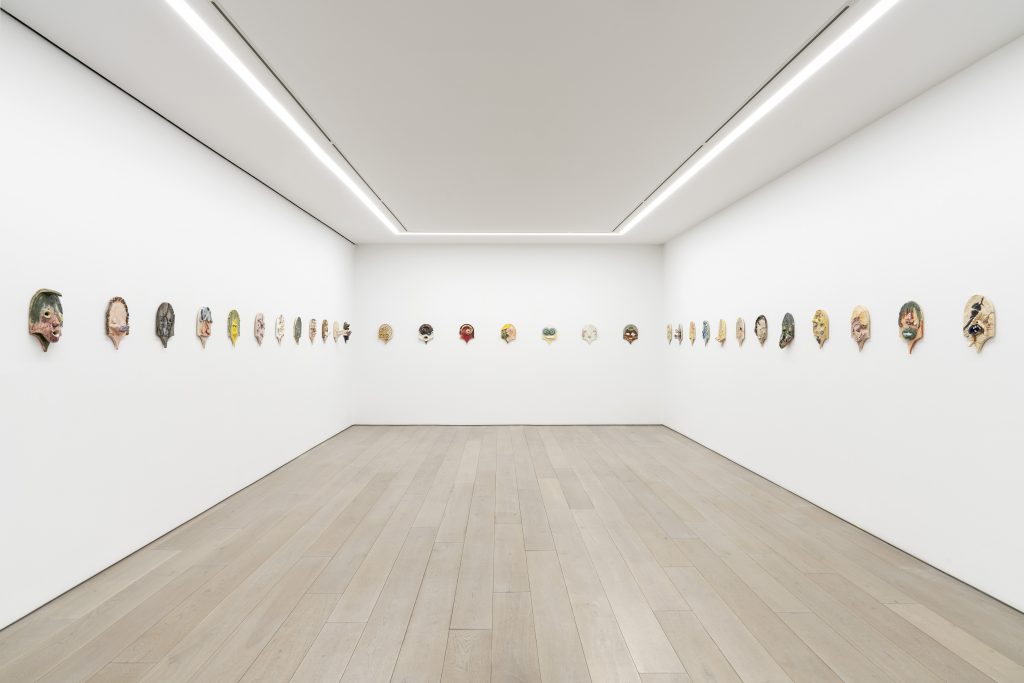
Accompagnata da una performance-conferenza tenutasi l’8 marzo al The Watermill Center, All for All alla galleria Perrotin, aperta fino all’11 aprile, si presenta come uno spazio vibrante di interazione e riflessione. Il progetto incarna un processo in divenire, che si rivela ai nostri occhi. È proprio in questo continuo trasformarsi che l’arte dei Gelitin trova la sua essenza più autentica: non nella glorificazione di una comunità già formata, ma nella costante e precaria possibilità della sua stessa genesi.
Gelitin and Community as Form: All for All at Perrotin Gallery, New York (Rephrased and Translated)
The Gelitin group, comprising Wolfgang Gantner (1968), Ali Janka (1970), Florian Reither (1970), and Tobias Urban (1971), began their collaboration in 1978 during a summer camp. This partnership became official with their first public exhibitions in 1993, establishing them as pioneers in international contemporary art. Today, the four artists live and work in Vienna, having notably represented Austria at the 54th Venice Biennale with their work Gelatin Pavilion – Some Like It Hot.
Gelitin’s practice aligns with Relational Aesthetics, a concept theorized by Nicolas Bourriaud in his 1998 essay. The collective’s work centers on interpersonal relationships and direct public engagement, aiming to redefine the traditional link between artwork and viewer. The audience is invited to become an active part of the creative process, acting as co-authors and collaborators. This approach has roots in Austria, for instance, in the works of Franz West (1947-2012), to whom Gelitin paid homage with Gelatin Sofa (2019), an imposing couch exhibited in the courtyard of the MAK – Museum of Applied Arts in Vienna. From early works like Die totale Osmose (Venice Biennale, 2001) and the iconic installation Hase / Pink Rabbit (2005) in the Piedmontese Alps, to performances such as Human Elevator (Los Angeles, 1999) and Democratic Sculpture 7 (Chicago, 2023), Gelitin has consistently explored collaboration between bodies, materials, and the public, founding their art on shared and collective experience.
In 2025, this research evolved into projects that intensified the experiential and participatory dimension. Notable among these are Gelatin Hütte, created with residents of Vienna’s 22nd district, and Am Asphodeliengrund 29, presented at the Steirischer Herbst festival in Graz. The latter was an installation in a former distillery basement where visitors accessed the performative journey aboard a small boat. In July of the same year, the collective action TUTTO STUCCO in Rome concluded their exhibition Nimbus Limbus Omnibus, followed in November by Frohes Fest 2, a reinterpretation of the traditional Christmas tree for the Heidi Horten Collection in Vienna.
Nevertheless, Gelitin does not idealize community as a harmonious structure; instead, they portray it as an unstable, imperfect, and transient organism, constantly on the verge of dissolution. This very precariousness is a central element of their artistic inquiry: the ability to create contexts where diverse individuals can experience, even if only temporarily, the shared construction of something.
Within this framework, All for All, the exhibition inaugurated on March 5th at Perrotin Gallery in New York, takes its place. The show features two distinct but conceptually interconnected bodies of work: the ceramic series also titled All for All and a collection of drawings inspired by the public artwork WirWasser.
Both series explore the theme of community and the relationships that define it. The centerpiece of the exhibition is the All for All ceramic tiles, an expanding collection of hand-modeled faces. Each piece is individually shaped, glazed, and fired, without the use of molds, emphasizing its uniqueness. The faces, with expressions ranging from joy to melancholy, from grotesque to enigmatic, represent the emotional richness of collective life, forming a heterogeneous “small society.”
The origin of this series dates back to 2022, conceived as a project for a newly built public school in Munich. There, over three hundred hand-modeled ceramic faces were installed on a large wall alongside a circular staircase, accompanying students in their daily movements and creating a plural presence that evolves over time. At Perrotin Gallery, the works are displayed in two distinct ways: in compact groups in one room and as a linear sequence of isolated individualities in another. This dual arrangement evokes the contemporary metropolis, where physical proximity coexists with solitude, and lives run in parallel. The concept of community also extends to the possibility of acquiring individual elements, transforming the artwork into an open and potentially shared structure.
Unframed : 40 3/16 x 28 3/8 inches Framed : 44 3/16 x 32 3/8 inches. Photographer: Guillaume Ziccarelli. Courtesy of the artists and Perrotin.
In dialogue with the ceramics, the exhibition features drawings inspired by WirWasser (“We Water”), the controversial permanent public fountain Gelitin created in Vienna in 2023. Commissioned for the 150th anniversary of the Erste Wiener Hochquellenleitung – the water system supplying Vienna with alpine spring water via 150 kilometers of pipelines – the artwork sparked lively debate from its inauguration.
Located at the intersection of Gundrunstrasse and Sonnwendgasse, the WirWasser fountain is a ring of deliberately clumsy and exaggerated humanoid figures whose bodies form the basin. Water flows from their hands, mouths, or limbs and returns to the central basin, creating a circular system that functions solely due to their proximity. These hybrid figures, oscillating between human and abstract, symbolize social plurality. Their unity represents a silent pact of solidarity to sustain and preserve the water flowing among them, drawing attention to collective responsibility for this fundamental resource. The drawings in the New York exhibition re-elaborate fragments of these figures, exploring new interactions and graphic compositions.
Accompanied by a lecture-performance held on March 8th at The Watermill Center, All for All at Perrotin Gallery, open until April 11th, manifests as a vibrant space for interaction and reflection. The project embodies an unfolding process, revealing itself before our eyes. It is precisely in this continuous becoming that Gelitin’s art finds its most authentic expression: not in the glorification of a fully formed community, but in the constant and precarious possibility of its own genesis.