


It’s a lesser-known fact, but before Giuseppe Ungaretti became renowned as the poet of the Carso or a master of Hermeticism, he harbored ambitions of becoming an art expert. While his concise and stark verses are what we primarily associate with him, his true intellectual awakening occurred not amidst books, but within artists’ studios. Arriving in Paris from Alexandria, Egypt, in 1912, Ungaretti had not yet realized his poetic calling; his initial goal was to enroll at the École du Louvre to specialize in art. It was in the French capital that he met and socialized with artists such as Léger, Gris, and Modigliani, as well as the nascent talents of Apollinaire and Picasso.
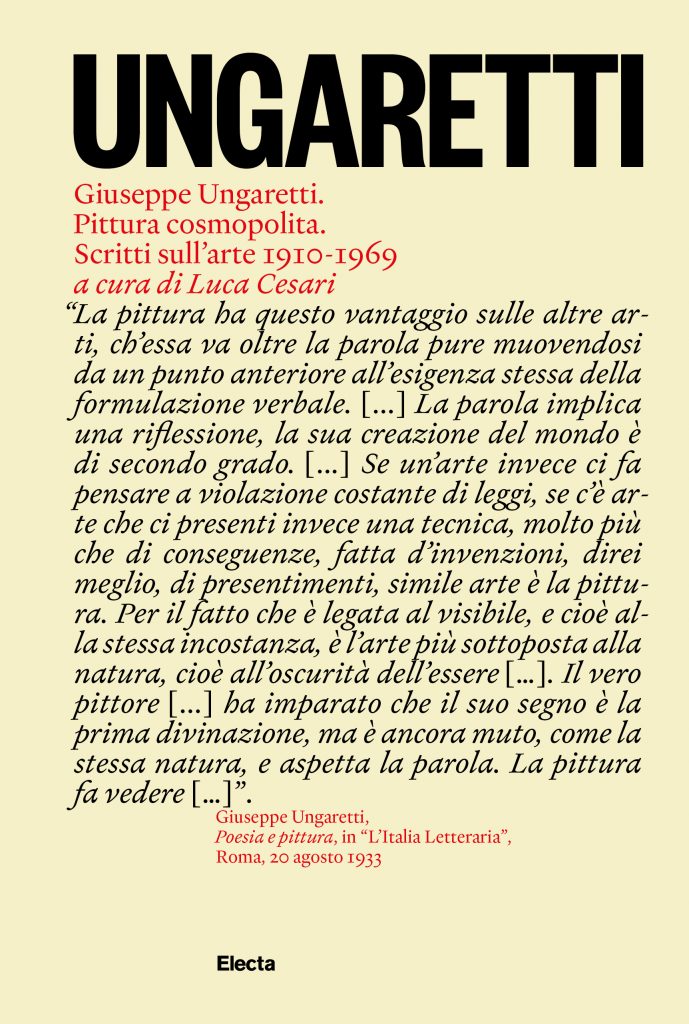
Now, the extensive body of Ungaretti’s reflections on visual art, spanning six decades, finally receives systematic presentation in the volume Pittura cosmopolita. Scritti sull’arte 1910-1969 (Cosmopolitan Painting: Writings on Art 1910-1969), edited by Luca Cesari. This significant work is set to be released on April 14th as part of Electa’s Scritti series.
“Direct” Criticism: Witnessing the Birth of the Twentieth Century
Ungaretti’s approach to criticism can be characterized as “direct,” rooted in his physical presence in the very spaces where the Avant-garde was emerging. He was an eyewitness to the debut of the Cubists and Duchamp at Parisian salons. He observed the creation of Carrà’s The Engineer’s Lover and, acting almost as a guardian, witnessed the genesis of de Chirico’s Piazze d’Italia (Squares of Italy), literally rescuing them from the domestic cleanings of the artist’s landlady after de Chirico had departed for war. Ungaretti thus saw the twentieth century unfold before his eyes, and the profound reflections that sprang from these experiences were meticulously captured in writings of remarkable historical and artistic value.
The Electa volume now compiles these prose pieces of “exceptional linguistic brilliance”—including essays, catalog introductions, articles, and correspondence—revealing an unprecedented Ungaretti. He moves with equal authority from the Cubism of Braque to the Futurism of Severini, extending his insights to encompass the new generations of Italian artists after the war.
Art According to Ungaretti: From Dalí to Schifano
Ungaretti’s narrative traverses various epochs with a freedom of judgment only afforded to someone who has deeply lived and experienced the subject matter. He could recount the extreme poverty of Modigliani, observe Utrillo painting on trattoria walls, or converse with Brancusi, yet his perspective was never solely anchored in the past.
His acute “visuality”—a sensibility that would profoundly nourish his poetry and his celebrated readings of Dante and Petrarch—allowed him to unequivocally dismiss Dalí’s technique with the blunt assessment, “he paints terribly.” Simultaneously, it enabled him to enthusiastically embrace the chromatic breakthroughs of Piero Dorazio or the vibrant pop energy of Mario Schifano.
This editorial endeavor by Electa fills a long-standing void, reintroducing one of art’s most perceptive witnesses. Ungaretti the critic was not merely a poet dabbling in painting, but rather a cosmopolitan eye capable of discerning form even before articulating it through words.