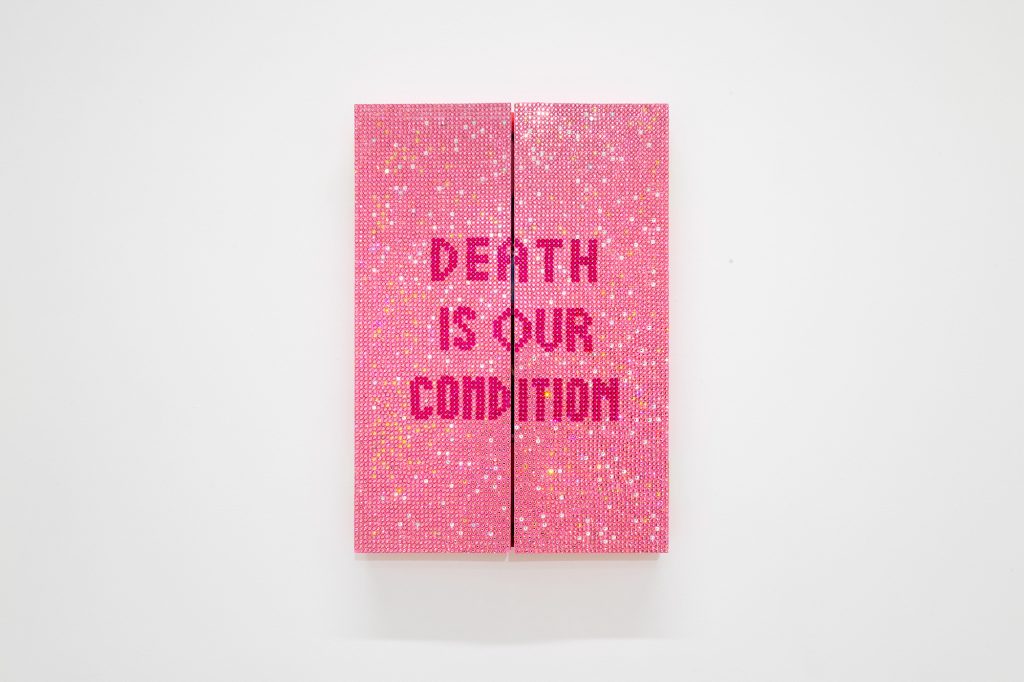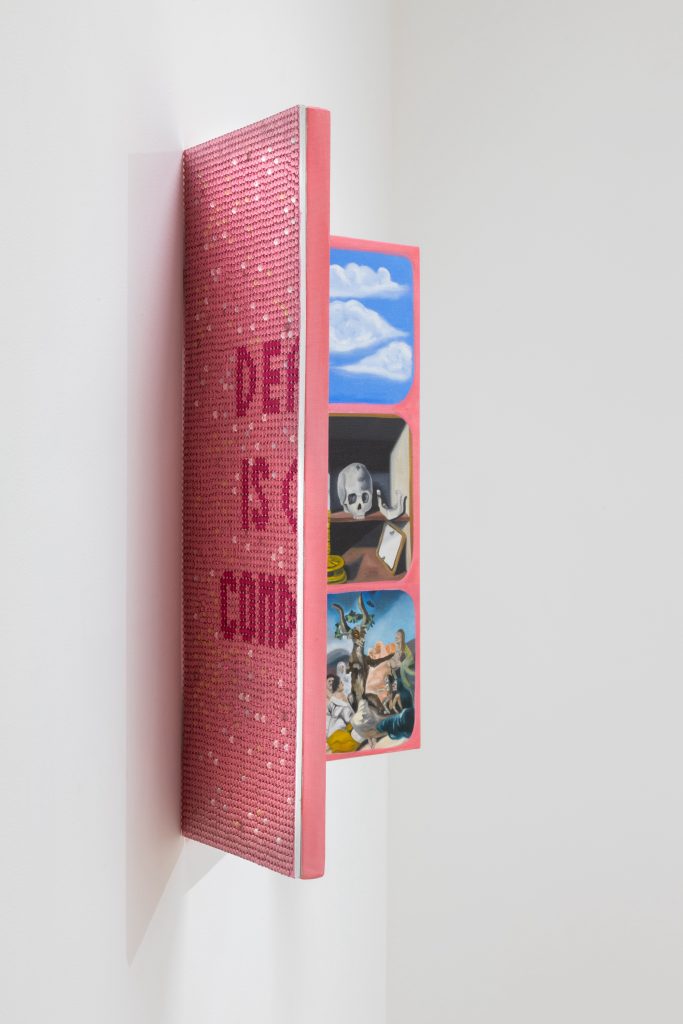

For Frieda Toranzo Jaeger, art cannot achieve true freedom unless it articulates what freedom itself might entail.
A Mexican artist recognized among the most compelling voices on the international scene, Toranzo Jaeger has developed a distinct artistic language over time. Her work intricately weaves painting and embroidery to critically examine the influence of ideological systems—be they religious, colonial, or economic.
On the occasion of her exhibition Visioni, curated by Elisa Carollo and currently on display at Fondazione Bonollo in Thiene, we met with the artist to delve deeper into her artistic exploration.
You grew up in Mexico City, closely exposed to the works of Frida Kahlo and Diego Rivera. How have they influenced your artistic practice and your vision of art?
«I believe anyone born and raised in Mexico is influenced by Frida and Diego, whether they intend to be or not. Personally, I find great inspiration in their commitment to translating socialist ideologies into a material reality, which then reflects in their works. Painting as a Mexican woman inevitably means confronting Frida’s legacy. However, I don’t believe I should limit myself to them solely because of nationality.»
In your practice, embroidery serves as a tool of rebellion against Western canons. In an era of incessant technological development, can the slow, manual tradition of embroidery be seen as a sacred origin (an ancient ritual) that resists simulation and the colonization by machines and artificial intelligence?
«It depends on what we mean by embroidery. I actually consider it a form of technology, not its antagonist. The difference lies in the information it conveys: a collective memory that predates capitalism and colonization. It is the only means through which I can access those memories that have been taken from me. My personal history has not survived these processes unscathed; what remains are fragments of something that will never be whole again.
The very existence of this discipline testifies to its capacity for resistance. Perhaps we resist through making (embroidering)… or perhaps, by doing it, we learn how to resist. The alienation and solitude stemming from new technologies are real, but today we must focus on survival in the face of rising fascism and war. I am not against artificial intelligence; in fact, I am interested in it. One could argue that every form of intelligence is artificial, or question what intelligence truly is. The problem isn’t technology itself, but the fascism that accompanies every innovation.»
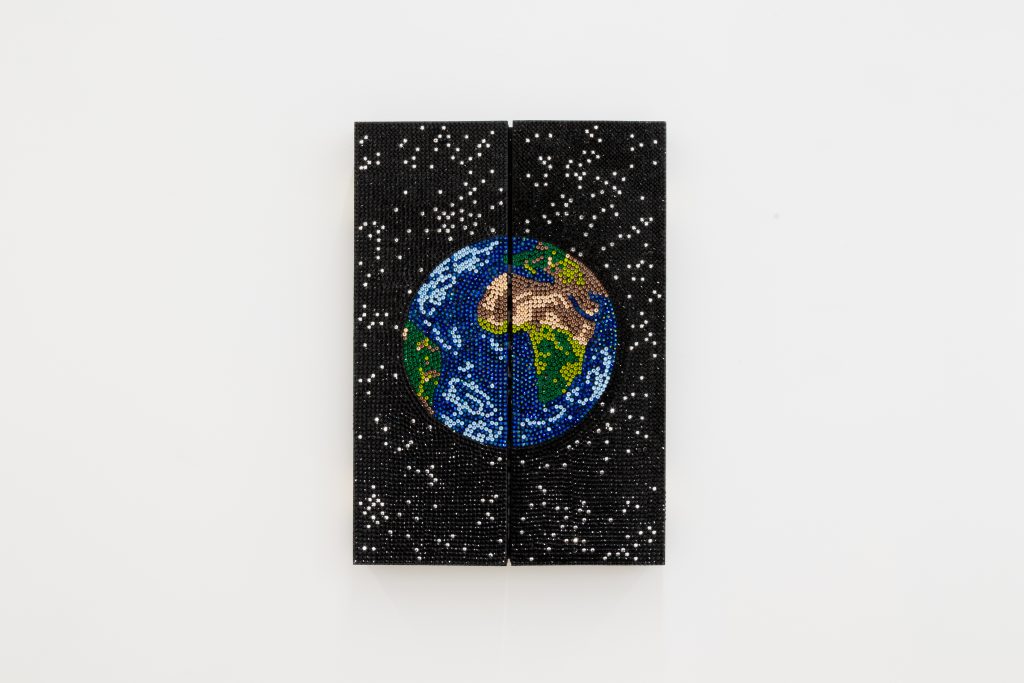
You have often spoken about the importance of recognizing historical and systemic substrata and how these shape the intrinsic limits of communication. In your view, the canvas is never blank but already saturated with heritage and preconceptions. Do you believe art can ever truly be a free and autonomous space?
«Absolutely not. Who can claim to be totally free? Art has never been truly free, but it can certainly freely express what freedom could be. It has never been entirely autonomous; it has always depended on its context. If we specifically speak of the speculative, international contemporary art circuit in which my work operates, then freedom of expression is in grave danger. This is especially evident in the West, where the neoliberal system promises freedom as a foundational value, while this promise is constantly undermined and unfulfilled.
We must also consider the issue of class, a topic no one ever wants to discuss. There is an increasing impression that art is made by and for a specific social class, which makes the entire system exclusionary.»
If art is, as you state, a profound act of self-reflection, what value does it hold in the face of contemporary society’s complexities?
«Art is a tool: it serves to humanize the other, to give material form to the inexpressible, to bring us closer to the immaterial. It tests the limits of our communication. We need tools for our inner worlds, artifacts capable of moving within us to help us confront our contradictions and make us more sensitive to an extremely violent world that seeks to dehumanize entire groups of people to annihilate them. In this sense, art is an antagonist to fascism. I believe this is the most complex problem we must confront today.»
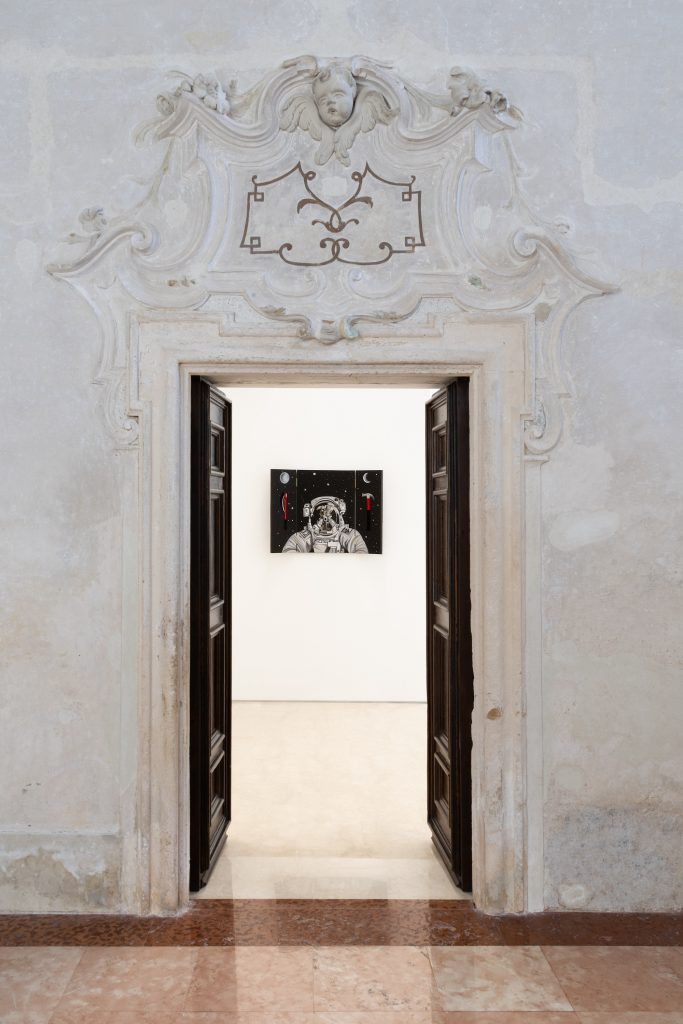
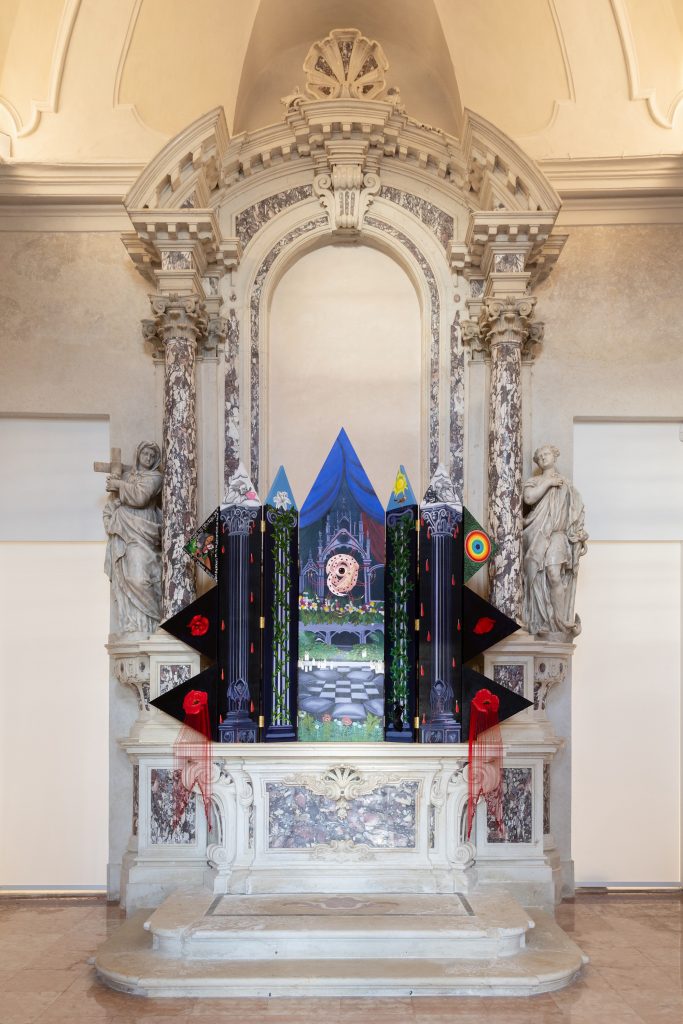
Your contribution to the Venice Arsenale in 2024 was a monumental installation that served as a centerpiece for Pedrosa’s Biennale. What was it like to occupy a space so densely laden with colonial history like the Corderie? What do you expect from the 2026 Art Biennale?
«In the West, especially in Europe, very few spaces are not laden with colonial history. The real question is: what can I do now, in this context, to address these histories and why? For me, it was very powerful to be able to exhibit a work with “Free Palestine” written on it for all to see. If we want to talk about colonialism, we cannot ignore the current genocide in Gaza.
I don’t expect much from the Biennale opening soon. The art world is undergoing a strong identity crisis. Institutions no longer follow values other than those of their donors; censorship is rampant, and the acquiescence of certain curators—who try to remain “apolitical” in such politically charged times—is, in general, pathetic. Will the Biennale be able to engage with our concrete and political reality? I don’t think so, but I certainly hope it will.»